Data independence means: we can change the schema at one level, without needing to change the schema at the level above it.
This is one of the biggest advantages of using a DBMS. It is possible because of the three-schema architecture each level is connected to the level above it only through a mapping (a kind of translation link), not directly.
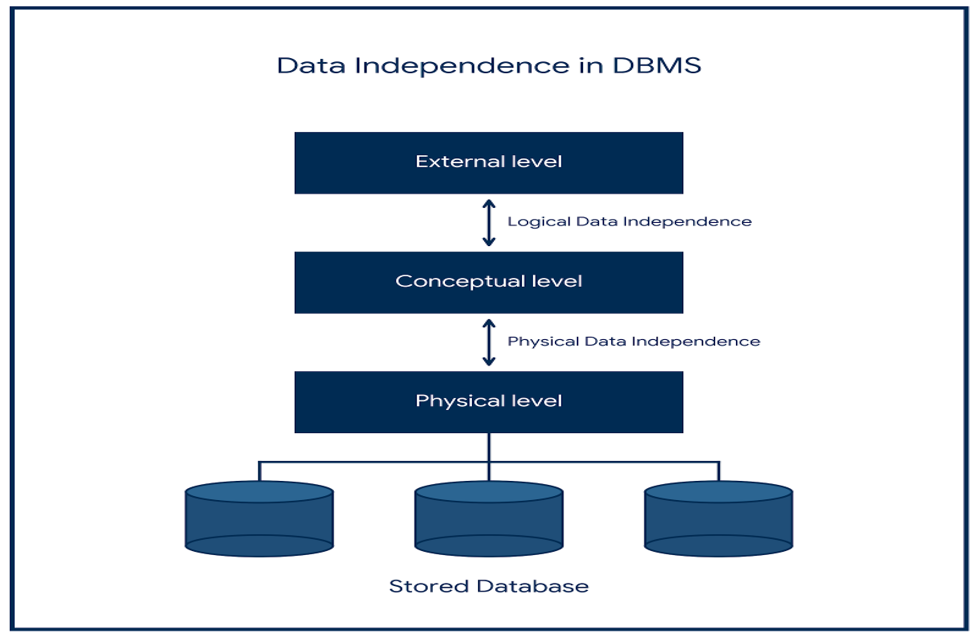
Types of Data Independence
1. Physical Data Independence
This means: we can change the physical schema – how data is stored, file organization, indexing without affecting the logical schema or the application programs.
Why does this work? Because applications only talk to the logical level, not the physical level. So any change made purely to improve storage or speed stays hidden from the users and applications.
Example: Changing the Student table’s file organization from sequential to hashed (for faster searching), or adding a new index the table structure that applications see stays the same.
Physical data independence is easier to achieve.
2. Logical Data Independence
This means: we can change the logical (conceptual) schema like adding, removing, or renaming a table or column without affecting the external schema or the application programs that use those views.
Example: Adding a new column Email to the Student table does not affect an existing application that only uses a view showing Roll No and Name.
Logical data independence is harder to achieve than physical data independence. This is because application programs are more closely connected to the logical structure.
Comparison
| Basis | Physical Data Independence | Logical Data Independence |
| Protects | Conceptual/logical schema from changes in physical schema | External/view schema and applications from changes in conceptual schema |
| Level of change | Storage structure, file organization, indexing | Table structure, attributes, relationships |
| Difficulty | Easier to achieve | Harder to achieve |
| Example | Changing indexing method | Adding a new attribute to a table |