In computer networks, data can be delivered using different communication models such as unicast, multicast, and broadcast. Among these, unicast is the most widely used mode on the internet and enterprise networks because most applications communicate one-to-one: a single sender transmits data to a single, specific receiver. Web browsing, email, SSH, and most client–server interactions rely on unicast. To deliver unicast packets efficiently across complex topologies, routers use unicast routing protocols. These protocols learn paths, compute the best routes based on metrics, and maintain routing tables to forward traffic reliably and quickly. For B.Tech CSE/IT students, understanding unicast and unicast routing protocols is fundamental to network design, performance tuning, and troubleshooting. This article explains what unicast is, how unicast communication works at a practical level, and how major unicast routing protocols (RIP, OSPF, IS-IS, EIGRP, and BGP) operate. We also cover advantages, disadvantages, and key considerations relevant for exams and real-world implementation.
What is Unicast in Computer Networks?
Unicast is a one-to-one communication method in computer networks in which a single sender transmits data packets to one specific destination. Each packet contains the destination IP address, allowing routers to forward it toward the intended receiver. Unicast is commonly used in web browsing, email, file transfers and client-server communication.
Example: When you open a website, your browser sends an HTTP/HTTPS request from your device’s IP (source) to the web server’s unicast IP (destination). Every intermediate router forwards the packets based on the server’s destination IP, ensuring a one-to-one delivery between your device and the specific server.
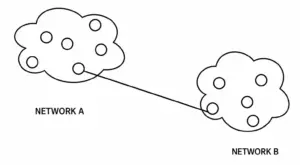
How Unicast Communication Works (Step-by-Step)
- Application generates data: A client app (e.g., a browser) needs to communicate with a server.
- Name resolution: The client resolves a domain name to a destination unicast IP using DNS.
- Transport setup: The client may establish a TCP connection (three-way handshake) or send a UDP datagram. The transport layer selects source/destination ports.
- IP packet creation: The network layer encapsulates the transport segment in an IP packet with a unicast destination address (IPv4 or IPv6) and a source address.
- Next-hop decision: The host consults its routing table (local routes and default gateway). If the destination is remote, it forwards to the default gateway (router).
- Link-layer resolution: For IPv4, ARP resolves the router’s MAC address; for IPv6, Neighbor Discovery (ND) finds the link-layer address.
- Router forwarding: Each router along the path performs a routing table lookup using the destination unicast address. It applies longest prefix match, decrements TTL (IPv4) or Hop Limit (IPv6), and forwards the packet to the next hop.
- Delivery and de-encapsulation: The destination host receives the packet, validates headers, and passes the payload to the transport and application layers for processing.
Unicast Addressing in IPv4 and IPv6
Unicast addressing assigns a unique address to an individual network interface. In IPv4, typical unicast addresses include public routable addresses and private ranges (e.g., 10.0.0.0/8, 172.16.0.0/12, 192.168.0.0/16) used with NAT for internet access. The loopback range 127.0.0.0/8 (commonly 127.0.0.1) is a special unicast used for local host testing. Subnetting via CIDR enables hierarchical aggregation for efficient routing.
In IPv6, unicast addresses include global unicast (2000::/3) for internet routing, unique local addresses (fc00::/7) for internal private use, link-local (fe80::/10) for local segment communication, and the loopback ::1. IPv6 also supports anycast (multiple interfaces share the same address; the network delivers to the nearest one), which is related but distinct from unicast. For unicast routing, routers treat global unicast addresses as individually reachable destinations.
Unicast Routing Basics
Routers forward unicast packets based on routing tables. A route associates a destination prefix (e.g., 203.0.113.0/24) with a next hop and an outgoing interface. Routes can be learned through:
- Direct/connected routes: Networks directly attached to the router.
- Static routes: Manually configured by administrators for simplicity or control.
- Dynamic routes: Learned via unicast routing protocols that exchange topology or path information.
Key concepts include:
- Longest Prefix Match (LPM): The most specific route (largest prefix length) that matches the destination IP is selected.
- Metric: A numeric value (e.g., hop count, cost, composite metric) that ranks route desirability.
- Administrative Distance/Preference: A tie-breaker that ranks the trustworthiness of route sources (static vs OSPF vs BGP, etc.).
- Convergence: The time routers take to agree on consistent routes after a change or failure.
Categories of Unicast Routing Protocols
Unicast routing protocols fall into two major categories:
- IGP (Interior Gateway Protocols): Used within a single administrative domain or autonomous system (AS). Examples: RIP (distance-vector), OSPF and IS-IS (link-state), EIGRP (advanced distance-vector/hybrid).
- EGP (Exterior Gateway Protocol): Used between different autonomous systems on the internet. Example: BGP (path-vector).
They also differ by algorithmic approach:
- Distance-Vector: Routers share routes as vectors of distance (metric) to networks. Simple but slower convergence. Example: RIP.
- Link-State: Routers flood link-state information and independently compute shortest paths with Dijkstra’s algorithm. Fast convergence and scalability. Examples: OSPF, IS-IS.
- Path-Vector: Routers advertise entire AS paths; policy-driven. Scales to the global internet. Example: BGP.
- Hybrid/Advanced Distance-Vector: Combines benefits (topology awareness, loop prevention). Example: EIGRP.
Key Unicast Routing Protocols and Their Operation
RIP (Routing Information Protocol)
A classic distance-vector IGP using hop count as the metric (maximum 15 hops). Operation steps: routers send periodic updates (every 30 seconds) to neighbors; each update lists known networks and hop counts. Upon receiving, a router increments hop count and updates its table if a better path is found. Loop suppression uses split horizon, route poisoning, and hold-down timers. RIP is simple and easy to configure but limited in scale and convergence speed.
OSPF (Open Shortest Path First)
A link-state IGP that builds a complete view of the network topology inside an area. Operation steps: neighbors form adjacencies using Hello packets and elect a designated router on multiaccess segments. Routers flood LSAs (Link-State Advertisements) describing links and costs. Each router runs Dijkstra’s SPF algorithm per area to compute shortest paths; the OSPF metric is “cost” (commonly derived from bandwidth). OSPF supports hierarchical design with areas (Area 0 backbone and non-backbone areas), route summarization, authentication, and fast convergence.
IS-IS (Intermediate System to Intermediate System)
Another link-state IGP originally from ISO/CLNS, widely used by service providers. Operation steps: routers exchange LSPs (Link State PDUs) and build a link-state database. IS-IS supports multi-level hierarchy with Level-1 (intra-area) and Level-2 (inter-area) routing. It is highly scalable, flexible with IP via Integrated IS-IS, and often chosen in large ISP backbones. Like OSPF, it uses Dijkstra’s algorithm and provides rapid convergence.
EIGRP (Enhanced Interior Gateway Routing Protocol)
An advanced distance-vector/hybrid IGP. Operation steps: routers form neighbor relationships and exchange route information using the DUAL algorithm (Diffusing Update Algorithm) to ensure loop-free paths. EIGRP uses a composite metric based on bandwidth and delay (optionally reliability and load). It supports unequal-cost load balancing, rapid convergence through feasible successors, and route summarization. While historically Cisco-proprietary, EIGRP is well-known in enterprise environments.
BGP (Border Gateway Protocol)
The internet’s de facto EGP and a path-vector protocol. Operation steps: BGP peers (eBGP between ASes, iBGP within an AS) establish TCP sessions (port 179) and exchange network reachability along with attributes such as AS_PATH, NEXT_HOP, LOCAL_PREF, MED, and communities. Route selection is policy-driven: routers prefer highest LOCAL_PREF, shortest AS_PATH, lowest origin type, lowest MED (with caveats), eBGP over iBGP, and other tie-breakers. BGP scales to millions of routes, supports route aggregation, filtering, and traffic engineering. Convergence can be slower than IGPs, but BGP’s strength is control and scalability across autonomous systems.
Route Selection and Convergence (Step-by-Step)
- Receive candidates: A router learns routes to the same destination via multiple sources (e.g., OSPF, BGP, static).
- Longest Prefix Match: The router first selects the route with the most specific prefix matching the destination IP.
- Administrative Preference: If multiple routes have the same prefix length but come from different protocols, the router prefers the route from the more trusted source (e.g., static over IGP, IGP over EGP or vice versa depending on platform).
- Metric comparison: If routes are from the same protocol, the router compares metrics (e.g., OSPF cost, RIP hop count) and picks the lowest metric.
- Equal-cost multipath (ECMP): If equal metrics exist, the router may install multiple next hops for load sharing.
- Install and forward: The winning route is installed in the forwarding table (FIB) and used to forward unicast traffic.
- Convergence considerations: Distance-vector protocols converge via periodic updates and triggered updates; link-state protocols converge by rapidly flooding changes and recomputing SPF; BGP relies on incremental updates, route flap damping (optional), and path exploration. Network design (hierarchy, summarization, timers, fast failure detection such as BFD) significantly affects convergence speed.
Metrics, Timers, and Loop Prevention
- Metrics: RIP uses hop count; OSPF uses interface cost; IS-IS uses link metrics configurable per interface; EIGRP uses a composite of bandwidth and delay; BGP uses policy attributes rather than a numeric “metric” alone. Correct metric design aligns routing decisions with desired performance (e.g., prefer higher bandwidth, lower latency links).
- Timers: Hello/dead timers detect neighbor failures; SPF timers throttle recomputation; RIP uses update/invalid/flush timers; BGP uses keepalive and hold timers to keep sessions up. Tuning timers balances convergence speed and stability.
- Loop prevention: Distance-vector uses split horizon, poison reverse, hold-downs; link-state avoids loops via synchronized LSDBs and SPF; EIGRP’s DUAL ensures loop-free feasible successors; BGP prevents loops using the AS_PATH attribute (if an AS sees itself in the path, it rejects the route).
Scaling Unicast Routing Protocols
To scale unicast routing, networks use hierarchical designs and summarization. OSPF and IS-IS use areas/levels to localize LSAs/LSPs and reduce CPU/memory. Route summarization at area borders or distribution layers limits route propagation and stabilizes the network. EIGRP supports summarization per interface and stub routers to reduce query scope. BGP scales with route aggregation, route reflectors for iBGP, confederations, and policy controls to avoid full mesh iBGP peering.
Security and Policy Considerations
Unicast routing security protects the control plane and ensures integrity of route information. Common practices include neighbor authentication (e.g., OSPF/IS-IS/EIGRP authentication), prefix filtering and route maps to control accepted/advertised routes, max-prefix limits, and bogon filtering. For BGP on the internet, additional measures include TTL security, TCP MD5/AO, RPKI-based origin validation, and careful policy design (LOCAL_PREF, communities) to prevent route leaks. Protecting the data plane includes ACLs, uRPF (for anti-spoofing), and rate-limiting.
Typical Use Cases
Enterprises commonly use OSPF or EIGRP as their IGP due to fast convergence and rich features, with static routes for simple edge cases. Service providers often choose IS-IS or OSPF in the core because of scalability and operational maturity. BGP is essential for multihoming, connecting to multiple ISPs, traffic engineering, and inter-AS routing on the global internet. RIP is mainly found in small labs or legacy systems due to its simplicity but limited scalability.
Advantages of Unicast
- Efficient one-to-one delivery ensures that data reaches a specific host without flooding the network.
- Destination-specific forwarding avoids broadcasting each packet, but unicast does not by itself reserve bandwidth per flow.
- Normal delivery is limited to the addressed destination, but unicast does not by itself provide confidentiality or prevent interception.
- Compatibility with most internet applications, which natively use unicast communication.
- Rich ecosystem of unicast routing protocols (OSPF, IS-IS, EIGRP, BGP) for scalability and control.
- Fine-grained policy control via routing metrics, attributes, and filtering to engineer traffic paths.
Disadvantages of Unicast
- Inefficient for one-to-many delivery because sending to multiple receivers requires multiple unicast streams.
- Complex routing design is needed in large networks to ensure fast convergence and stability.
- Control-plane overhead from dynamic routing protocols can consume CPU, memory, and bandwidth.
- Potential for misconfiguration or route leaks, especially with BGP, impacting reachability and security.
- Convergence delays can occur after failures, particularly with distance-vector protocols or large BGP tables.
- Scalability challenges without proper hierarchy and summarization can lead to large routing tables and slow reconvergence.
Conclusion
Unicast is the fundamental one-to-one communication model on which most internet and enterprise applications rely. It delivers packets to a single, uniquely addressed destination and depends on routers making fast, accurate forwarding decisions. Unicast routing protocols such as RIP, OSPF, IS-IS, EIGRP, and BGP enable networks to discover paths, select optimal routes, converge after changes, and apply policies for performance and security. IGPs work within an autonomous system to provide fast, resilient internal routing, while BGP connects autonomous systems at internet scale using path attributes and policies. For students and practitioners, mastering unicast routing concepts—addressing, metrics, longest prefix match, convergence, and protocol-specific operations—is essential for designing scalable, secure networks and for performing well in exams and interviews. With sound architecture (hierarchy, summarization) and security (authentication, filtering), unicast routing provides reliable, controllable connectivity across modern networks.