Asymmetric Digital Subscriber Line (ADSL) is a widely used broadband technology that provides Internet access through existing copper telephone lines. It is popular among home users and small businesses because of its relatively low cost, easy availability, and simple installation. ADSL provides higher download speeds than upload speeds, making it suitable for activities such as web browsing, downloading files, watching videos, and accessing online services.
However, ADSL has certain limitations when used in large business environments. Its lower upload speed can create difficulties for organizations that frequently send large files, upload data to cloud platforms, maintain online servers, and conduct high-quality video conferences. Additionally, its performance can be affected by the distance between the user’s premises and the telephone exchange, as well as the condition of the copper telephone line.
As businesses increasingly depend on cloud computing, remote working, online collaboration, video conferencing, and real-time data exchange, they require Internet connections that provide higher speeds in both directions. They also need stable performance, lower latency, greater bandwidth, and better reliability to support multiple users and business applications simultaneously.
To overcome the limitations of ADSL, several alternative technologies are available. Symmetric Digital Subscriber Line (SDSL), Very High Bitrate Digital Subscriber Line (VDSL), Fiber Optic Connections, and Leased Lines provide different levels of speed, bandwidth, and reliability to meet business requirements.
What is ADSL Technology?
ADSL (Asymmetric Digital Subscriber Line) is a type of DSL (Digital Subscriber Line) technology that provides high-speed Internet access through existing copper telephone lines. It allows users to access the Internet without installing separate telephone cables, making it an affordable and widely available broadband technology.
The term “asymmetric” refers to the difference between download and upload speeds. ADSL provides a higher download speed than upload speed because most home users and small businesses generally download more data than they upload. For example, users may download videos, browse websites, and access online services more frequently than they upload large files.
How ADSL Works?
ADSL works by dividing the available frequency range of a copper telephone line into separate bands for voice communication and digital data transmission. This allows users to make telephone calls and access the Internet simultaneously using the same telephone line.
- Voice Frequency Band (0–4 kHz): The lower frequency range is used for normal telephone conversations and carries analog voice signals.
- Data Frequency Bands (Above approximately 25 kHz): Higher frequencies are used to transmit digital Internet data. Separate frequency ranges are allocated for downloading and uploading information.
A splitter or microfilter separates voice and data signals. It prevents interference between telephone calls and Internet communication, allowing both services to operate simultaneously.
Working of ADSL (Step-by-Step)
- Data Reception: When a user requests information from the Internet, the data reaches the telephone exchange through the Internet service provider’s network.
- DSLAM Processing: The DSL Access Multiplexer (DSLAM), located at the telephone exchange, manages multiple ADSL connections and directs data to the appropriate subscriber line.
- Data Transmission: The data travels from the DSLAM to the user’s ADSL modem through the existing copper telephone line.
- Signal Separation: A splitter or microfilter separates the voice and data frequency signals so that telephone calls and Internet access can work simultaneously.
- Internet Access: The ADSL modem processes the incoming data and provides Internet connectivity to the user’s computer, router, or other connected devices.
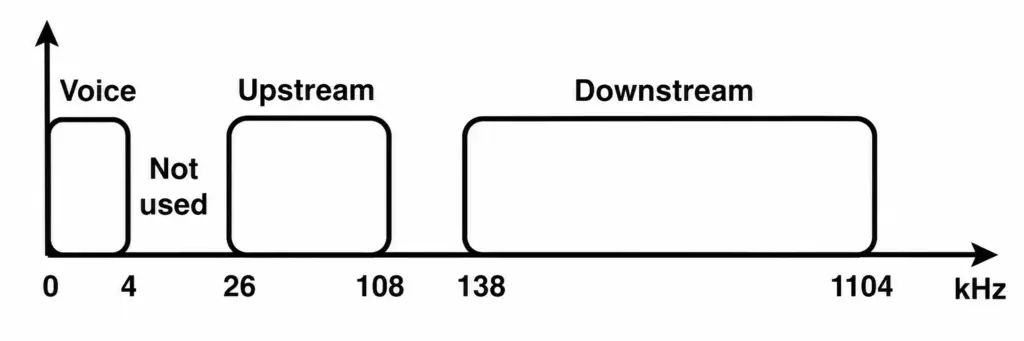
Figure: Bandwidth division in ADSL
Why ADSL Is Not Suitable for Large Business Applications
ADSL (Asymmetric Digital Subscriber Line) is a broadband technology that provides internet connectivity through existing copper telephone lines. It is mainly designed for home users and small offices that generally require more download speed than upload speed. Although ADSL is useful for basic internet activities such as browsing websites, watching videos, and downloading files, it has several limitations that make it unsuitable for large business applications.
Large organizations depend on fast, stable, and reliable internet connections to manage daily operations, communicate with customers, access cloud platforms, transfer large amounts of data, and support multiple employees. ADSL may not meet these requirements because of the following limitations.
1. Lower Upload Speed
ADSL provides higher download speeds than upload speeds. This is because it allocates more bandwidth for downloading data and less bandwidth for uploading data.
In large businesses, employees regularly upload documents, share large files, transfer company data, perform cloud backups, and communicate through video conferencing platforms. Since ADSL offers comparatively lower upload speeds, these activities may take more time. For example, uploading large project files to a cloud storage platform can become slow, affecting employee productivity and business operations.
2. Limited Bandwidth
ADSL provides limited bandwidth compared to modern broadband technologies such as fiber-optic connections. Bandwidth determines how much data can be transmitted over a network within a given period.
Large organizations may have hundreds of employees accessing the internet simultaneously. They may use cloud applications, online databases, video conferencing tools, email services, and other business applications at the same time. When many users share a limited ADSL connection, the available bandwidth may become insufficient. This can result in slower internet speeds, longer loading times, and delays in accessing important business resources.
3. Distance Limitations
The performance of ADSL depends on the distance between the user’s location and the telephone exchange. It uses copper telephone lines to transmit data, and signal quality generally decreases as the distance increases.
Businesses located far away from the telephone exchange may experience lower internet speeds and weaker signal quality. This can make it difficult for large organizations to maintain consistent network performance across their offices. Therefore, ADSL may not be a suitable option for businesses that require high-speed connectivity over long distances.
4. Unstable Connection
ADSL uses traditional copper telephone lines, which can be affected by poor line quality, electrical interference, physical damage, and environmental conditions. These factors may cause fluctuations in internet speed or unexpected connection interruptions.
Large businesses often depend on continuous internet access for important operations such as online transactions, customer support, cloud-based services, and communication between different departments. Even a short network interruption can delay work, affect customer services, and interrupt business activities. Therefore, the connection stability of ADSL may not be sufficient for organizations that require reliable connectivity.
5. Not Ideal for Multiple Users
ADSL is generally more suitable for a limited number of users rather than large organizations with many employees. When several employees connect to the same network, they share the available bandwidth.
For example, employees may simultaneously attend online meetings, download files, access company databases, browse websites, and use cloud-based applications. These activities consume network bandwidth. As the number of users increases, network performance may decrease, resulting in buffering, slow downloads, and interruptions during video conferences.
6. Limited Scalability
Scalability refers to the ability of a network to handle increasing demands as an organization grows. Large businesses may expand their workforce, open new branches, introduce new applications, and increase their data usage over time.
ADSL has limitations when it comes to increasing bandwidth and supporting growing network requirements. Businesses may find it difficult to achieve the higher speeds and capacity needed as their operations expand. This can lead to additional network limitations and may require the organization to upgrade to a more suitable internet technology.
7. Not Suitable for High-Bandwidth Applications
Large businesses often use applications that require high-speed internet connectivity, such as cloud computing, video conferencing, remote desktop services, online data processing, and large-scale file sharing.
These applications need sufficient bandwidth and consistent network performance to work smoothly. Since ADSL offers limited bandwidth and lower upload speeds, it may cause delays, buffering, and slower data transfers when handling demanding business applications. This can reduce the efficiency of employees and affect overall business productivity.
8. Limited Reliability for Critical Business Operations
Some business operations require continuous internet connectivity. For example, banks, financial institutions, e-commerce companies, and customer service centers depend on network connections to process transactions, access customer information, and provide services.
If an ADSL connection becomes slow or unavailable, these activities may be interrupted. Businesses that require continuous access to important online services generally need more reliable connectivity options with better performance and support.
Advantages of ADSL
1. Uses Existing Telephone Lines: ADSL uses existing copper telephone lines to provide internet connectivity. Therefore, users do not need to install completely new cables, which helps reduce installation costs.
2. Affordable Internet Connection: ADSL is generally an economical broadband option for home users and small businesses compared to some high-speed internet technologies.
3. Simultaneous Voice and Data Transmission: ADSL allows users to make telephone calls and access the internet at the same time because voice and data signals use different frequency bands.
4. Higher Download Speed: ADSL provides higher download speeds than upload speeds. This makes it suitable for activities such as browsing websites, downloading files, watching videos, and accessing online content.
5. Dedicated Connection: ADSL provides a connection between the user’s modem and the telephone exchange. Its performance does not depend on sharing the same local cable bandwidth with nearby subscribers in the same way as traditional shared cable broadband.
6. Easy Installation and Usage: ADSL can be installed using existing telephone infrastructure with an ADSL modem and suitable filters or splitters. It is also relatively simple to use.
Disadvantages of ADSL
1. Lower Upload Speed: ADSL provides lower upload speeds compared to download speeds. This makes uploading large files, sharing data, and performing cloud backups slower.
2. Distance Limitations: ADSL performance depends on the distance between the user’s location and the telephone exchange. As the distance increases, internet speed and signal quality generally decrease.
3. Limited Bandwidth: ADSL offers limited bandwidth compared to modern broadband technologies such as fiber-optic connections. It may not provide sufficient capacity for applications that require high-speed data transmission.
4. Connection Quality Issues: Since ADSL uses copper telephone lines, poor line quality, electrical interference, and physical damage can affect connection speed and stability.
5. Not Suitable for Large Businesses: ADSL may not provide enough bandwidth and upload speed to support a large number of employees accessing internet services simultaneously.
6. Limited Scalability: ADSL has limitations when businesses need to increase their internet speed and network capacity. Therefore, it may not support the growing connectivity requirements of large organizations.
7. Performance Depends on Line Quality: The speed and reliability of ADSL depend on the condition and quality of the copper telephone line. Old or damaged lines may result in slower connections and frequent interruptions.
8. Not Ideal for High-Bandwidth Applications: Applications such as large-scale cloud computing, high-quality video conferencing, and transferring large files may not perform efficiently because of ADSL’s limited bandwidth and lower upload speed.