An error in a computer network occurs when the data received by the destination device is different from the data originally transmitted by the sender.
For example, suppose a sender transmits the following binary data:
- Original data:
10110110 - Received data:
10100110
Here, one bit has changed during transmission. This is called a transmission error.
A computer network is a collection of interconnected computers and devices that communicate with each other to share data, resources, and information. During data transmission, information travels from one device to another through communication channels such as cables, optical fibres, or wireless signals.
However, sometimes the transmitted data does not reach the destination correctly. It may get modified, lost, or corrupted due to noise, interference, hardware problems, or other communication issues.
Such problems are known as errors in computer networks.
Causes of Errors in Computer Networks
Errors can occur due to several reasons during data transmission.
- Noise: Unwanted electrical or electromagnetic signals may interfere with the original data.
- Signal Attenuation: The strength of a signal decreases as it travels over a long distance.
- Electromagnetic Interference: Nearby electrical devices, motors, or other electronic equipment may disturb signals.
- Hardware Failure: Damaged cables, faulty network cards, or defective network devices can cause data corruption.
- Wireless Interference: Other wireless networks and physical obstacles can affect signal transmission.
- Synchronization Problems: If the sender and receiver are not properly synchronized, the receiver may interpret transmitted bits incorrectly.
Types of Transmission Error
- Single-bit error: Only one bit in the data unit changes from 0 to 1 or from 1 to 0. For example, transmitted
1011001may be received as1010001; only the fourth bit changed. - Burst error: Two or more bits within a span are corrupted. For example, transmitted
11001001may be received as10111001. The affected span runs from the second bit through the fourth bit, so the burst length is 3 bits.
1. Single-Bit Error
A single-bit error occurs when only one bit of the transmitted data changes its value from 0 to 1 or from 1 to 0.
In other words, only one bit gets corrupted during the transmission of a data unit.
Example of Single-Bit Error
Suppose the sender transmits the following data:
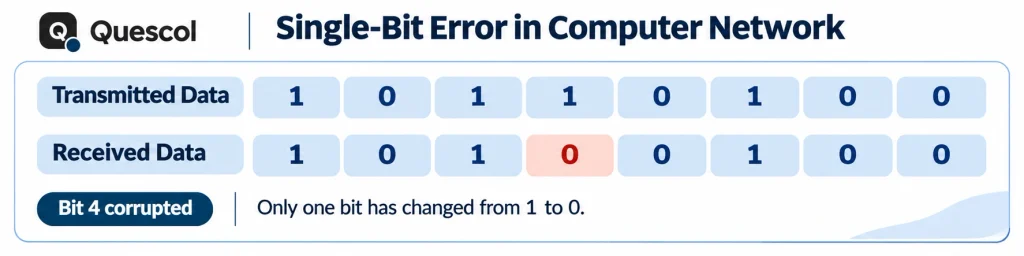
In the above example:
- Original data:
10110100 - Received data:
10100100 - Only the fourth bit has changed.
Therefore, it is an example of a single-bit error.
Characteristics of Single-Bit Error
- Only one bit is changed during transmission.
- The error may occur at any position in the data.
- It is generally less common in high-speed data transmission systems.
- It can be detected using error detection techniques such as parity checking.
Example in real life: A small amount of electrical interference may change one bit while transmitting data through a communication channel.
2. Burst Error
A burst error occurs when two or more bits in a data unit are affected during transmission.
In this type of error, multiple bits within a sequence of transmitted data become corrupted.
The important point is that the burst length is measured from the first corrupted bit to the last corrupted bit, including any unchanged bits in between.
Example of Burst Error
Suppose the sender transmits the following binary data:
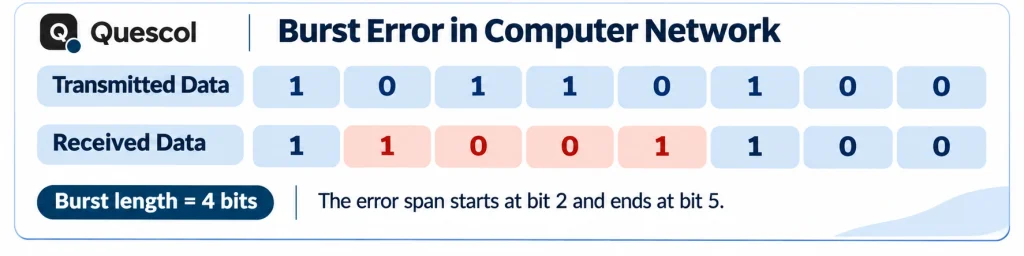
In the above example:
- Original data:
10110100 - Received data:
11001100 - Multiple bits have changed within the data sequence.
The burst length is 4 bits because the first affected bit is at position 2 and the last affected bit is at position 5.
Characteristics of Burst Error
- Two or more bits are affected.
- Errors may occur in consecutive or non-consecutive positions within the burst span.
- Burst errors are common in wireless and long-distance communication.
- They can be detected using techniques such as CRC (Cyclic Redundancy Check).
- They are generally more challenging to handle than single-bit errors.
Example in real life: During wireless communication, sudden interference may affect several bits of a transmitted data frame, resulting in a burst error.
Difference Between Single-Bit Error and Burst Error
| Basis | Single-Bit Error | Burst Error |
|---|---|---|
| Meaning | Only one bit gets corrupted. | Two or more bits get corrupted. |
| Number of affected bits | One bit | Two or more bits |
| Complexity | Comparatively simple | Comparatively complex |
| Occurrence | Can occur in any bit position. | Often caused by interference affecting a sequence of bits. |
| Detection | Parity checking can detect it. | CRC is commonly used. |
| Example | 1011 becomes 1001 | 10110010 becomes 11001010 |
Error Detection Techniques in Computer Networks
Error detection is the process of identifying whether transmitted data has been corrupted during communication.
The sender adds some additional information, known as redundant bits, to the original data. The receiver uses these bits to check whether the received data contains an error.
The major error detection techniques are:
Parity Check
Parity checking is one of the simplest techniques used to detect errors in transmitted data.
In this method, an additional bit called a parity bit is added to the original data.
There are two types of parity checking:
1. Even Parity
In even parity, the parity bit is selected so that the total number of 1s in the transmitted data, including the parity bit, becomes even.
Example:
- Original data:
1011001 - Number of 1s: 4
- Parity bit: 0
- Transmitted data:
10110010
2. Odd Parity
In odd parity, the parity bit is selected so that the total number of 1s in the transmitted data becomes odd.
Example:
- Original data:
1011001 - Number of 1s: 4
- Parity bit: 1
- Transmitted data:
10110011
Advantages:
- Simple to implement.
- Requires very little additional data.
- Can detect any odd number of bit errors.
Disadvantages:
- Cannot detect an even number of bit errors.
- Cannot identify the exact position of an error.
- Cannot correct errors.
Checksum
Checksum is an error detection technique used to verify the integrity of transmitted data.
In this method, the sender divides the data into fixed-size segments and adds them using binary arithmetic. The complement of the sum is calculated and transmitted along with the original data.
At the receiver side, the checksum is recalculated to verify whether the data has been corrupted.
Working of Checksum:
- The sender divides data into equal-sized blocks.
- All blocks are added using binary addition.
- The complement of the final sum is calculated.
- The checksum is transmitted along with the data.
- The receiver performs the same calculation.
- If the result is valid, the data is accepted; otherwise, an error is detected.
Advantages:
- Easy to implement.
- Requires less processing power.
- Commonly used in network protocols.
Applications: Checksum is used in protocols such as IP, TCP, and UDP (with protocol-specific details).
Cyclic Redundancy Check (CRC)
CRC stands for Cyclic Redundancy Check. It is a widely used error detection technique in computer networks.
It uses binary division to generate a remainder, which is attached to the original data before transmission.
The receiver performs the same division operation to check whether the received data contains an error.
Working of CRC:
- The sender selects a predefined binary divisor called the generator polynomial.
- Extra zeros are appended to the original data.
- The data is divided by the generator using modulo-2 division.
- The remainder is calculated.
- The remainder is appended to the original data.
- The receiver divides the received data using the same generator.
- A non-zero remainder indicates an error.
Advantages:
- Highly effective in detecting burst errors within its guaranteed detection range.
- More reliable than simple parity checking.
- Widely used in communication systems and network technologies.
Applications: Ethernet frames, storage devices, and communication protocols.
Error Detection vs Error Correction
Error detection and error correction are two important concepts in computer networks.
| Basis | Error Detection | Error Correction |
|---|---|---|
| Meaning | Identifies whether an error has occurred. | Identifies and corrects errors. |
| Purpose | To detect corrupted data. | To recover correct data. |
| Additional bits | Generally fewer redundant bits. | May require more redundant bits. |
| Complexity | Comparatively simple. | Comparatively complex. |
| Examples | Parity, Checksum, CRC | Hamming Code, Forward Error Correction |
Error Correction Techniques:
- Hamming Code: Adds redundant bits at specific positions to detect and correct certain bit errors.
- Forward Error Correction (FEC): Adds sufficient redundant information so that the receiver can correct errors without requesting retransmission.
- Automatic Repeat Request (ARQ): Requests retransmission when corrupted or missing data is detected.
Conclusion
Errors in computer networks occur when transmitted data becomes corrupted during communication. These errors can affect the accuracy and reliability of data transmission.
The two main types of transmission errors are single-bit errors and burst errors. Single-bit errors affect only one bit, whereas burst errors affect multiple bits within a sequence.
To ensure reliable communication, computer networks use error detection and correction techniques such as parity checking, checksum, CRC, Hamming Code, and ARQ.
These techniques help maintain data integrity and ensure that information is transmitted accurately from sender to receiver.