Optical fiber is a type of guided transmission medium used in computer networks to transfer information from one location to another using light signals. It consists of very thin, flexible strands of glass or plastic that carry data in the form of light pulses.
Unlike traditional copper cables, which transmit information through electrical signals, optical fiber uses light to transmit data. This makes it possible to transfer large amounts of information at very high speeds over long distances with minimal signal loss.
The working principle of optical fiber is based on Total Internal Reflection (TIR). In this process, light travels through the central part of the fiber, known as the core. It repeatedly reflects at the boundary between the core and the surrounding cladding, allowing the light signals to travel along the fiber without escaping into the surrounding material.
Optical fiber provides several benefits, including high bandwidth, low signal attenuation, immunity to electromagnetic interference, and better data security compared to conventional copper cables.
Due to these advantages, optical fiber is widely used in high-speed internet connections, telecommunication networks, cable television, medical equipment, and modern data communication systems.
Structure of Optical Fiber
An optical fiber is a thin, flexible transmission medium made of glass or plastic. It is used to transmit information in the form of light signals from one point to another. The structure of optical fiber consists of three main layers: Core, Cladding, and Protective Coating. Each layer performs a specific function to ensure efficient and reliable data transmission.
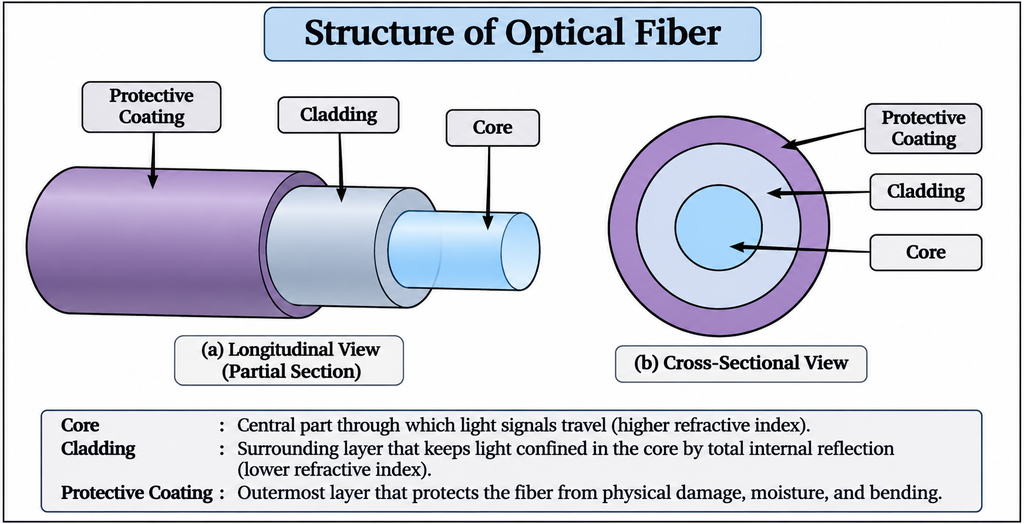
Figure: Structure of an Optical Fiber
1. Core
The core is the central and innermost part of an optical fiber through which light signals travel. It is made of very pure glass or transparent plastic and has a higher refractive index than the cladding.
- It carries light signals from the transmitting end to the receiving end.
- It provides the path for light propagation.
- Its refractive index helps support total internal reflection.
- The diameter of the core depends on the type of optical fiber.
2. Cladding
Cladding is the optical layer that surrounds the core. It is also made of glass or plastic, but it has a lower refractive index than the core.
- It keeps light signals confined within the core through total internal reflection.
- It prevents light from escaping easily into the surrounding material.
- It helps maintain efficient signal transmission.
- It protects the optical core from unwanted optical interference.
3. Protective Coating
The protective coating is the outermost protective layer surrounding the cladding. It is generally made of plastic material.
- It protects the optical fiber from physical damage.
- It prevents scratches, moisture, and other environmental effects from damaging the fiber.
- It provides flexibility and improves the durability of the fiber.
- It helps protect the fiber during installation and handling.
Working of These Layers Together
The three layers work together to transmit information through optical fiber. The core carries the light signals, while the cladding keeps the light confined inside the core by supporting total internal reflection. The protective coating protects the fiber from external damage.
Thus, the structure of optical fiber helps transmit data over long distances with high speed and low signal loss.
Working of Optical Fiber Transmission
The transmission of information through optical fiber takes place through a series of steps.
Step 1: Data Input
The process begins when information such as voice, video, images, or digital data is provided by a source device, such as a computer, telephone, or network system.
The input information is prepared for transmission through the optical fiber.
Step 2: Conversion of Electrical Signals into Light Signals
At the transmitting end, the input data is represented as electrical signals. An optical transmitter uses a light source, such as an LED or laser diode, to convert these electrical signals into light pulses.
These light pulses represent the digital information being transmitted. Different pulse patterns represent different combinations of binary data.
Step 3: Transmission Through the Optical Fiber
The generated light pulses enter the core of the optical fiber through an optical connector or coupling arrangement.
As the light travels through the core, it reaches the boundary between the core and cladding. Due to the difference in their refractive indices, total internal reflection takes place.
The light is repeatedly reflected inside the core and continues travelling towards the receiving end.
Step 4: Signal Propagation Over Long Distances
The light pulses travel through the optical fiber while remaining confined within the core.
Optical fiber supports high-speed data transmission because light can carry information with low attenuation compared with electrical signals in many copper transmission systems.
For very long distances, optical amplifiers or repeaters may be used to compensate for signal loss and maintain transmission quality.
Step 5: Reception of Light Signals
At the receiving end, an optical receiver detects the incoming light pulses using a photodetector, such as a photodiode.
The photodetector converts the received light signals back into electrical signals.
Step 6: Recovery of Original Data
The electrical signals are processed by the receiving device to recover the original transmitted information.
The recovered information may include voice, video, images, or computer data. In this way, optical fiber completes the transmission of information from the sender to the receiver.
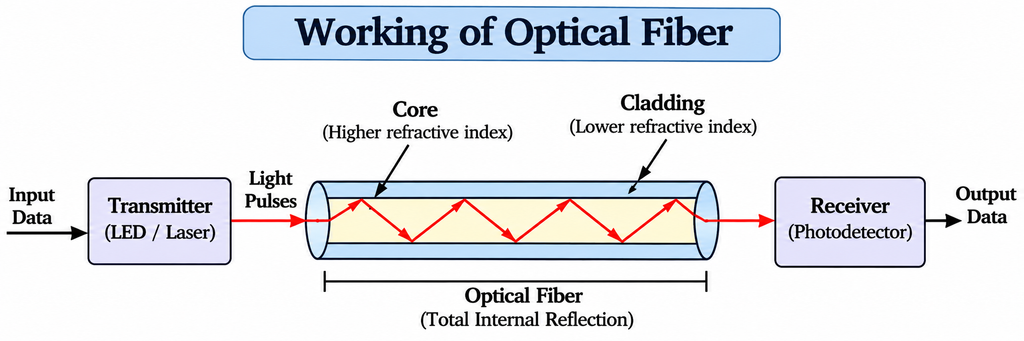
Figure: Working of Optical Fiber
This simple diagram shows how light pulses travel through the optical fiber using Total Internal Reflection
Advantages of Optical Fiber
1. High Bandwidth: Optical fiber supports high bandwidth and can transmit large amounts of data at very high speeds. It is suitable for applications that require fast data communication, such as high-speed internet and video streaming.
2. Low Signal Loss: Optical fiber experiences very little signal loss during transmission compared to many traditional copper cables. Therefore, it can transmit information over long distances without requiring frequent signal amplification.
3. Immunity to Electromagnetic Interference: Optical fiber uses light signals instead of electrical signals. Therefore, it is not affected by electromagnetic interference from electrical devices, motors, or power cables.
4. High Security: Optical fiber provides secure data transmission because it is difficult to tap into the cable without disturbing the signal. This makes it useful for transmitting confidential information.
5. Small Size and Lightweight: Optical fiber cables are thinner and lighter than many copper cables. They require less space and are easier to install in areas where cable space is limited.
6. Reliable Communication: Optical fiber provides stable and efficient data transmission. It is suitable for communication systems that require high-speed and continuous connectivity.
7. Long-Distance Transmission: Optical fiber can transmit data over long distances with relatively low attenuation, making it useful for telecommunication networks and long-distance internet connections.
Disadvantages of Optical Fiber
1. High Installation Cost: Installing optical fiber networks can be expensive because they require specialized cables, equipment, and skilled technicians.
2. Fragility: Optical fibers are made of glass or plastic and can be damaged if they are bent excessively or handled improperly.
3. Difficult Maintenance: Repairing damaged optical fiber cables requires specialized tools and trained technicians. This can make maintenance more difficult and expensive.
4. Specialized Equipment Required: Optical fiber communication requires special equipment such as optical transmitters, receivers, photodetectors, and connectors to transmit and receive light signals.
5. Complex Installation: Joining and connecting optical fiber cables requires careful handling and specialized techniques such as fiber splicing.
6. Cannot Carry Electrical Power: Optical fiber transmits information using light signals and cannot carry electrical power to connected devices like some copper cables can.
Applications of Optical Fiber
1. Telecommunication Networks: Optical fiber is widely used in telephone networks to transmit voice, video, and data signals over long distances with high speed and low signal loss.
2. Internet Connectivity: It is used to provide high-speed broadband internet connections to homes, offices, educational institutions, and businesses.
3. Cable Television: Optical fiber is used to transmit television signals and deliver high-quality audio and video content to customers.
4. Medical Equipment: Optical fibers are used in medical instruments such as endoscopes, which help doctors examine internal organs and body parts without major surgery.
5. Computer Networks: Optical fiber connects computers, servers, routers, and data centers to support fast and reliable communication between network devices.
6. Industrial Applications: It is used in industrial monitoring and sensing systems because it is resistant to electromagnetic interference and can operate in electrically noisy environments.
7. Military and Aerospace Communication: Optical fiber is used in military and aerospace communication systems because of its lightweight structure, high bandwidth, and resistance to electromagnetic interference.
8. Undersea Communication: Optical fiber cables are installed under oceans and seas to connect different countries and continents. They carry large amounts of international internet and communication traffic.