Introduction to Go-Back-N ARQ
In computer networks, data is transmitted from a sender to a receiver through a communication channel. During transmission, frames may sometimes get lost, damaged, or delayed because of network problems or transmission errors.
To ensure reliable communication, computer networks use error control techniques. One important technique is Automatic Repeat reQuest (ARQ).
ARQ is a method used to control transmission errors by using acknowledgements and retransmissions. When the receiver detects a missing or damaged frame, it informs the sender so that the required data can be transmitted again.
One of the important ARQ techniques is Go-Back-N ARQ. It is a continuous (sliding window) error control protocol that allows the sender to transmit multiple frames without waiting for an acknowledgement after every frame.
If a frame is lost or damaged, the sender retransmits that frame and all the frames sent after it, even if some of those frames were received correctly.
This method improves transmission efficiency compared to Stop-and-Wait ARQ, especially when communication takes place over long distances.
What Is Go-Back-N ARQ?
Go-Back-N ARQ (Automatic Repeat reQuest) is a sliding window error control protocol in which the sender can transmit multiple frames continuously before receiving acknowledgements. If a frame is lost or damaged, the sender goes back to that frame and retransmits it along with all the subsequent unacknowledged frames.
Go-Back-N ARQ uses a sequence numbering system to identify each transmitted frame.
The sender maintains a window that determines how many frames can be transmitted without receiving acknowledgements. The receiver accepts frames only in the correct sequence and discards out-of-order frames.
For example, suppose the sender transmits five frames numbered 0, 1, 2, 3, and 4. If frame 2 is lost during transmission, the receiver will not accept frames 3 and 4 because it is still waiting for frame 2.
After receiving a timeout or negative acknowledgement, the sender retransmits frame 2 and all subsequent unacknowledged frames.
This process is called Go-Back-N because the sender goes back to the first missing or damaged frame and retransmits the remaining frames.
Meaning of Continuous ARQ
Continuous ARQ is an error control technique in which the sender transmits multiple frames continuously without waiting for an acknowledgement after each frame.
It uses a sliding window mechanism to manage the transmission of frames.
The main idea is to improve communication efficiency by allowing several frames to travel through the communication channel at the same time.
Go-Back-N ARQ and Selective Repeat ARQ are two important examples of continuous ARQ protocols.
Working Principle of Go-Back-N ARQ
Go-Back-N ARQ works using a sliding window mechanism, sequence numbers, acknowledgements, and retransmission timers.
The working principle can be explained through the following steps:
1. Frame Numbering: The sender assigns a unique sequence number to each frame before transmitting it.
2. Sliding Window: The sender maintains a window that specifies the maximum number of frames that can be sent without waiting for acknowledgements.
3. Continuous Transmission: The sender transmits multiple frames continuously as long as they fall within the sending window.
4. Acknowledgement: The receiver sends acknowledgements to inform the sender about the frames received successfully. In the common cumulative acknowledgement scheme, an ACK indicates the next frame expected.
5. In-Order Reception: The receiver accepts only the frames that arrive in the correct sequence. If a frame is missing, later out-of-order frames are discarded.
6. Error Detection: If a frame is lost or damaged, the receiver detects the problem and does not accept the following frames as valid in-order data.
7. Timeout: If the sender does not receive the expected acknowledgement within the specified time, its timer expires.
8. Retransmission: The sender retransmits the missing frame and all subsequent unacknowledged frames.
9. Window Movement: After receiving acknowledgements, the sender moves its window forward and continues transmitting new frames.
Detailed Example of Go-Back-N ARQ
Let us understand the working of Go-Back-N ARQ with a simple example.
Consider the following situation:
- The sender wants to transmit five frames numbered 0, 1, 2, 3, and 4.
- The sender’s window size is 4.
- Frame 2 is lost during transmission.
- The receiver accepts only frames in the correct sequence.
Step 1: Sender Transmits Frames
The sender transmits frames 0, 1, 2, and 3 continuously without waiting for an individual acknowledgement.
Step 2: Receiver Receives Frames
The receiver successfully receives frames 0 and 1.
However, frame 2 is lost during transmission.
Step 3: Receiver Discards Subsequent Frames
After frame 2 is lost, the receiver expects frame 2.
When frame 3 arrives, the receiver discards it because it is not the expected frame.
The receiver sends a cumulative acknowledgement indicating that frame 2 is the next expected frame.
Step 4: Sender Receives Acknowledgement
The sender receives ACK 2, which indicates that frames 0 and 1 have been received successfully and frame 2 is expected next.
The sender identifies that frame 2 needs to be transmitted again.
Step 5: Retransmission of Frames
The sender retransmits frame 2 and all subsequent unacknowledged frames.
Therefore, frames 2 and 3 are transmitted again.
Step 6: Successful Reception
The receiver receives frames 2 and 3 in the correct order and accepts them.
It sends an acknowledgement indicating that frame 4 is expected next.
The sender can now continue transmitting new frames.
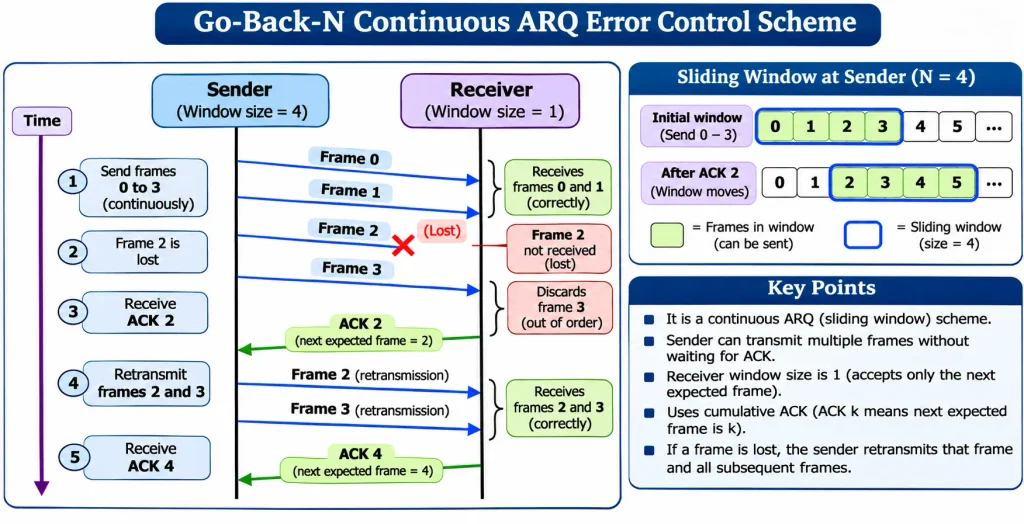
Figure: Working of Go-Back-N ARQ
Sliding Window Mechanism in Go-Back-N ARQ
The sliding window mechanism is an important part of Go-Back-N ARQ. It allows the sender to transmit multiple frames before receiving acknowledgements.
A window represents the range of frames that the sender is allowed to transmit without waiting for further acknowledgements.
1. Sender Window
The sender window determines how many frames can be transmitted at a time.
For example, if the window size is 4, the sender can transmit four frames continuously before receiving acknowledgements.
Initially, the sender may transmit frames 0, 1, 2, and 3.
After receiving acknowledgements, the window moves forward and allows the sender to transmit additional frames.
2. Receiver Window
The receiver window determines which frame the receiver is currently expecting.
In Go-Back-N ARQ, the receiver window size is always 1.
This means that the receiver accepts only the next expected frame. If a frame arrives out of order, it is discarded.
3. Window Size Formula
If the sequence number field contains \(m\) bits, the maximum sender window size is:
Where:
- W_s = Sender window size.
- m = Number of bits used for sequence numbers.
Example:
If the sequence number field contains 3 bits:
Therefore, the maximum sender window size is 7 frames.
The receiver window size is:
Role of Acknowledgement and Timeout
Acknowledgements and timeouts are important for controlling data transmission in Go-Back-N ARQ.
1. Acknowledgement (ACK)
An acknowledgement is a message sent by the receiver to inform the sender about successfully received frames.
Go-Back-N ARQ commonly uses cumulative acknowledgements.
For example, ACK 3 means that frames 0, 1, and 2 have been received successfully, and frame 3 is expected next.
2. Timeout
A timeout occurs when the sender does not receive the expected acknowledgement within a specified time.
When the timer expires, the sender retransmits the oldest unacknowledged frame and all subsequent unacknowledged frames.
This ensures that lost or damaged frames can be transmitted again.
Go-Back-N Continuous ARQ Error Control Scheme
Go-Back-N ARQ is a continuous error control scheme used in computer networks to provide reliable data transmission between a sender and a receiver. It uses a sliding window mechanism that allows multiple frames to be transmitted continuously without waiting for an acknowledgement after every frame.
In this scheme, the sender assigns a sequence number to each frame before transmitting it. These sequence numbers help the sender and receiver identify frames and maintain the correct order of data transmission.
The sender maintains a sending window that determines how many frames can be transmitted at a time. The receiver maintains a receiving window of size 1, which means it accepts only the next expected frame.
When the receiver receives a frame successfully, it sends an acknowledgement (ACK) to inform the sender. If a frame is lost or damaged during transmission, the receiver rejects the subsequent frames because they are not in the expected sequence.
The sender then retransmits the lost or damaged frame along with all the subsequent unacknowledged frames. This process helps recover missing data and ensures reliable communication.
Advantages of Go-Back-N ARQ
Go-Back-N ARQ provides several advantages in computer networks.
1. Continuous Transmission: The sender can transmit multiple frames without waiting for individual acknowledgements.
2. Improved Efficiency: It provides better channel utilization than Stop-and-Wait ARQ, particularly when the communication delay is high.
3. Simple Receiver Design: The receiver accepts only frames in the correct sequence, making its operation relatively simple.
4. Cumulative Acknowledgement: It reduces the need for sending a separate acknowledgement for every frame.
5. Automatic Retransmission: Lost or damaged frames and subsequent unacknowledged frames are retransmitted automatically.
6. Reliable Communication: It helps ensure that data reaches the receiver in the correct order.
Disadvantages of Go-Back-N ARQ
Although Go-Back-N ARQ improves transmission efficiency, it also has some limitations.
1. Unnecessary Retransmission: If one frame is lost, all subsequent unacknowledged frames must be retransmitted, even if they were received correctly.
2. Reduced Efficiency During Errors: When transmission errors occur frequently, repeated retransmissions can reduce network performance.
3. Bandwidth Wastage: Retransmitting multiple frames increases the amount of data sent through the communication channel.
4. Buffer Requirement: The sender needs sufficient buffer space to store transmitted frames until they are acknowledged.
5. Performance Depends on Network Conditions: Its efficiency decreases when the communication channel has a high error rate.
Difference Between Stop-and-Wait ARQ and Go-Back-N ARQ
Stop-and-Wait ARQ and Go-Back-N ARQ are two important error control protocols used in computer networks.
However, they differ in their transmission methods and window mechanisms.
| Stop-and-Wait ARQ | Go-Back-N ARQ |
|---|---|
| Sends one frame at a time. | Sends multiple frames continuously. |
| Waits for an acknowledgement after each frame. | Does not wait for an individual acknowledgement after every frame. |
| Sender window size is 1. | Sender window size can be greater than 1. |
| Receiver window size is 1. | Receiver window size is 1. |
| Simple to implement. | More complex than Stop-and-Wait ARQ. |
| Lower channel utilization. | Generally higher channel utilization. |
| Retransmits the lost or damaged frame. | Retransmits the erroneous frame and all subsequent unacknowledged frames. |
Applications of Go-Back-N ARQ
Go-Back-N ARQ is used in communication systems where reliable and continuous data transmission is required.
Some important applications include:
1. Computer Networks: It is used as an example of sliding window-based error control in data communication.
2. Data Link Layer: It explains how reliable frame transmission can be achieved using sequence numbers and acknowledgements.
3. Wireless Communication: Go-Back-N principles can be used in communication systems where retransmission is required to handle transmission errors.
4. Satellite Communication: Its continuous transmission mechanism can improve channel utilization in suitable communication environments.
5. Data Transmission Systems: It is useful in systems that require ordered delivery and automatic retransmission of lost frames.