In computer communication networks, multiple users and devices need to communicate and exchange information through a shared communication medium. However, the available communication resources, such as bandwidth and frequency channels, are limited.
When several users try to access the same communication medium, proper arrangements are required to avoid interference, communication conflicts, and unnecessary delays.
Channel allocation is the process of assigning available communication channels to different users or devices for transmitting data. It determines how communication resources are distributed and shared among users.
The main objective of channel allocation is to utilize the available bandwidth efficiently, provide fair access to users, reduce interference, and improve the overall performance of the network.
Channel allocation is commonly used in wireless networks, mobile communication systems, satellite communication, radio broadcasting, and computer networks.
Communication Channel
A communication channel is a medium or path through which information travels from a sender to a receiver.
It provides a way for two or more devices to exchange information. Depending on the communication technology, a channel may use a specific frequency band, time slot, physical connection, or logical communication path.
For example, in wireless communication, different frequency channels are used to transmit signals between mobile devices and network stations.
Examples of communication channels:
- Frequency channels used in radio and mobile communication.
- Time slots used in Time Division Multiplexing (TDM).
- Physical communication links used in wired networks.
- Wireless channels used in Wi-Fi communication.
Need for Channel Allocation
Channel allocation is necessary because communication networks have limited resources that must be shared among multiple users.
The following points explain why channel allocation is important:
- Efficient Use of Bandwidth: It helps distribute the available bandwidth among different users so that communication resources are not wasted.
- Avoiding Interference: Proper channel assignment reduces the possibility of signals interfering with one another, especially in wireless communication.
- Supporting Multiple Users: It allows several users to access the communication network by assigning available channels according to their requirements.
- Improving Network Performance: Proper allocation helps reduce unnecessary delays and communication conflicts, improving overall network efficiency.
- Fair Distribution of Resources: It helps ensure that available communication channels are distributed among users according to network rules and requirements.
- Handling Network Traffic: It helps manage changing communication requirements when the number of users or amount of data transmission increases.
Types of Channel Allocation
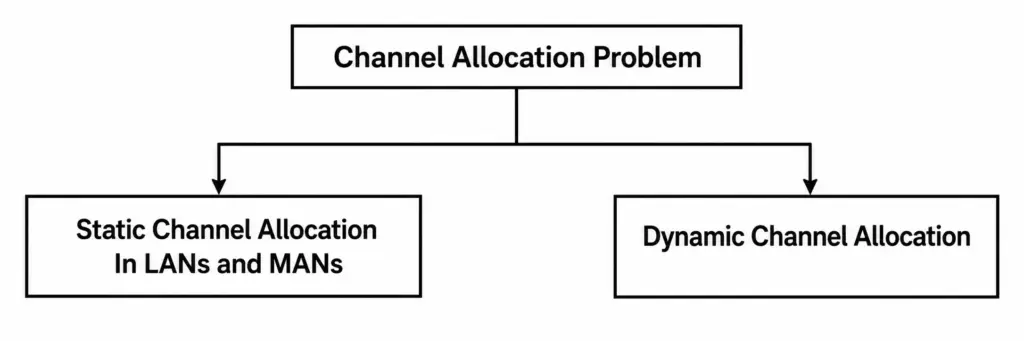
Channel allocation is mainly classified into two types:
- Static Channel Allocation
- Dynamic Channel Allocation
1. Static Channel Allocation
Static Channel Allocation is a method in which available communication channels are assigned permanently or in advance to specific users or devices.
In this method, each user receives a fixed communication channel or a predetermined portion of the available bandwidth. The assigned channel generally remains reserved for that user, even when the user is not transmitting data.
The allocation is decided before communication begins. Therefore, users do not need to request a new channel every time they want to transmit information.
Static channel allocation is simple to implement and manage because the channel assignments remain fixed. However, it may result in bandwidth wastage when some users do not use their assigned channels.
Working of Static Channel Allocation
The working process of static channel allocation involves the following steps:
- Channel Assignment: The available communication channels are divided among the users or devices in advance.
- Fixed Allocation: Each user receives a specific channel or a fixed portion of the communication resources.
- Data Transmission: Users transmit information through their assigned channels whenever they need to communicate.
- Reserved Channels: The assigned channels remain reserved for their respective users, even when they are temporarily inactive.
- Continuous Allocation: The same channel assignment is maintained unless the network administrator or system changes the configuration.
Example of Static Channel Allocation
Consider a communication system with four users and four available communication channels.
Each user is assigned one fixed channel:
- User 1 is assigned Channel 1.
- User 2 is assigned Channel 2.
- User 3 is assigned Channel 3.
- User 4 is assigned Channel 4.
If User 2 does not transmit any data, Channel 2 may remain unused. Other users cannot automatically use that channel under a fixed allocation arrangement.
Figure: Static Channel Allocation
       Available Channels
               |
       -------------------
       |    |    |    |
      C1   C2   C3   C4
       |    |    |    |
      U1   U2   U3   U4
Advantages of Static Channel Allocation
- Simple Implementation: Static channel allocation is easy to design and implement because channels are assigned to users in advance. No continuous channel allocation mechanism is required.
- Predictable Communication: Since each user has a fixed channel, the communication process becomes predictable. Users know which channel is available for their transmission.
- No Channel Request Delay: Users do not need to request a channel whenever they want to transmit data because the channel is already assigned to them.
- Easy Network Management: The network administrator can easily identify which channel is assigned to each user. This makes monitoring and managing the network simpler.
- Reduced Channel Conflicts: Separate channel assignments help prevent multiple users from attempting to use the same allocated channel at the same time.
- Suitable for Regular Traffic: It is useful in communication systems where users have continuous or predictable communication requirements.
Disadvantages of Static Channel Allocation
- Bandwidth Wastage: If a user does not transmit data, the assigned channel may remain unused. This results in inefficient utilization of available bandwidth.
- Lack of Flexibility: Channels are assigned in advance and cannot easily be changed according to the changing requirements of users.
- Unequal Resource Utilization: Some users may require more bandwidth, while others may require less. Fixed allocation may not satisfy these different requirements.
- Poor Performance During Variable Traffic: Static allocation is not suitable for networks where the amount of data transmitted by users changes frequently.
- Limited Resource Sharing: An unused channel may not be available to other users, even when they need additional communication capacity.
2. Dynamic Channel Allocation
Dynamic Channel Allocation is a method in which available communication channels are assigned to users whenever they need to transmit data.
Unlike static allocation, channels are not permanently assigned to specific users. Instead, the network monitors channel availability and assigns resources according to current user requirements and network conditions.
When a user requests a channel, the system checks whether a suitable channel is available. If a channel is available, it is assigned to that user. After communication is completed, the channel is released and becomes available for other users.
Dynamic channel allocation improves bandwidth utilization because communication resources can be shared among different users based on their actual requirements.
Working of Dynamic Channel Allocation
The working process of dynamic channel allocation involves the following steps:
- Channel Availability: The network monitors the available communication channels and identifies which channels are free.
- Channel Request: When a user wants to transmit data, the user sends a request to the network for an available channel.
- Channel Assignment: The network checks the available resources and assigns a suitable channel to the requesting user.
- Data Transmission: After receiving the channel, the user starts transmitting data through the assigned communication channel.
- Channel Release: Once the communication is completed, the user releases the channel.
- Reallocation: The released channel becomes available and can be assigned to another user who requests communication resources.
Example of Dynamic Channel Allocation
Consider a communication system with four users and two available communication channels.
Initially, User 1 and User 2 receive the available channels. When User 1 completes data transmission, Channel 1 is released.
The network can then assign Channel 1 to User 3. Similarly, when another channel becomes free, it can be assigned to User 4.
In this way, the available channels are shared among users according to their communication requirements.
Figure: Dynamic Channel Allocation
       Available Channels
               |
          -----------
          |         |
         C1        C2
          |         |
         U1        U2
          |
     Channel Released
          |
         U3
Advantages of Dynamic Channel Allocation
- Efficient Bandwidth Utilization: Channels are assigned according to actual user requirements. This reduces the possibility of communication resources remaining unused.
- Flexible Resource Allocation: The network can assign and release channels whenever users need them. This makes the system more flexible than static allocation.
- Supports Multiple Users: Available channels can be shared among several users at different times, allowing better utilization of network resources.
- Improved Network Performance: Dynamic allocation distributes available resources according to current communication requirements and helps improve network efficiency.
- Suitable for Variable Traffic: It is useful in networks where the number of users and the amount of transmitted data change frequently.
- Better Resource Sharing: Users can access available channels when required instead of depending on permanently assigned channels.
- Adaptability: The system can respond to changing network traffic by assigning resources based on channel availability and user demand.
Disadvantages of Dynamic Channel Allocation
- Complex Implementation: Dynamic allocation requires additional mechanisms to monitor channel availability, process requests, assign channels, and release resources.
- Channel Allocation Delay: Users may need to wait until the network finds an available channel before starting data transmission.
- Management Overhead: The network must continuously monitor channel usage and manage allocation requests, which requires additional processing.
- Possibility of Congestion: When many users request communication channels simultaneously, the available channels may become insufficient.
- Higher Management Cost: Dynamic allocation may require advanced networking equipment and software to manage communication resources effectively.
- Uncertain Availability: A channel may not always be available when a user requests it, especially during periods of heavy network traffic.
Difference Between Static and Dynamic Channel Allocation
| Basis | Static Channel Allocation | Dynamic Channel Allocation |
|---|---|---|
| Meaning | Channels are assigned in advance. | Channels are assigned according to user requirements. |
| Assignment | Fixed | Flexible |
| Resource Utilization | May waste bandwidth. | Generally uses resources more efficiently. |
| Flexibility | Less flexible | More flexible |
| Complexity | Simple | More complex |
| Channel Usage | Reserved for specific users. | Shared among users based on demand. |
| Allocation Delay | Usually no allocation delay. | May involve allocation delay. |
| Traffic Handling | Suitable for predictable traffic. | Suitable for variable traffic. |
| Management | Easy to manage | Requires continuous monitoring. |
| Example | Fixed frequency assignment | Dynamic assignment of wireless channels |
Factors Affecting Channel Allocation
Several factors influence how communication channels are assigned in a network.
- Number of Users: The number of users requesting communication resources affects channel availability. When more users access the network, the system must distribute the available channels carefully.
- Available Bandwidth: The total bandwidth available in a communication system determines how many channels can be created and assigned.
- Network Traffic: The amount of data transmitted by users affects channel requirements. Networks with heavy traffic may need more efficient allocation methods.
- Interference: In wireless networks, signals from nearby devices or networks may interfere with one another. Channel allocation must consider interference to maintain communication quality.
- Channel Capacity: Each communication channel has a limited capacity. The allocation system must assign channels according to the data transmission requirements of users.
- Quality of Service (QoS): Some applications, such as voice and video communication, require low delay and reliable transmission. Channel allocation may consider these requirements when distributing resources.
- Network Conditions: Changes in signal strength, congestion, and channel availability can influence how communication resources are allocated.
Applications of Channel Allocation
Channel allocation is used in several communication technologies to manage available communication resources and support multiple users.
- Mobile Communication Networks: Mobile networks allocate radio channels to users for voice calls, messages, and internet access. Channel allocation helps mobile devices communicate with nearby base stations.
- Wireless Networks: Wi-Fi networks use different wireless channels to support communication between routers and connected devices. Proper channel selection helps reduce interference from nearby networks.
- Radio Broadcasting: Radio stations are assigned specific frequency channels to broadcast programs. This helps different stations operate without unnecessary interference.
- Satellite Communication: Satellite systems allocate communication channels to different users and services for transmitting voice, video, and data over large geographical areas.
- Telecommunication Networks: Channel allocation is used to distribute communication resources among users for telephone calls and data transmission.
- Computer Networks: It helps manage access to shared communication resources and allows multiple devices to transmit information through an organized allocation process.
- Cellular Networks: Cellular communication systems use channel allocation techniques to assign available radio resources to mobile users within different geographical cells.