What is twisted pair cable?
Twisted pair cable is one of the most commonly used types of guided transmission media in computer networks. It consists of two separate insulated copper wires twisted around each other to form a pair. These wires carry electrical signals from one device to another during data communication.
The main purpose of twisting the wires is to reduce electromagnetic interference (EMI), external noise, and crosstalk that may affect the quality of transmitted signals. The twisting helps both wires experience similar interference, which can be reduced when the receiving equipment processes the signals.
Twisted pair cables are widely used in telephone communication systems, Local Area Networks (LANs), and Ethernet connections. They are popular because of their low cost, simple construction, flexibility, and easy installation.
Structure of Twisted Pair Cable
A twisted pair cable consists of two insulated copper conductors twisted together to form a pair. Several such pairs are bundled under a common jacket. The twisting is not decorative—it is fundamental to the cable’s ability to reduce electromagnetic interference (EMI) and crosstalk, enabling clean signal transmission over meaningful distances.
1. Copper Wires
- A twisted pair cable contains two thin copper conductors.
- These wires carry electrical signals from the transmitting device to the receiving device.
- Copper is used because it provides good electrical conductivity.
2. Insulation
- Each copper wire is covered with an insulating material, usually plastic.
- It prevents direct electrical contact between the two conductors.
- It also protects the wires from short circuits and unwanted electrical interference.
3. Twisting of Wires
- The two insulated copper wires are twisted around each other along the length of the cable.
- This arrangement helps reduce electromagnetic interference and crosstalk.
- The twisting also improves the quality and reliability of signal transmission.
4. Outer Protective Jacket
- The outer jacket covers and protects the internal wires.
- It protects the cable from dust, moisture, physical damage, and environmental conditions.
- It also provides strength and flexibility to the cable.
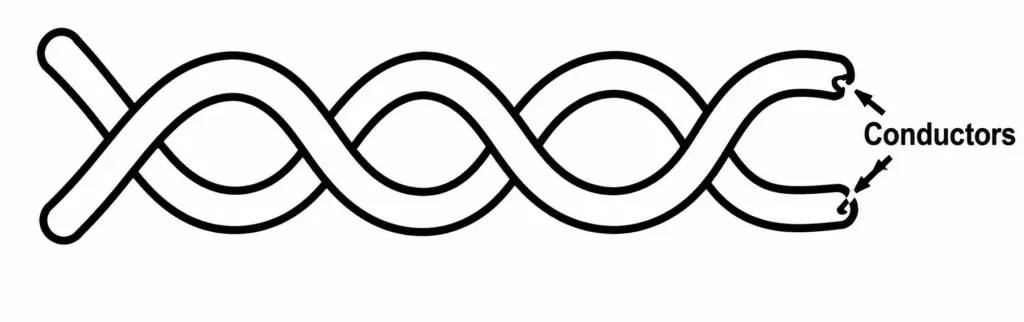
Figure: Two Conductors Twisted Together
Working of Twisted Pair Cable
Twisted pair cable transmits data in the form of electrical signals through two insulated copper wires twisted around each other. These wires carry electrical signals from the transmitting device to the receiving device. The twisting arrangement helps reduce electromagnetic interference (EMI), external noise, and crosstalk, thereby improving the quality of data transmission.
The working of twisted pair cable is based on the transmission of electrical signals through copper conductors. When a device sends information, digital data is converted into electrical signals. These signals travel through the twisted wires and are received by another device, where they are interpreted and converted back into digital information.
Step-by-Step Working Process
1. Signal Generation
- The transmitting device, such as a computer or router, generates digital data that needs to be transferred.
- A network interface converts this data into suitable electrical signals.
- These signals represent the information being transmitted from one device to another.
2. Signal Transmission
- The electrical signals travel through the two copper conductors inside the cable.
- The two wires carry complementary electrical signals in a balanced transmission system.
- This allows information to travel from the sender to the receiver through the cable.
3. Noise and Interference Reduction
- The two copper wires are twisted around each other to reduce the effects of external electromagnetic interference.
- Twisting helps both wires experience similar unwanted interference, which can be rejected by the receiving equipment.
- It also reduces crosstalk, which occurs when signals from one wire pair interfere with signals in another pair.
4. Signal Reception
- The receiving device detects the electrical signals arriving through the twisted pair cable.
- Its network interface receives and processes the signals.
- The receiving equipment detects the difference between the signals carried by the two conductors.
5. Data Recovery
- The receiving device interprets the received electrical signals.
- It converts them back into digital data.
- The recovered information is then delivered to the appropriate application or network component.
Overall, twisted pair cable enables communication between network devices by carrying electrical signals through copper wires. Its twisted structure helps minimize unwanted interference and maintain reliable data transmission.
Types of Twisted Pair Cable
Twisted pair cables are mainly classified into two types based on the presence or absence of additional metallic shielding. Both types consist of twisted copper wire pairs, but they differ in their construction, interference protection, cost, and applications.
1. Unshielded Twisted Pair (UTP):
Unshielded Twisted Pair (UTP) cable consists of multiple pairs of insulated copper wires twisted around each other without any additional metallic shielding. The twisting arrangement helps reduce electromagnetic interference and crosstalk during data transmission.
UTP cables are widely used in computer networks because they are lightweight, flexible, affordable, and easy to install. They are commonly found in homes, offices, telephone systems, and Ethernet networks.
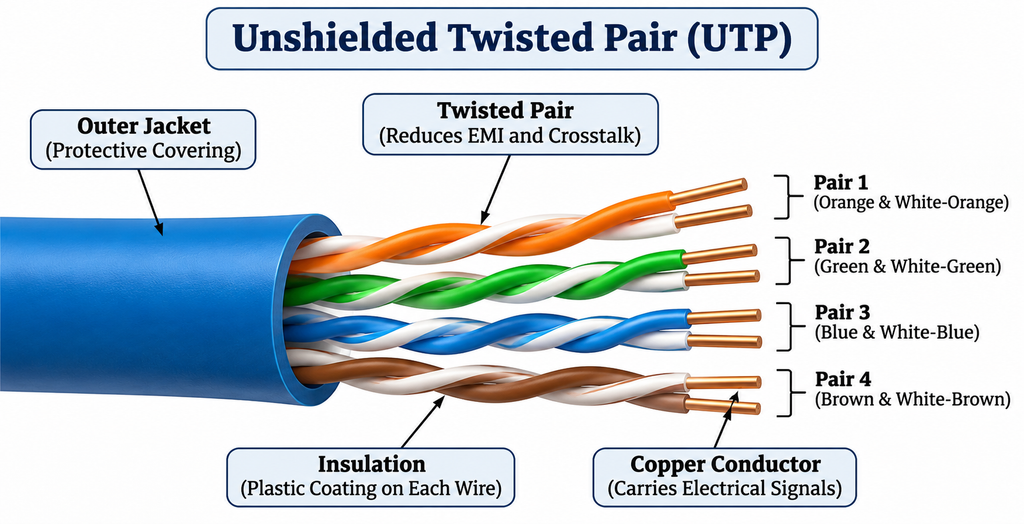
Figure: Unshielded Twisted Pair Cable
Characteristics of UTP:
- No Additional Shielding: Does not contain metallic foil or braided shielding around the wire pairs.
- Low Cost: Less expensive to manufacture and purchase compared to shielded cables.
- Lightweight and Flexible: Easy to bend, handle, and install in buildings.
- Noise Reduction: Twisting helps minimize electromagnetic interference and crosstalk.
- Easy Maintenance: Simple construction makes installation, testing, and replacement easier.
Applications of UTP:
- Used in telephone communication systems.
- Commonly used in Ethernet and Local Area Networks (LANs).
- Used for connecting computers, routers, and network switches.
- Widely used in home and office networking.
2. Shielded Twisted Pair (STP):
Shielded Twisted Pair (STP) cable consists of twisted copper wire pairs covered with additional metallic shielding, such as aluminium foil or braided metal. This shielding protects the wires from external electromagnetic interference and reduces unwanted noise during data transmission.
STP cables are generally used in environments where electrical interference is high and reliable signal transmission is important. They provide better protection against interference than UTP cables, but they are comparatively expensive and require proper installation and grounding.
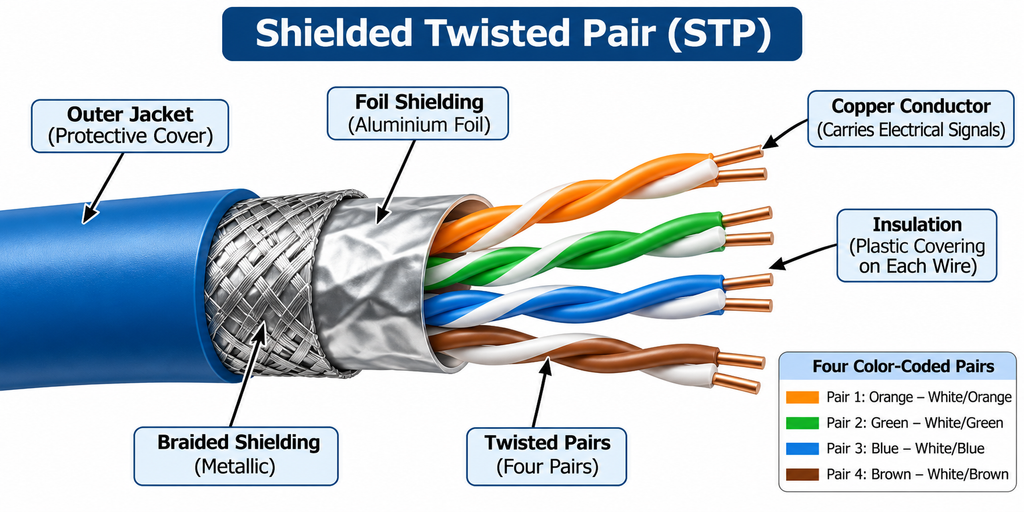
Figure: Shielded Twisted Pair Cable
Characteristics of STP:
- Additional Shielding: Contains metallic foil or braided shielding around individual pairs or the entire cable.
- Better Interference Protection: Provides additional protection against electromagnetic interference and external noise.
- Reduced Crosstalk: Shielding helps reduce unwanted signal interference between wire pairs.
- Higher Cost: More expensive than UTP because of its additional protective materials.
- Installation Requirements: Requires careful installation and proper grounding to ensure effective shielding.
Applications of STP:
- Used in industrial environments with high electromagnetic interference.
- Used in data centers and commercial networking installations.
- Used in communication systems that require additional interference protection.
- Used in networks installed near electrical equipment and machinery.
Categories of Twisted Pair Cable
Twisted pair cables are classified into different categories based on their frequency, bandwidth, and data transmission speed.
| Category | Frequency | Data Transmission Speed | Common Usage |
|---|---|---|---|
| Cat 1 | Not specified | Voice only | Traditional telephone systems |
| Cat 2 | 1 MHz | 4 Mbps | Older Token Ring networks |
| Cat 3 | 16 MHz | 10 Mbps | Telephone and older Ethernet networks |
| Cat 4 | 20 MHz | 16 Mbps | Older Token Ring networks |
| Cat 5 | 100 MHz | 100 Mbps | Fast Ethernet networks |
| Cat 5e | 100 MHz | 1 Gbps | Home and office networks |
| Cat 6 | 250 MHz | Up to 10 Gbps* | Modern Ethernet networks |
| Cat 6a | 500 MHz | 10 Gbps | Enterprise networks |
| Cat 7 | 600 MHz | 10 Gbps | High-performance network |
Advantages of Twisted Pair Cable
1. Low Cost
Twisted pair cable is less expensive compared to coaxial and optical fiber cables. Its manufacturing process is simple and requires fewer materials. This makes it an economical choice for installing network connections in homes, schools, offices, and other organizations. It helps reduce the overall cost of network installation.
2. Easy Installation
Twisted pair cable is lightweight, flexible, and easy to handle. It can be installed through walls, ceilings, and cable ducts without much difficulty. Its simple construction makes it convenient to connect computers, routers, switches, and other networking devices.
3. Reduced Electromagnetic Interference
The twisting arrangement of copper wires helps reduce electromagnetic interference (EMI) and unwanted electrical noise. It also minimizes crosstalk between adjacent wire pairs. This improves signal quality and helps maintain reliable communication between connected devices.
4. Easy Maintenance
Twisted pair cables have a simple structure, making them easy to inspect, test, and maintain. If a cable becomes damaged, it can be replaced without changing the entire network infrastructure. Standard connectors and testing tools are also readily available, which reduces maintenance time and cost.
5. Supports Voice and Data Communication
Twisted pair cables can transmit both voice signals and digital data. They are widely used in telephone systems, Ethernet networks, and Internet connections. Different cable categories support different transmission speeds and bandwidth requirements, making them useful for various communication applications.
Disadvantages of Twisted Pair Cable
1. Limited Transmission Distance
Twisted pair cables support shorter transmission distances compared to optical fiber cables. As the distance increases, the strength of electrical signals gradually decreases. Additional networking equipment may be required to maintain communication over longer distances.
2. Limited Bandwidth
Twisted pair cables generally provide lower bandwidth than optical fiber cables. Their data transmission capacity depends on the cable category and installation quality. Older categories support lower speeds, making them less suitable for certain high-bandwidth applications.
3. Signal Attenuation
Signal attenuation refers to the gradual reduction in signal strength as it travels through a cable. In twisted pair cables, electrical signals become weaker over longer distances. This can affect data transmission quality and may require additional equipment to maintain reliable communication.
4. Electromagnetic Interference
Twisted pair cables can be affected by electromagnetic fields generated by nearby electrical devices and machinery. Although twisting helps reduce interference, it cannot eliminate it completely. UTP cables are generally more vulnerable to external interference than properly installed STP cables.
5. Security Limitations
Twisted pair cables transmit information through electrical signals, which may be intercepted through unauthorized physical access to the cable. Therefore, additional security measures are required to protect sensitive information. Encryption and proper physical network protection help reduce these risks.
Applications of Twisted Pair Cable
1. Telephone Communication Systems
Twisted pair cables are traditionally used in telephone communication systems to transmit voice signals. They connect telephone devices to telephone exchanges and support communication between users. They are commonly found in traditional landline telephone infrastructure.
2. Local Area Networks (LANs)
Twisted pair cables are widely used to connect computers and other devices within a limited geographical area. They establish wired connections between computers, printers, routers, and network switches. They allow connected devices to share information and network resources in schools, colleges, offices, and organizations.
3. Ethernet Networks
Twisted pair cables are commonly used in Ethernet-based communication systems. They provide wired connections between computers, routers, switches, and servers. Different categories, such as Cat 5e, Cat 6, and Cat 6a, support different data transmission speeds and are used for reliable network communication.
4. CCTV and Security Systems
Twisted pair cables are used in certain CCTV installations to transmit video and control signals. They help connect surveillance cameras to monitoring and recording equipment. They are commonly used in some commercial buildings, offices, and security installations.
5. Industrial Communication Systems
Twisted pair cables are used in industrial environments for communication between sensors, controllers, and monitoring equipment. Shielded twisted pair cables are particularly useful in areas where electrical interference is high. They support the transmission of control signals and monitoring data in industrial automation systems.