In computer networks, data communication plays an important role in exchanging information between two or more devices. Whenever we send a message, share a file, make a video call, or browse a website, data travels from one device to another through a communication channel.
But how does this data travel between connected devices? Does it move in only one direction, or can both devices send and receive data at the same time?
The answer depends on the transmission mode used in the communication system.
Transmission mode refers to the direction in which data is transmitted between two connected devices. It determines whether communication takes place in only one direction, in both directions at different times, or in both directions simultaneously.
In computer networks, transmission modes are generally classified into three main types: Simplex Mode, Half-Duplex Mode, and Full-Duplex Mode. Each mode follows a different communication method depending on how devices send and receive information.
What is Transmission Mode?
Transmission mode is the method or direction in which data is transferred between two or more devices through a communication channel. It defines how information flows from a sender to a receiver and determines whether data can travel in one direction or both directions.
In computer networks, devices communicate by exchanging data through wired or wireless communication channels. Transmission mode explains how this data exchange takes place and whether both devices can send and receive information simultaneously.
For example, in television broadcasting, data travels from the broadcasting station to the television in only one direction. In a telephone conversation, both people can speak and listen at the same time. Similarly, walkie-talkies allow communication in both directions, but only one person can speak at a time.
Transmission mode is important in data communication because it determines the direction of data flow and helps devices exchange information according to their communication requirements.
Types of Transmission Modes
There are three major types of transmission modes used in data communication:
- Simplex Mode
- Half-Duplex Mode
- Full-Duplex Mode
Each mode has a different method of transferring data between devices.
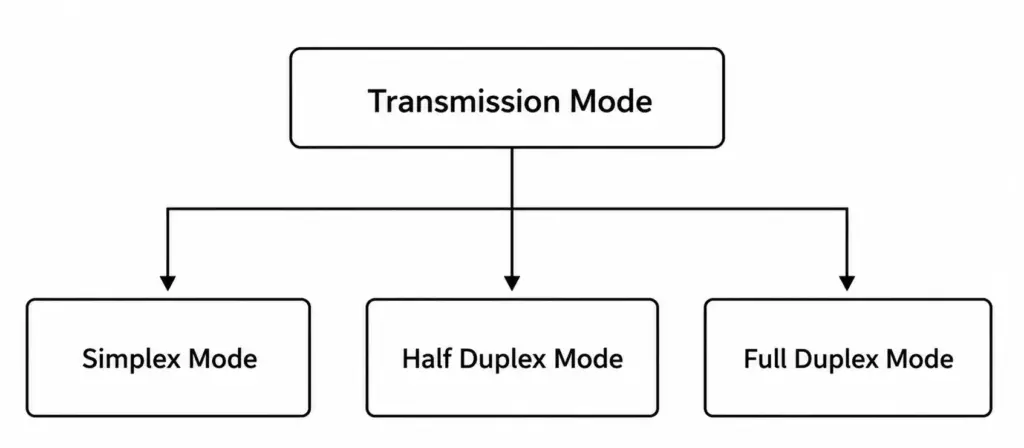
Figure :Transmission mode
1. Simplex Mode
Simplex mode is a type of transmission mode in which data travels in only one direction, from the sender to the receiver. In this mode, the sender can transmit information, but the receiver cannot send a response through the same communication channel.
Here, one device always acts as the sender, while the other acts as the receiver. Data flows in a single direction without any reverse communication. This mode is mainly used in communication systems where information needs to be delivered from one point to another without requiring feedback.
How Does Simplex Mode Work?
In simplex mode, the sender continuously transmits information to the receiving device. The receiving device accepts the information but cannot respond through the same communication channel.
For example, a television broadcasting station sends audio and video signals to televisions. Viewers can receive the broadcast, but their televisions do not send information back to the broadcasting station through that broadcast channel.
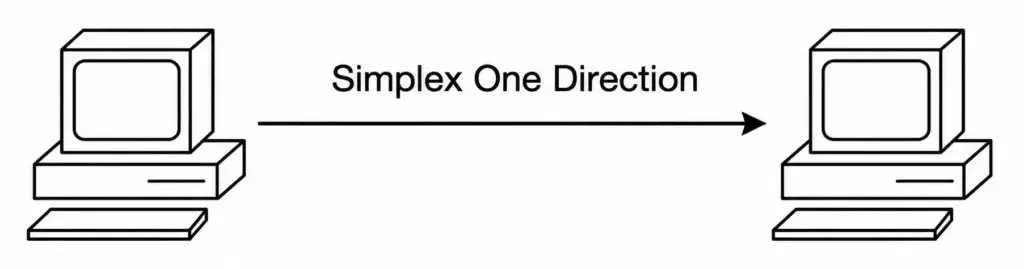
Figure: Simplex mode
Examples of Simplex Mode
- Television broadcasting: A television station sends programs to viewers, but viewers cannot communicate back through the same broadcast channel.
- Radio broadcasting: Radio stations transmit audio signals to listeners in one direction.
- Keyboard to computer (traditional one-way example): A keyboard sends input signals to a computer. This illustrates one-way data flow in a basic communication example.
Advantages of Simplex Mode
- It is simple to design and implement.
- It requires less communication complexity.
- It is useful for broadcasting information to multiple receivers.
Disadvantages of Simplex Mode
- Communication is possible in only one direction.
- The receiver cannot send feedback to the sender through the same channel.
- It is not suitable for applications that require two-way communication.
2. Half-Duplex Mode
Half-duplex mode is a type of transmission mode in which data can travel in both directions between two connected devices, but not at the same time. Both devices can send and receive information, but only one device can transmit data at a time.
In this mode, communication takes place in both directions, but the devices must take turns sending information. When one device is transmitting data, the other device receives it. After the transmission is completed, the second device can send information in the opposite direction.
This process allows both devices to exchange information through the same communication channel without transmitting data simultaneously.
How Does Half-Duplex Mode Work?
In half-duplex mode, one device sends data while the other device receives it. After the first device finishes transmitting, the second device can send its data in the opposite direction.
Both devices can communicate with each other, but simultaneous transmission is not possible.
For example, walkie-talkies use half-duplex communication. When one person speaks, the other person listens. After the first person finishes speaking, the second person can respond.
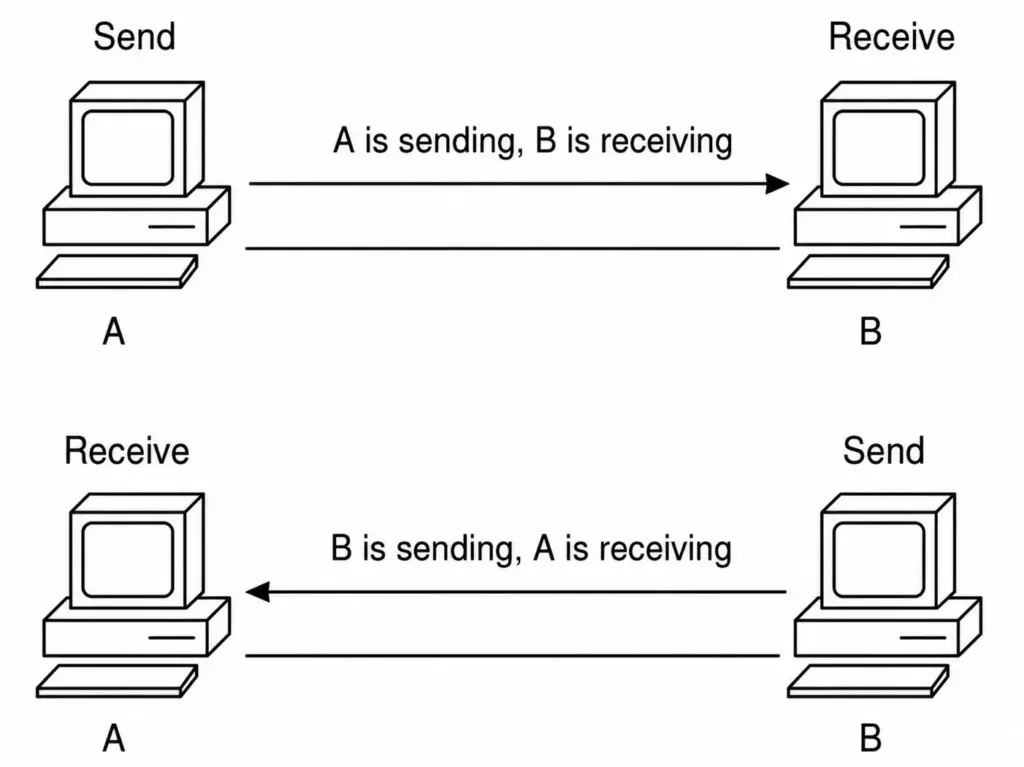
Figure: Half Duplex mode
Examples of Half-Duplex Mode
- Walkie-talkies: Two people can communicate in both directions, but only one person can speak at a time.
- Traditional shared radio communication systems: Users take turns transmitting and receiving messages.
- Certain older communication systems: Some systems allow two-way communication but require devices to take turns transmitting.
Advantages of Half-Duplex Mode
- It supports communication in both directions.
- It is less complex than full-duplex communication.
- It can be useful in systems where simultaneous communication is not necessary.
Disadvantages of Half-Duplex Mode
- Both devices cannot transmit data simultaneously.
- Users must wait for their turn to communicate.
- Communication may take more time when both devices need to exchange information frequently.
3. Full-Duplex Mode
Full-duplex mode is a type of transmission mode in which data can travel in both directions simultaneously between two connected devices. Both devices can send and receive information at the same time without waiting for the other device to finish transmitting.
In this mode, communication takes place continuously in both directions. Unlike half-duplex mode, devices do not need to take turns sending information. Both devices can transmit and receive data simultaneously through a communication channel.
Full-duplex mode improves communication efficiency by reducing waiting time and allowing faster data exchange. It is commonly used in modern communication systems that require continuous two-way communication.
How Does Full-Duplex Mode Work?
In full-duplex mode, both connected devices can transmit and receive information simultaneously.
For example, during a telephone conversation, both people can speak and listen at the same time. One person does not need to wait for the other person to finish speaking before responding.
This makes communication faster and more convenient.
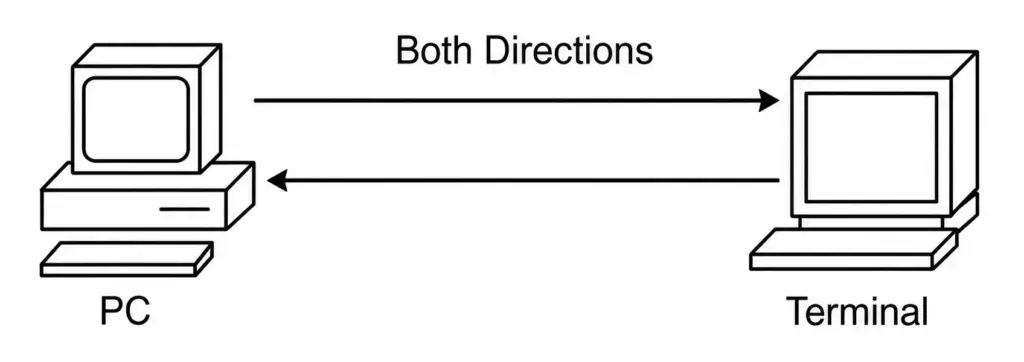
Figure: Full Duplex Mode
Examples of Full-Duplex Mode
- Telephone conversations: Both people can speak and listen simultaneously.
- Video calls: Participants can communicate with each other at the same time.
- Modern switched Ethernet connections: Devices can send and receive data simultaneously over a full-duplex link.
- Mobile communication: Modern cellular communication systems support simultaneous two-way communication using suitable transmission techniques.
Advantages of Full-Duplex Mode
- It allows simultaneous communication in both directions.
- It provides faster and more efficient data exchange.
- It reduces waiting time between transmissions.
Disadvantages of Full-Duplex Mode
- It may require more complex communication hardware and techniques.
- It can be more expensive to implement in certain systems.
- It requires suitable communication channels and mechanisms to support simultaneous data transmission.
Difference Between Simplex, Half-Duplex, and Full-Duplex Modes
The three transmission modes differ mainly in the direction and timing of data transmission.
| Basis | Simplex Mode | Half-Duplex Mode | Full-Duplex Mode |
|---|---|---|---|
| Direction of communication | One direction | Both directions | Both directions |
| Data transmission | One-way only | Two-way, one at a time | Two-way simultaneously |
| Sending and receiving | One device sends, another receives | Devices take turns | Both devices send and receive simultaneously |
| Communication speed | Depends on the channel | May involve waiting time | Supports simultaneous communication |
| Complexity | Simple | Moderate | More complex |
| Example | Television broadcasting | Walkie-talkie | Telephone conversation |
Importance of Transmission Mode in Computer Networks
Transmission modes are important because they determine how information is exchanged between connected devices.
Their importance can be understood through the following points:
- Direction of data flow: They define whether information travels in one direction or both directions.
- Communication efficiency: They help select an appropriate method for exchanging data.
- Network performance: The transmission mode affects how devices communicate and whether they can transmit simultaneously.
- Resource utilization: Different modes use communication channels according to their transmission requirements.
- Application requirements: They help support different communication needs, such as broadcasting, voice calls, and video conferencing.