Communication in computer networks plays a very important role in sharing data between devices. It allows information to travel from one system to another using different transmission methods. These methods decide how data flows, whether in one direction or both directions. As a result, network communication becomes more structured, efficient, and reliable.
In addition, transmission modes help in improving the performance of digital communication systems. They define how sender and receiver interact during data exchange. Along with this, retransmission ensures that lost or damaged data is sent again for correct delivery. Therefore, understanding these concepts is essential for smooth and error-free networking.
What is Retransmission?
Retransmission is a process in computer networks in which the sender sends data again when the original data is lost, corrupted, or not received correctly by the destination. It is an important technique used to improve the reliability and accuracy of data communication between devices.
During data transmission, information is divided into smaller units called packets or segments and transmitted over a network. Sometimes, these packets may be lost due to network congestion, transmission errors, weak connections, or other network problems. In such situations, the receiver may not receive the complete or correct data.
To handle these problems, retransmission is used. When the receiver detects an error or does not receive the expected data within a specific time, it can notify the sender through a negative acknowledgment (NAK) or the absence of an acknowledgment (ACK). The sender then transmits the missing or damaged data again.
How Retransmission Works:
- The sender divides the data into packets or segments and transmits them to the receiver.
- The receiver checks whether the received data is correct and complete.
- If the data is received correctly, the receiver sends an acknowledgment (ACK) to the sender.
- If a packet is lost or corrupted, the receiver may send a negative acknowledgment (NAK), or the sender may identify the problem when an acknowledgment is not received.
- The sender retransmits the missing or damaged data.
- The receiver accepts the correctly received data, and communication continues.
Example:
Suppose a sender transmits five data packets to a receiver. Due to network problems, the third packet gets lost during transmission. The receiver identifies that packet 3 is missing and may request it again. The sender retransmits packet 3, and the receiver combines it with the other packets to obtain the complete data.
Retransmission is commonly used in the TCP (Transmission Control Protocol) to provide reliable data delivery. TCP uses acknowledgments, sequence numbers, and retransmission timers to detect missing data and send it again when necessary.
Therefore, retransmission helps prevent data loss, improves communication reliability, and ensures that the receiver gets the required information correctly and completely.
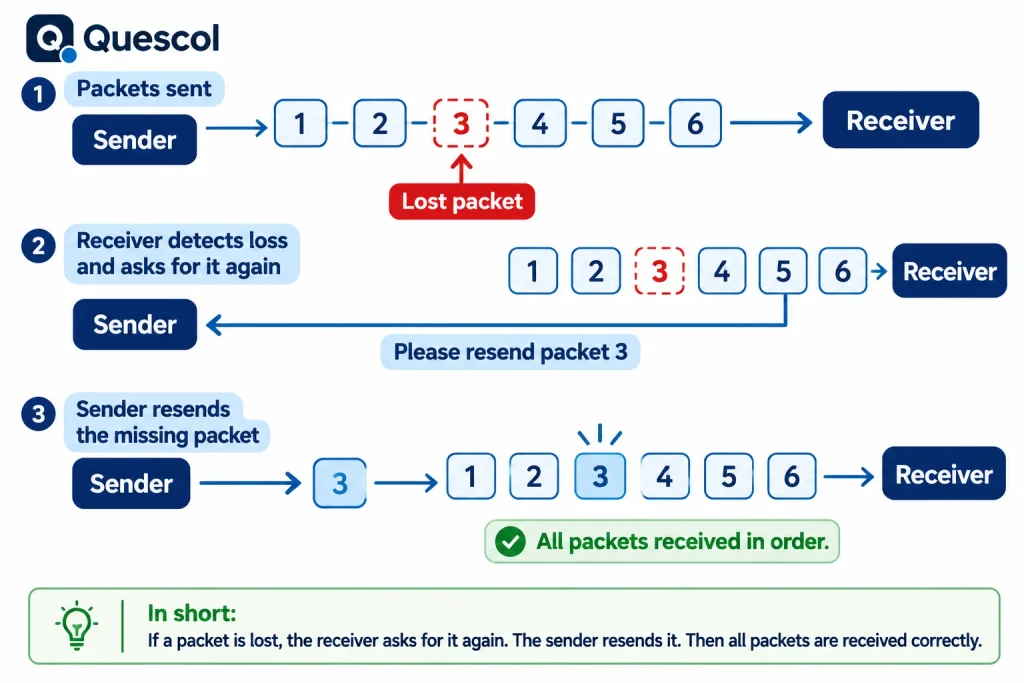
Figure: Retransmission
Types of Retransmission
Retransmission in computer networks is mainly used to ensure that data is delivered correctly and completely. When data is lost or damaged during transmission, different types of retransmission methods are used to resend the information. These methods help improve reliability and reduce communication errors in network systems.
1. Automatic Repeat reQuest (ARQ)
In this type, the receiver detects errors in data and sends a request back to the sender for retransmission. The sender then resends the lost or corrupted packets. It is widely used in reliable communication systems. This method ensures accurate data delivery by repeating transmission only when needed.
2. Stop-and-Wait ARQ
In this method, the sender sends one data frame and waits for an acknowledgment from the receiver. If no acknowledgment is received, the same frame is sent again. It is simple but slower because each frame is sent one at a time. However, it ensures high accuracy in data transfer.
3. Go-Back-N ARQ
In this technique, multiple frames are sent continuously without waiting for acknowledgment. If an error occurs in one frame, that frame and all subsequent frames are retransmitted. It improves speed but may waste bandwidth during errors. It is useful in high-speed networks.
4. Selective Repeat ARQ
In this method, only the incorrect or lost frames are retransmitted instead of all frames. The receiver stores correct frames and requests only missing ones. It is more efficient than Go-Back-N. However, it requires more memory and complex processing.
Factors Affecting Retransmission in Computer Networks
Retransmission in computer networks is influenced by several technical and environmental factors. These factors decide how often packets are resent and how efficiently data is delivered. When these conditions are not stable, retransmission increases, which may affect network performance and speed.
1. Network Congestion
When too many users send data at the same time, the network becomes overloaded. As a result, packets may get delayed or dropped. This increases the need for retransmission to ensure data reaches correctly.
2. Packet Loss
Packet loss occurs when data packets fail to reach the destination. It can happen due to weak signals, faulty hardware, or overloaded routers. Lost packets must be retransmitted to complete the communication.
3. Transmission Errors
Errors during data transfer, such as noise or signal interference, can corrupt packets. When the receiver detects incorrect data, it requests retransmission to maintain accuracy.
4. Timeout Settings
Retransmission depends on the timeout value set in protocols like TCP. If the timeout is too short or too long, it can increase unnecessary retransmissions or delay recovery of lost packets.
5. Network Delay (Latency)
High delay in data delivery can make the sender think that packets are lost. This may trigger retransmission even when packets are just delayed, affecting efficiency.
6. Bandwidth Limitations
Low bandwidth restricts the amount of data that can be transmitted. When bandwidth is limited, packets may be dropped or delayed, leading to more retransmissions.
| Factor | Description | Impact on Retransmission |
|---|---|---|
| Network Congestion | Too many devices send data at the same time, causing overload. | Increases packet loss and leads to frequent retransmission. |
| Packet Loss | Data packets fail to reach the destination due to errors or failures. | Directly causes retransmission to recover missing data. |
| Transmission Errors | Noise or interference corrupts data during transmission. | Receiver requests retransmission of incorrect packets. |
| Timeout Settings | Time limit set for receiving acknowledgment in protocols like TCP. | Incorrect timeout increases unnecessary or delayed retransmissions. |
| Network Delay (Latency) | Delay in sending or receiving data across the network. | May trigger retransmission even when packets are only delayed. |
| Bandwidth Limitations | Limited data capacity of the network. | Causes packet drops, increasing retransmission frequency. |
What is Transmission Mode?
Transmission mode is the method that defines the direction of data flow between two communication devices in a network. It determines how information is sent and received during communication. In computer networks, transmission mode helps devices exchange data efficiently and accurately. It mainly controls whether communication happens in one direction or both directions.
Transmission modes are important for smooth and reliable communication systems. They help improve network performance and data transfer speed. The three main types of transmission modes are simplex, half duplex, and full duplex. These modes are widely used in networking, internet communication, and digital devices.
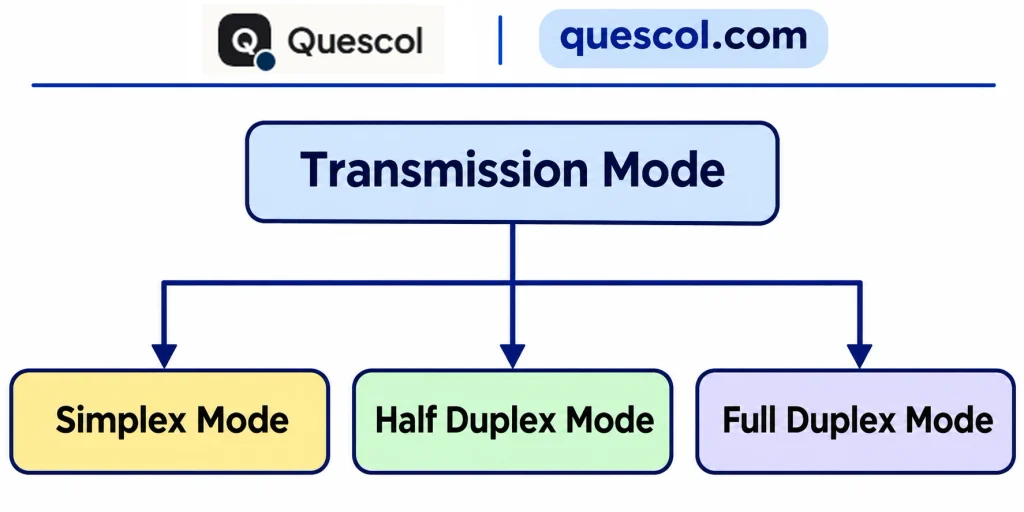
Figure: Modes of Transmission
What is Simplex Transmission?
Simplex transmission is a type of communication mode in which data flows in only one direction, from the sender to the receiver. In this mode, one device always acts as the sender, while the other device always acts as the receiver. The sender can transmit data, but the receiver cannot send any response or feedback to the sender through the same communication channel.
In simplex transmission, communication takes place in a single direction, so there is no possibility of sending information back from the receiver to the sender. This makes the communication process simple and easy to manage. It is mainly used in situations where information needs to be transmitted continuously or displayed to users without requiring a response.
Working of Simplex Transmission:
- One device acts as the sender and generates the data.
- The sender transmits the information through a communication channel.
- The receiving device receives the transmitted information.
- The receiver cannot send data or acknowledgments back to the sender through the same channel.
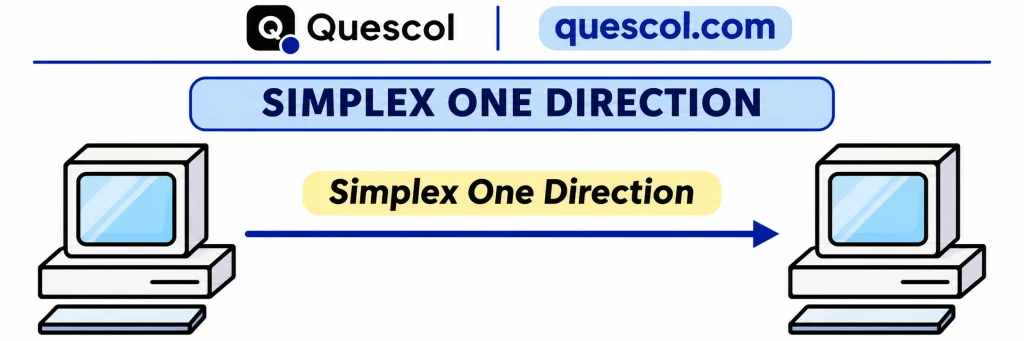
Figure: Simplex
- The image shows Simplex Transmission.
- Data flows in only one direction.
- One computer sends data.
- The other computer only receives data.
- The arrow shows the direction of communication.
- No reply is sent back to the sender.
- It is called one-way communication.
- Example: TV and radio broadcasting.
Advantages of Simplex Transmission
1. Simple and Easy Communication
Simplex transmission uses a one-way communication process, so it is very easy to understand and operate. One device only sends data while the other only receives it. Therefore, the system remains simple and efficient for basic communication needs.
2. Low Cost System
This transmission mode requires less hardware and fewer communication components. As a result, installation and maintenance costs remain low. It is an economical choice for broadcasting and information-sharing systems.
3. No Data Collision
Since communication happens only in one direction, data packets never collide with each other. This improves the stability of data transmission. Thus, the communication process becomes smoother and more reliable.
4. Fast Data Transmission
Simplex mode sends information directly without waiting for any response from the receiver. Because of this, data transfer becomes quick and continuous. It is highly suitable for systems that only need one-way communication.
5. Easy Maintenance
The structure of simplex communication is less complex compared to other transmission modes. Therefore, troubleshooting and maintenance become easier. This reduces technical difficulties and operational effort.
6. Useful for Broadcasting
Simplex transmission is highly effective for radio, television, and public announcement systems. In these systems, information is only delivered to users without feedback. Hence, simplex mode supports smooth broadcasting services.
7. Reduced Network Traffic
As the receiver does not send replies or acknowledgments, network traffic remains low. This helps in better utilization of communication channels. Consequently, the system performs efficiently in one-way communication.
8. Reliable One-Way Communication
Simplex mode provides stable communication when feedback is unnecessary. It continuously transfers data from sender to receiver without interruption. Therefore, it is reliable for monitoring and broadcasting applications.
Disadvantages of Simplex Transmission
1. No Feedback from Receiver
In simplex transmission, the receiver cannot send any response back to the sender. Because of this, the sender never knows whether the data reached correctly or not. Therefore, communication becomes less interactive and less reliable.
2. One-Way Communication Only
This mode supports communication in only one direction. The receiver cannot exchange information with the sender during transmission. As a result, it is not suitable for modern two-way communication systems.
3. Limited Usage
Simplex transmission is mainly useful for broadcasting and monitoring systems. However, most modern applications require two-way communication for better interaction. Therefore, its practical usage is limited in advanced networks.
4. No Error Reporting
The receiver cannot report errors or request retransmission if data gets damaged or lost. This may reduce communication accuracy and reliability. Hence, data transmission problems may remain undetected.
5. Poor Communication Flexibility
Since only one device can transmit data, communication flexibility becomes very low. Users cannot interact or exchange messages in real time. Thus, simplex mode is less adaptable for dynamic communication needs.
6. Inefficient for Interactive Systems
Applications like video calls, online chatting, and customer support require instant responses. Simplex transmission cannot support such interactive communication. Therefore, it is not suitable for real-time communication systems.
7. Wastage of Communication Resources
In some situations, the receiver remains idle because it cannot transmit any information. This may lead to inefficient use of communication channels. As a result, system resources are not fully utilized.
8. Lower Reliability
Without acknowledgments or feedback, the sender cannot confirm successful data delivery. This decreases overall communication reliability. Hence, simplex mode is less dependable for critical communication systems.
Applications of Simplex Transmission
1. Television Broadcasting
Television broadcasting uses simplex transmission to send audio and video signals from TV stations to viewers. The television only receives information and cannot send responses back to the broadcaster. Therefore, simplex mode is highly suitable for one-way entertainment services.
2. Radio Broadcasting
Radio stations transmit music, news, and programs to listeners using simplex communication. In this system, listeners only receive signals through their radios. Thus, communication happens smoothly in one direction without interruption.
3. Keyboard and Computer Communication
A computer keyboard sends data to the computer whenever a user presses a key. The keyboard acts as the sender, while the computer receives the input. Hence, simplex transmission supports basic input communication effectively.
4. Public Announcement Systems
Public announcement systems in schools, railway stations, and airports use simplex mode to deliver information. Announcements are sent from microphones to speakers without any response from listeners. Therefore, it is useful for mass information sharing.
5. Traffic Signal Systems
Traffic lights send signals and instructions to drivers and pedestrians in one direction. Vehicles and people only receive the information shown by the signals. As a result, simplex transmission helps in maintaining road safety and traffic control.
6. Sensor Devices
Many sensor systems use simplex communication to transmit data to monitoring devices. For example, temperature or smoke sensors only send information to control systems. Thus, simplex mode supports continuous monitoring applications.
7. Digital Display Boards
Digital display boards at bus stands, airports, and shopping malls display information to the public. These boards only provide updates without receiving responses from viewers. Therefore, simplex transmission is ideal for information display systems.
8. CCTV Monitoring Systems
Some CCTV systems transmit video signals from cameras to monitoring screens in one direction. The monitoring device receives footage without sending data back to the camera. Hence, simplex communication helps in surveillance and security applications.
What is Half Duplex Transmission?
Half-duplex transmission is a communication mode in which data can flow in both directions between two devices, but not at the same time. In this mode, both devices can send and receive data, but they must take turns communicating with each other.
At a particular moment, one device acts as the sender while the other device acts as the receiver. After completing the transmission, they can switch their roles. This allows communication to take place in both directions using the same communication channel.
Half-duplex transmission is more flexible than simplex transmission because it supports two-way communication. However, it is slower than full-duplex transmission because both devices cannot transmit data simultaneously.
It is commonly used in communication systems where devices need to exchange information by taking turns sending and receiving data.
Working of Half-Duplex Transmission:
- Two devices are connected through a communication channel.
- The first device starts sending data while the second device receives it.
- After the first device completes its transmission, it stops sending data.
- The second device then starts transmitting data, and the first device receives it.
- Both devices continue communicating by taking turns sending and receiving information.
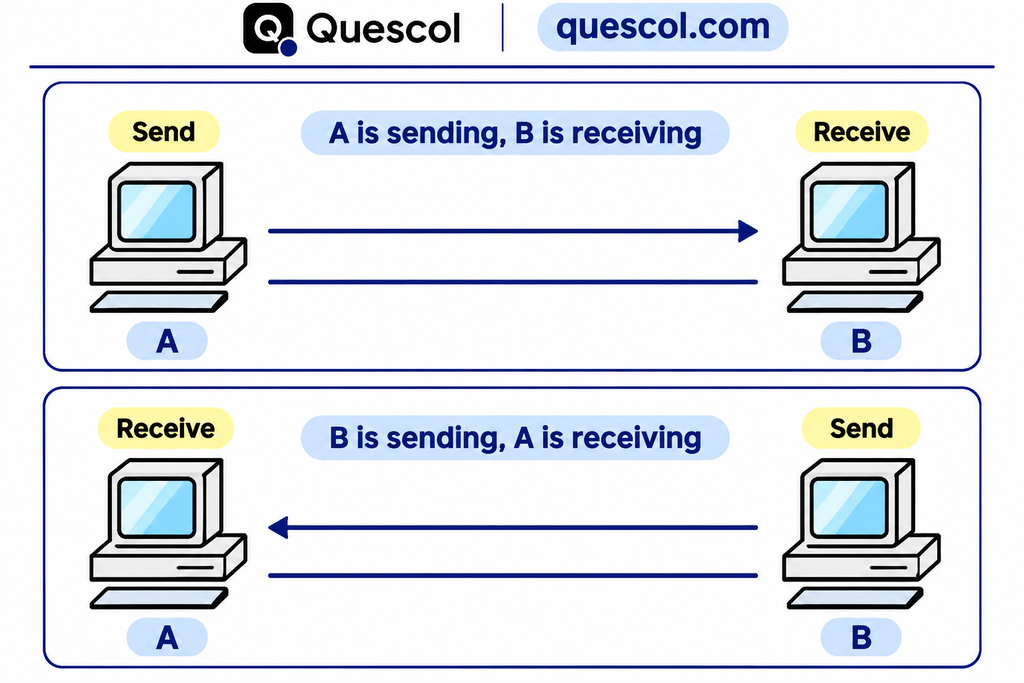
Figure: Half Duplex
- The image shows Half Duplex Transmission.
- Data flows in both directions, but not at the same time.
- In the first step, A sends data and B receives data.
- In the second step, B sends data and A receives data.
- Only one device can send data at a time.
- Devices take turns for communication.
- It is called two-way alternate communication.
- Example: Walkie-talkie communication.
Advantages of Half Duplex Transmission
1. Supports Two-Way Communication
Half duplex transmission allows both devices to send and receive data. However, communication takes place one direction at a time. Therefore, users can exchange information effectively when continuous communication is not required.
2. Cost-Effective System
This communication mode requires less complex hardware compared to full duplex systems. As a result, installation and maintenance costs remain lower. Hence, it becomes an economical choice for many communication networks.
3. Better Use of Communication Channel
Both sender and receiver share the same communication channel for transmitting data. This helps in efficient channel utilization without needing separate paths. Therefore, network resources are used more effectively.
4. Simple Network Design
Half duplex systems have a simpler design compared to full duplex communication. Because of this, setup and management become easier. Thus, organizations can implement communication systems without much complexity.
5. Reduced Data Collision
Only one device transmits data at a particular time in half duplex communication. This reduces the chances of simultaneous data collision. As a result, communication remains more organized and stable.
6. Suitable for Controlled Communication
Half duplex works well in systems where users communicate one after another. It allows clear and disciplined communication between devices. Therefore, it is highly useful in military and security communication systems.
7. Lower Bandwidth Requirement
This transmission mode does not require separate bandwidth for sending and receiving simultaneously. Hence, bandwidth usage remains lower than full duplex systems. This makes it suitable for smaller communication networks.
8. Reliable for Short Communication
Half duplex communication performs efficiently for short message exchanges. It ensures proper delivery of information when communication is not continuous. Thus, it supports reliable communication in limited data transfer systems.
Disadvantages of Half Duplex Transmission
1. Communication Delay
In half duplex transmission, only one device can send data at a time. The other device must wait before replying. Therefore, communication becomes slower compared to full duplex systems.
2. Cannot Support Simultaneous Communication
Both users cannot communicate at the same moment in this transmission mode. This limitation reduces communication efficiency during real-time interaction. Hence, it is not ideal for continuous conversations.
3. Lower Speed
Since devices communicate alternately, the overall data transfer speed becomes lower. Frequent waiting time affects communication performance. As a result, network efficiency decreases in high-traffic situations.
4. Waiting Time for Users
One user must stop transmitting before the other can start sending data. This creates delays and interrupts smooth communication flow. Therefore, users may experience inconvenience during conversations.
5. Less Efficient for Heavy Data Transfer
Half duplex systems cannot handle large amounts of simultaneous data traffic efficiently. Continuous switching between sending and receiving affects performance. Thus, it is less suitable for modern high-speed networks.
6. Chances of Communication Interruption
If devices fail to switch communication properly, interruptions may occur. This can reduce communication quality and create confusion between users. Hence, communication may become unstable at times.
7. Lower Productivity
In environments that require instant communication, half duplex may slow down work processes. Employees or users need to wait for their turn to communicate. As a result, productivity may decrease in fast-paced systems.
8. Limited Modern Usage
Most modern communication technologies prefer full duplex systems for faster interaction. Therefore, half duplex transmission is less common in advanced networking environments. Its usage remains limited to specific applications.
Applications of Half Duplex Transmission
1. Walkie-Talkies
Walkie-talkies use half duplex communication for voice transmission between users. One person speaks while the other listens before replying. Therefore, communication happens in turns for smooth information exchange.
2. Police Communication Systems
Police departments use half duplex systems for secure and organized communication. Officers communicate one at a time to avoid confusion during important operations. Thus, it supports disciplined communication effectively.
3. Military Communication
Military communication devices often use half duplex transmission in field operations. Soldiers exchange messages in sequence for better coordination. Hence, it provides reliable communication in defense systems.
4. Amateur Radio Systems
Ham radio operators use half duplex communication to share messages over radio frequencies. Users take turns speaking and listening during communication. Therefore, it helps maintain clear radio communication.
5. Traditional Ethernet Networks
Older Ethernet networks used half duplex mode for data transfer between devices. Devices transmitted data one direction at a time over shared channels. As a result, network communication remained controlled and organized.
6. Wireless Communication Devices
Some wireless communication systems use half duplex mode for efficient channel sharing. Devices alternate between transmitting and receiving signals. Thus, communication resources are utilized effectively.
7. Intercom Systems
Certain intercom systems use half duplex communication in offices and security systems. One user speaks while the other listens before responding. Therefore, communication remains clear and manageable.
8. Air Traffic Communication
Air traffic controllers and pilots use half duplex radio systems for communication. Only one side communicates at a time to avoid message overlap. Hence, it ensures safe and clear communication in aviation systems.
What is Full Duplex Transmission?
Full-duplex transmission is a communication mode in which data can flow in both directions simultaneously between two connected devices. In this mode, both devices can send and receive information at the same time without waiting for the other device to finish transmitting.
Unlike simplex and half-duplex transmission, full-duplex transmission supports continuous two-way communication. It makes data exchange faster, smoother, and more efficient because both devices can communicate simultaneously.
Full-duplex transmission may use separate communication channels for sending and receiving data or techniques that allow both directions to share the same physical medium without interfering with each other.
It is widely used in modern communication systems where continuous and real-time communication is required, such as telephone networks, video calls, and modern Ethernet networks.
Working of Full-Duplex Transmission:
- Two devices are connected through a communication channel.
- Both devices can start transmitting data at the same time.
- Each device can send information while receiving data from the other device.
- Data flows continuously in both directions without requiring either device to wait for its turn.
- Both devices can communicate simultaneously, making the transmission process faster and more efficient.
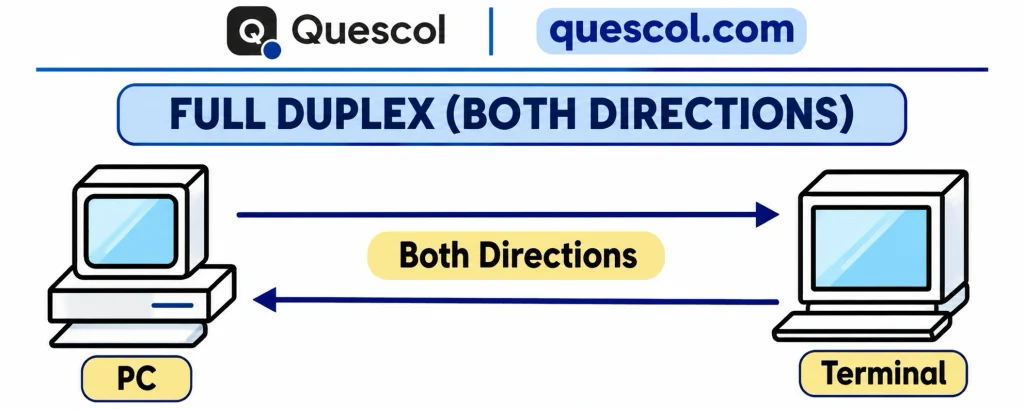
Figure: Full Duplex
- The image shows Full Duplex Transmission.
- Data flows in both directions at the same time.
- The PC and terminal can send and receive data simultaneously.
- Two arrows represent two-way communication.
- No waiting is needed for sending data.
- Communication is fast and efficient.
- It supports real-time interaction.
- Example: Mobile phone and video calls.
Advantages of Full Duplex Transmission
1. Simultaneous Communication
Full duplex transmission allows both sender and receiver to communicate at the same time. There is no need to wait for turns during communication. Therefore, communication becomes faster and more efficient.
2. High Data Transfer Speed
Since data flows in both directions simultaneously, transmission speed increases significantly. This improves overall network performance and communication quality. Thus, full duplex is suitable for high-speed communication systems.
3. Better Communication Efficiency
Users can send and receive information continuously without interruption. This reduces delays and improves the flow of communication. As a result, conversations become smoother and more natural.
4. No Waiting Time
In full duplex mode, devices do not need to pause before transmitting data. Both devices work together at the same moment. Therefore, users experience real-time communication without delay.
5. Reduced Data Collision
Full duplex systems use separate communication channels for sending and receiving data. Because of this, data packets do not collide during transmission. Hence, communication becomes more stable and reliable.
6. Improved Network Performance
Continuous two-way communication increases the efficiency of network operations. It supports faster processing and better resource utilization. Thus, modern networks achieve higher performance with full duplex transmission.
7. Suitable for Real-Time Applications
Applications like video conferencing and online gaming require instant communication. Full duplex transmission supports these applications effectively. Therefore, it is ideal for real-time communication systems.
8. Better User Experience
Users can interact naturally without interruptions during communication. This creates smooth and comfortable conversations in digital systems. As a result, full duplex improves overall user satisfaction.
Disadvantages of Full Duplex Transmission
1. High Implementation Cost
Full duplex systems require advanced hardware and separate communication channels. Because of this, installation and maintenance costs become higher. Therefore, it is more expensive than simplex and half duplex systems.
2. Complex System Design
The design of full duplex communication systems is more complicated. Managing simultaneous data transmission requires advanced technology. Hence, system setup and troubleshooting become more difficult.
3. Higher Bandwidth Requirement
Full duplex transmission needs more bandwidth to support two-way simultaneous communication. This increases network resource consumption. As a result, efficient bandwidth management becomes necessary.
4. Expensive Hardware Devices
Devices used in full duplex systems are generally more advanced and costly. High-quality transmitters and receivers are needed for smooth communication. Therefore, equipment expenses increase significantly.
5. Increased Power Consumption
Continuous simultaneous communication may consume more electrical power. This can affect battery life in portable communication devices. Thus, energy consumption becomes a concern in some systems.
6. Difficult Maintenance
Because of the complex architecture, maintaining full duplex systems can be challenging. Technical experts are often required for repairs and monitoring. Hence, maintenance becomes more time-consuming.
7. Risk of Signal Interference
If communication channels are not properly managed, signal interference may occur. This can reduce communication quality and system performance. Therefore, proper network management is essential.
8. Not Necessary for Small Systems
Small communication systems may not require simultaneous data transmission. In such cases, full duplex becomes unnecessarily expensive and complex. Thus, simpler transmission modes may be more practical.
Applications of Full Duplex Transmission
1. Mobile Phone Communication
Mobile phones use full duplex transmission for voice calls and video calls. Both users can speak and listen at the same time during communication. Therefore, conversations become smooth and natural.
2. Video Conferencing Systems
Applications like Zoom and Google Meet use full duplex communication for real-time interaction. Participants can talk and hear others simultaneously. Thus, online meetings become more effective and interactive.
3. Modern Ethernet Networks
Modern computer networks use full duplex mode for high-speed data transfer. Devices send and receive data simultaneously without collision. Hence, network performance improves significantly.
4. Online Gaming
Online multiplayer games require instant communication between players and servers. Full duplex transmission supports continuous real-time data exchange. Therefore, gaming experiences become faster and more responsive.
5. Telephone Networks
Telephone communication systems use full duplex mode for smooth conversations. Both people can communicate together without waiting for turns. As a result, communication feels natural and uninterrupted.
6. Internet Communication
Internet services like chatting, streaming, and cloud computing use full duplex communication. Data flows continuously between users and servers. Thus, internet performance and speed improve greatly.
7. Banking and ATM Networks
Banking systems require fast and secure communication between devices and servers. Full duplex transmission helps in processing transactions instantly. Therefore, banking operations become reliable and efficient.
8. Satellite Communication
Satellite communication systems use full duplex mode for simultaneous data exchange. Ground stations and satellites communicate continuously in real time. Hence, it supports global communication services effectively.