Piggybacking is an important technique used in computer networks to improve the efficiency of data transmission. It is mainly used in bidirectional communication, where two devices exchange information with each other.
During data communication, the receiver must send an acknowledgment (ACK) to inform the sender that the transmitted frame has been received successfully. Normally, this acknowledgment is sent as a separate frame.
However, sending a separate acknowledgment for every received frame increases network traffic and consumes additional bandwidth. To reduce this overhead, the piggybacking technique is used.
In piggybacking, the receiver temporarily holds the acknowledgment and combines it with its own outgoing data frame. This allows data and acknowledgment information to be transmitted together in a single frame.
Therefore, piggybacking reduces the number of separate acknowledgment frames and makes better use of the available communication channel.
Definition of Piggybacking
Piggybacking is a technique used in the Data Link Layer in which an acknowledgment for a received data frame is attached to an outgoing data frame instead of being transmitted separately.
It is commonly used in full-duplex or bidirectional communication, where both devices can send and receive data.
The acknowledgment information is generally included in the header of the outgoing frame. This allows a single frame to carry both data and acknowledgment information.
Main purpose: To reduce acknowledgment overhead, improve bandwidth utilization, and increase the efficiency of data communication.
Need for Piggybacking
Piggybacking is introduced to make data transmission more efficient, especially when two devices communicate in both directions.
The main reasons for using piggybacking are:
- Reduction in Separate ACK Frames: In normal communication, every received frame may require a separate acknowledgment. Piggybacking combines the acknowledgment with an outgoing data frame.
- Efficient Bandwidth Utilization: It reduces the bandwidth consumed by separate acknowledgment frames and allows the communication channel to be used more effectively.
- Reduction in Network Traffic: Combining data and acknowledgment information reduces the total number of frames transmitted.
- Improved Communication Efficiency: Both data and acknowledgment information can be delivered in one transmission.
- Support for Bidirectional Communication: It is particularly useful when two devices regularly exchange data with each other.
- Reduced Protocol Overhead: It avoids transmitting separate frames only for acknowledgment information.
Working of Piggybacking
Piggybacking works by combining acknowledgment information with outgoing data frames during bidirectional communication.
The process takes place as follows:
Step 1: Data Transmission from Sender
Device A sends a data frame to Device B. The frame contains the required information and a sequence number to identify it.
Step 2: Frame Reception
Device B receives the data frame and checks whether it has been received correctly. It processes the frame and prepares an acknowledgment.
Step 3: Acknowledgment Preparation
Device B prepares an ACK to inform Device A that its data frame has been received successfully.
Step 4: Waiting for Outgoing Data
Instead of immediately sending a separate acknowledgment frame, Device B waits for a short period to check whether it has any data to transmit to Device A.
Step 5: Combining Data and ACK
If Device B has outgoing data, it attaches the acknowledgment information to that data frame. Thus, the frame contains both outgoing data and acknowledgment information.
Step 6: Transmission of Combined Frame
Device B transmits the combined frame to Device A through the communication channel.
Step 7: Acknowledgment Reception
Device A receives the combined frame. It extracts the acknowledgment information and understands that its previously transmitted frame has been successfully received.
Step 8: Continuous Communication
The same process continues in the opposite direction. Both devices can combine acknowledgments with their outgoing data frames whenever possible.
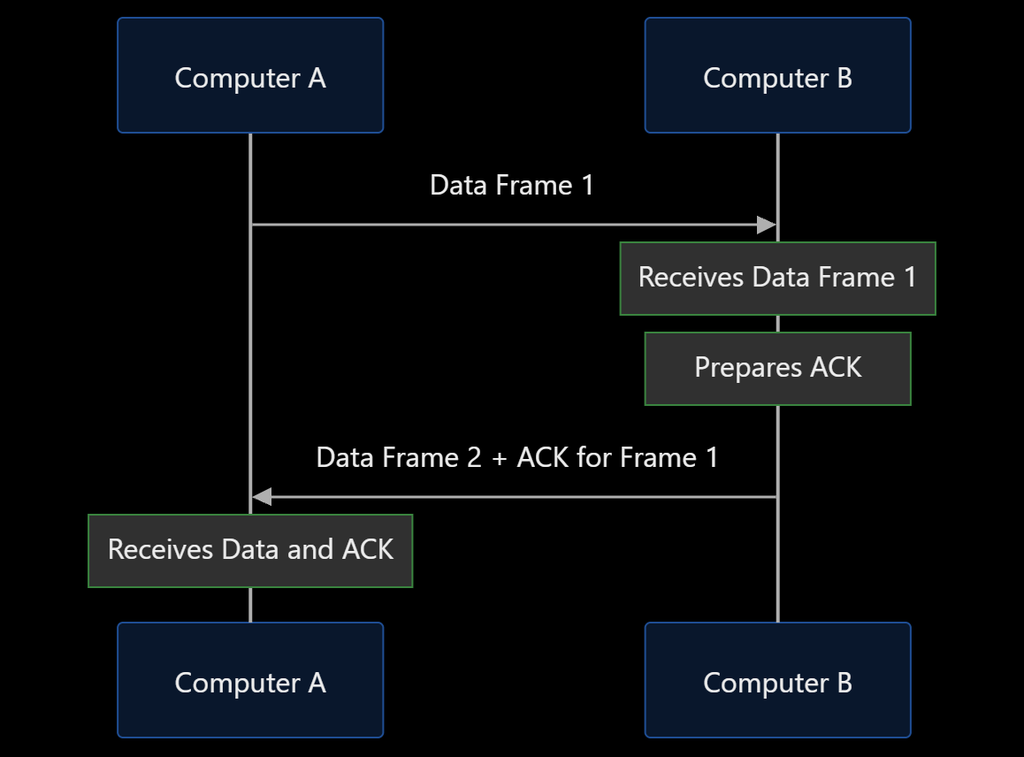
Figure: Working of Piggybacking
Important Components of Piggybacking
Piggybacking involves several important components that work together to combine data transmission and acknowledgment information. These components help maintain reliable communication, control data flow, and reduce unnecessary transmissions between devices.
1. Sender
- The sender is the device that transmits data frames to another device through a communication channel.
- It prepares data frames containing the information to be transmitted.
- Each frame is generally assigned a sequence number to identify it.
- The sender keeps track of transmitted frames and waits for acknowledgments from the receiver.
- After receiving the acknowledgment, it understands that the corresponding data has been successfully received.
2. Receiver
- The receiver is the device that accepts data frames transmitted by the sender.
- It checks the received frames to determine whether they have arrived correctly.
- After receiving a valid frame, it prepares an acknowledgment to inform the sender.
- If the receiver also has data to transmit, it combines the acknowledgment with its outgoing data frame.
- This helps reduce the need for separate acknowledgment frames.
3. Data Frame
- A data frame is the basic unit used to carry information between communicating devices.
- It contains the actual data being transmitted from one device to another.
- It generally includes header information, source and destination addresses, and error-checking information.
- In piggybacking, the outgoing data frame also carries acknowledgment information.
- Therefore, a single frame can perform two functions: carrying data and acknowledging previously received data.
4. Acknowledgment (ACK)
- An acknowledgment is a control message sent by the receiver to confirm the successful reception of a data frame.
- It informs the sender that the transmitted information has been received correctly.
- In normal acknowledgment methods, the ACK is transmitted as a separate frame.
- In piggybacking, the ACK information is attached to an outgoing data frame.
- This reduces the number of separate acknowledgment transmissions and improves communication efficiency.
5. Sequence Number
- A sequence number is a unique identifier assigned to each data frame during transmission.
- It helps the sender and receiver identify individual frames.
- The receiver uses sequence numbers to maintain the correct order of received frames.
- They also help identify missing or duplicate frames.
- In piggybacking, sequence numbers help track transmitted data and associate acknowledgments with the appropriate frames.
6. Acknowledgment Number
- An acknowledgment number indicates the next frame expected by the receiver or the data successfully received, depending on the protocol.
- It helps the sender understand which data has been received successfully.
- The acknowledgment number is included in the control information of an outgoing frame.
- When piggybacking is used, this information is transmitted along with the outgoing data.
- It helps maintain proper synchronization between communicating devices.
7. Communication Channel
- A communication channel is the medium through which data frames and acknowledgment information travel between devices.
- It can be a wired or wireless communication medium.
- Both communicating devices use the channel to exchange data and acknowledgments.
- Piggybacking helps reduce separate acknowledgment transmissions over the channel.
- This improves the utilization of available communication resources.
8. Timer
- A timer is used to monitor the time taken to receive an acknowledgment.
- When a sender transmits a data frame, it waits for the corresponding acknowledgment within a specified time.
- In piggybacking, the receiver may temporarily delay the acknowledgment while waiting for outgoing data.
- If no outgoing data is available within the permitted waiting time, the receiver sends a separate acknowledgment.
- This prevents excessive acknowledgment delays and unnecessary retransmissions.
Advantages of Piggybacking
Piggybacking provides several advantages in bidirectional data communication.
- Reduced Network Overhead: Combines acknowledgment information with outgoing data, reducing the need for separate ACK frames.
- Better Bandwidth Utilization: Uses the available communication channel more efficiently by reducing separate acknowledgment transmissions.
- Improved Transmission Efficiency: Allows data and acknowledgment information to be transmitted together.
- Reduced Network Traffic: Minimizes the number of acknowledgment-only frames exchanged between devices.
- Efficient Bidirectional Communication: Supports communication systems in which both devices frequently send and receive data.
- Reduced Frame Transmission: Decreases the total number of separate frames required for communication.
- Better Resource Utilization: Reduces unnecessary use of communication resources for acknowledgment-only transmissions.
Disadvantages of Piggybacking
Although piggybacking improves communication efficiency, it also has certain limitations.
- Acknowledgment Delay: The receiver may need to wait for outgoing data before sending the acknowledgment.
- Timeout Problems: If an acknowledgment is delayed for too long, the sender’s timer may expire and cause unnecessary retransmission.
- Implementation Complexity: Requires proper management of acknowledgment information and transmission timing.
- Not Suitable for One-Way Communication: It provides limited benefits when data is transmitted mainly in one direction.
- Dependence on Outgoing Data: Piggybacking is useful only when the receiver has data to send back.
- Additional Buffering: The receiver may need to temporarily hold acknowledgment information while waiting for outgoing data.
- Performance Issues: Improper acknowledgment delays can affect the overall communication performance.
Applications of Piggybacking
Piggybacking is useful in communication systems where devices exchange data in both directions.
- Data Link Layer Protocols: Used in protocols such as HDLC to combine acknowledgment information with outgoing data frames.
- Full-Duplex Communication: Helps devices exchange data and acknowledgment information in both directions.
- Computer Networks: Reduces acknowledgment overhead during bidirectional data transmission.
- Wireless Communication: Can reduce the number of separate control transmissions in suitable bidirectional communication protocols.
- Reliable Data Transfer: Supports acknowledgment management in protocols that use sliding window mechanisms.
- Point-to-Point Communication: Helps two directly connected devices exchange data efficiently.