Email communication has become an important part of daily life because people use emails for business, education, banking, and personal communication. Earlier email systems could send only simple text messages through SMTP. However, users soon needed better features such as file attachments, images, audio, and video sharing. Therefore, a more advanced email format became necessary for modern communication.
To solve this problem, MIME was introduced as an extension of SMTP. MIME improved the way emails worked because it allowed different types of multimedia content inside an email message. In addition, MIME made email communication more flexible, faster, and user-friendly. Today, almost every email service uses MIME to support attachments and rich content.
What is MIME?
MIME stands for Multipurpose Internet Mail Extensions. It is an Internet standard that extends the capabilities of the Simple Mail Transfer Protocol (SMTP) by allowing email messages to contain different types of content, including text, images, audio, video, documents, and other file attachments.
Originally, SMTP was designed mainly to transfer text-based email messages using a limited character set. It did not directly support sending multimedia content or files in their original binary formats. MIME was introduced to overcome these limitations and make email communication more flexible.
MIME provides a standard way to identify different types of email content and represent non-text data in a format suitable for email transmission. It uses information in email headers, such as MIME-Version, Content-Type, and Content-Transfer-Encoding, to describe the content and how it is represented.
For example, when a user sends an email containing a PDF document, MIME identifies the attachment as a PDF file and specifies how its data is encoded for transmission. The receiver’s email application uses this information to decode and display or download the attachment correctly.
Moreover, MIME supports different character sets and HTML-formatted messages, allowing users to exchange emails in multiple languages and with rich formatting.
Therefore, MIME plays an important role in modern email communication by extending SMTP to support multimedia content, file attachments, and different text formats.
Important Features of MIME
1. Full Form: MIME stands for Multipurpose Internet Mail Extensions.
2. Internet Standard: MIME is an Internet standard used to extend the content capabilities of email communication systems.
3. Extends SMTP: It extends the capabilities of SMTP, which was originally designed mainly for transferring text-based email messages.
4. Multimedia Support: MIME allows users to send different types of multimedia content, such as images, audio, and video, through email messages.
5. File Attachments: It supports file attachments such as PDF files, Word documents, spreadsheets, images, audio files, and video files.
6. Multiple Character Sets: MIME supports different character sets, allowing users to send and receive emails written in different languages, including languages that use non-ASCII characters.
7. Binary Data Encoding: It provides encoding methods such as Base64 and Quoted-Printable to represent non-text data or special text characters in a form suitable for email transmission.
8. HTML and Rich Text Support: MIME allows email messages to contain HTML content, including formatted text, hyperlinks, colors, and images. It also supports plain-text and HTML alternatives within the same email.
9. Multiple Attachments: It allows users to include multiple attachments in a single email message using the multipart message structure.
10. Content Identification: MIME uses content types and subtypes to identify the format of email content, helping the receiver’s email application process the message correctly.
11. Content Separation: It allows an email message to contain different parts, such as plain text, HTML content, and file attachments, within a single message.
12. Improved Email Communication: MIME makes email communication more flexible and useful by supporting multimedia content, different languages, and various file formats.
Example of MIME in Email Communication
Suppose a user wants to send an email containing a message, an image, and a PDF document. SMTP alone was originally designed mainly for text-based email transmission. MIME extends its capabilities by identifying the different content types and encoding the attachments when necessary.
The receiving email application uses MIME information to identify the content, decode the attachments, and display the message correctly.
Thus, MIME makes it possible to exchange different types of information through a single email message.
How MIME Enhances SMTP?
SMTP is mainly designed for sending plain text emails. However, SMTP alone cannot transfer multimedia files such as images, audio, video, or application documents. MIME enhances SMTP by adding extra headers and encoding techniques that convert non-text data into a transferable format.
MIME labels content as body parts and can encode binary data, commonly with Base64, so it can be carried in an email message; ordinary MIME does not automatically bypass server attachment-size limits. After receiving the email, the email client decodes the content back into its original format. Therefore, users can view attachments, images, and formatted emails without any issue.
In addition, MIME improves email compatibility between different devices and operating systems. Whether a user opens an email on a smartphone, laptop, or tablet, MIME ensures proper display of multimedia content. Thus, MIME greatly expands the functionality and efficiency of SMTP in modern email systems.
1. Supports Multimedia Content: MIME extends SMTP by allowing users to include multimedia content such as images, audio, videos, and other media files in email messages. This makes email communication more useful than sending plain text messages alone.
2. Overcomes Plain-Text Limitations: Traditional SMTP was designed mainly for transferring text-based messages. MIME extends its capabilities by supporting different content types, including multimedia files and application documents.
3. Converts Non-Text Data into a Transferable Format: MIME uses encoding techniques such as Base64 and Quoted-Printable to represent binary data and certain text characters in a format suitable for email transmission. The receiving email application decodes the information when necessary.
4. Supports File Attachments: MIME allows users to attach files such as PDF documents, Word files, Excel spreadsheets, presentations, photographs, and other application files to email messages. This makes it easier to exchange documents and information over the Internet.
5. Supports Multiple Character Sets and Languages: MIME supports different character encodings, allowing users to send and receive emails containing characters from various languages. This helps people communicate across different countries and language systems.
6. Enables HTML Email Formatting: MIME allows email messages to contain HTML content with formatted text, different fonts, colors, hyperlinks, tables, and images. This helps users create attractive and well-organized email messages.
7. Improves Email Compatibility: MIME provides a standardized method of identifying email content. As a result, different email applications and operating systems can interpret and display supported content types consistently.
8. Supports Multiple Attachments: MIME allows users to include multiple attachments in a single email message. For example, a user can send several photographs, a PDF document, and a presentation together in one email.
9. Supports Different Content Types: MIME uses headers such as Content-Type to identify whether a message contains plain text, HTML, images, audio, video, or application files. This helps the receiving email application process each part correctly.
10. Makes Email Communication More Flexible: By supporting multimedia content, file attachments, different languages, and rich formatting, MIME makes modern email communication more interactive, professional, and user-friendly.
Example of How MIME Enhances SMTP
Consider a situation where a student wants to send an email to a teacher containing a message, a photograph, and a PDF assignment.
Without MIME, traditional SMTP has limitations in handling multimedia and binary attachments. With MIME, the email can contain multiple parts, and each part can be identified using appropriate content headers.
The process works as follows:
- The sender creates an email containing a text message, an image, and a PDF document.
- MIME identifies the different content types included in the email.
- It encodes binary attachments using a suitable encoding method, such as Base64.
- SMTP transfers the complete email message to the receiving mail server.
- The receiver’s email application reads the MIME headers and identifies the different message parts.
- The application decodes the attachments and displays the text message, image, and PDF document in their appropriate formats.
Thus, MIME makes it possible to send different types of content through SMTP-based email communication.
How MIME Works?
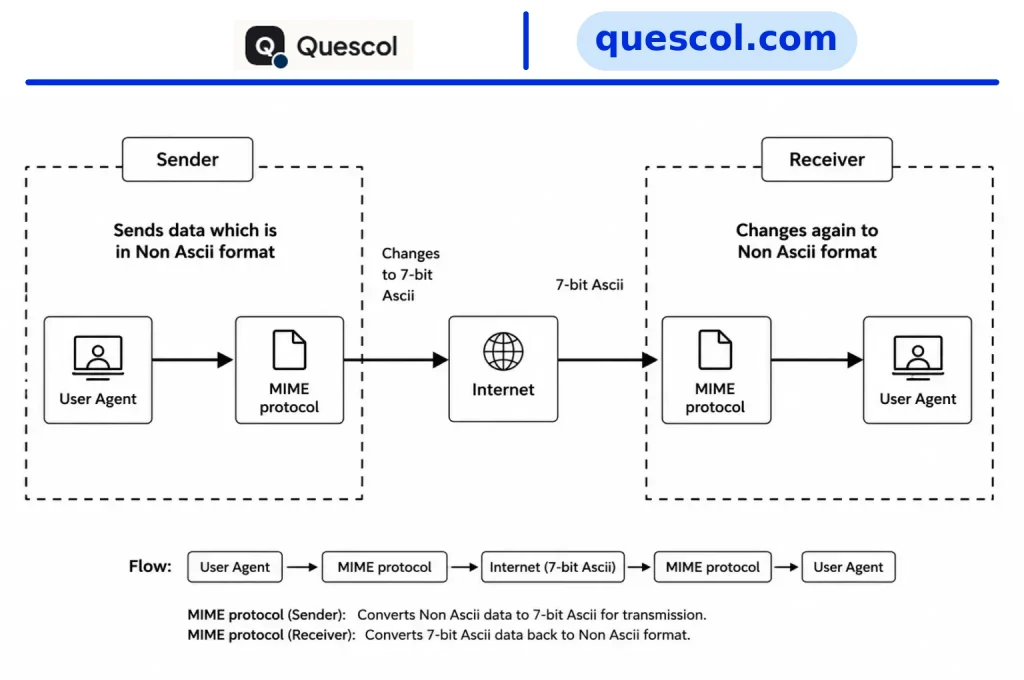
Figure: Working of MIME
1. Encoding
When a user sends an email containing non-ASCII content such as images, audio, or documents, MIME first converts the data into a 7-bit ASCII format. This encoding ensures that the data can safely travel across different email systems without getting corrupted.
2. Transmission
After encoding, the message is transmitted through the email system using the SMTP protocol. During this process, the data moves across multiple servers in a standardized format, ensuring smooth and reliable delivery over the internet.
3. Decoding
When the message reaches the receiver, the email client begins the decoding process. MIME converts the encoded ASCII data back into its original format, restoring files like images, PDFs, or audio correctly.
4. Interpretation
Finally, the recipient’s email client reads the MIME headers to understand the content type. Based on this information, it displays the email content and attachments properly, ensuring accurate and user-friendly communication.
Objectives of MIME
1. Support Multimedia Content
The main objective of MIME is to support multimedia content in email communication. Earlier email systems handled only plain text messages, but MIME allows images, videos, audio files, and documents in emails. Therefore, users can share different types of digital content easily. As a result, email communication becomes more informative and interactive.
2. Support Multiple File Attachments
MIME helps users attach multiple files within a single email message. For example, a user can send a Word document, image, and PDF together in one email. This feature improves productivity because users do not need to send separate emails for each file. In addition, it saves both time and internet resources.
3. Support Different Languages
MIME supports multiple character sets and encoding methods for different languages. Because of this feature, people can send emails in languages such as Hindi, Japanese, French, and Arabic without data corruption. Therefore, MIME supports global communication and international business operations. Moreover, it improves readability for users worldwide.
4. Improve Email Formatting
MIME also improves the formatting of email messages by supporting HTML content. Users can create colorful emails with images, links, tables, and styled text. As a result, businesses can design professional marketing and promotional emails. Therefore, MIME enhances the visual appearance of modern emails.
Characteristics of MIME
1. Supports Multiple Data Types
MIME can handle different types of data such as text, images, audio, video, and application files. This makes email communication more powerful and flexible.
2. Uses Encoding Techniques
It converts non-text data into ASCII format for safe transmission. This ensures that files do not get corrupted during sending over networks.
3. Content Type Identification
MIME clearly defines content types using headers like image/jpeg, text/html, and video/mp4. This helps systems understand how to process each file.
4. Works with Email Protocols
It works along with SMTP to send emails efficiently. MIME enhances basic email systems by adding support for multimedia content.
5. Platform Independent
MIME works across different operating systems and email clients. This ensures smooth communication between different devices and platforms.
6. Reliable Data Transfer
It ensures that data is transmitted without loss or modification. Both encoding and decoding processes maintain data integrity.
7. Extensible Standard
MIME is flexible and can support new file types in the future. This makes it suitable for modern internet applications and evolving technologies.
Advantages of MIME
1. Supports Multimedia Emails
MIME allows users to send images, videos, audio, and documents through email. Therefore, communication becomes more detailed and effective. Businesses also use this feature for marketing and professional communication.
2. Supports Multiple Languages
MIME supports different character sets and languages. As a result, users from different countries can communicate without language encoding problems. This feature improves international communication.
3. Improves Email Presentation
MIME supports HTML formatting, colorful text, and hyperlinks in emails. Therefore, emails look more professional and attractive. Businesses especially benefit from this feature for advertising and customer communication.
4. Allows File Attachments
Users can send multiple files within a single email message. This feature increases convenience and reduces the need for multiple emails. Consequently, communication becomes faster and more organized.
5. Enhances SMTP Functionality
MIME extends SMTP capabilities beyond simple text communication. It enables interoperable transfer of multimedia data in email; security requires mechanisms such as TLS, S/MIME, or OpenPGP. Therefore, modern email systems heavily depend on MIME.
Disadvantages of MIME
1. Increases Email Size
MIME encoding increases the overall size of email messages. Therefore, large attachments consume more bandwidth and storage space. This may also slow down email transmission.
2. Security Risks
Multimedia attachments may contain viruses or malicious software. Because of this, users must carefully verify email attachments before opening them. Otherwise, systems may become vulnerable to cyberattacks.
3. More Processing Required
Encoding and decoding multimedia content require additional processing power. As a result, older systems may experience slower performance while handling MIME emails.
4. Compatibility Issues
Some older email applications may not fully support advanced MIME features. Therefore, multimedia content may not display correctly in outdated systems.
Applications of MIME
1. Business Communication
Companies use MIME for sending reports, invoices, presentations, and official documents through email. Therefore, employees and clients can easily exchange important files. This improves productivity and professional communication.
2. Online Shopping Services
E-commerce websites use MIME to send product images, invoices, order confirmations, and shipping details. As a result, customers receive complete purchase information directly through email.
3. Educational Systems
Schools and universities use MIME to share notes, assignments, presentations, and study materials. Therefore, students can receive educational content quickly and efficiently.
4. Marketing and Advertising
Businesses create attractive HTML emails with images, banners, and promotional links using MIME. This helps companies improve customer engagement and digital marketing performance.
5. Social Media Notifications
Social media platforms send multimedia notifications, profile images, and verification emails using MIME technology. Therefore, users receive interactive and informative email updates.
Conclusion
MIME is an important extension of SMTP that makes modern email communication more advanced and flexible. It supports multimedia content, multiple languages, file attachments, and formatted emails. Therefore, MIME improves both personal and professional communication over the internet.
Moreover, MIME enhances SMTP by enabling the transfer of non-text data such as images, videos, and documents. Without MIME, modern email services would support only plain text communication. As a result, MIME plays a major role in today’s digital communication systems.
Finally, MIME provides many benefits for businesses, educational institutions, and online services. Although it has some limitations such as larger email size and security risks, its advantages are far more useful in real-world applications. Thus, MIME remains an essential technology in modern email architecture.
The header fields are also covered in what MIME is.