In computer networks, IP (Internet Protocol) is used to identify devices and transfer data packets from one device to another over interconnected networks. Every device communicating through an IP network requires an IP address to identify its network interface.
IPv4 and IPv6 are two versions of the Internet Protocol used for communication over the Internet and private networks.
IPv4 stands for Internet Protocol Version 4, whereas IPv6 stands for Internet Protocol Version 6.
IPv4 uses a 32-bit addressing system, which provides approximately 4.3 billion possible addresses. Due to the increasing number of Internet-connected devices, the available IPv4 address space became insufficient.
To overcome this limitation, IPv6 was developed. It uses a 128-bit addressing system and provides a much larger number of IP addresses.
Although both protocols perform the same basic function of addressing and routing data packets, they differ in their address formats, address sizes, header structures, and other features.
What Is IPv4?
IPv4 stands for Internet Protocol Version 4. It is the fourth version of the Internet Protocol and uses a 32-bit addressing system to identify devices on a network.
An IPv4 address is divided into four groups of 8 bits each. These groups are called octets and are represented in decimal numbers separated by dots.
Each octet can have a value between 0 and 255.
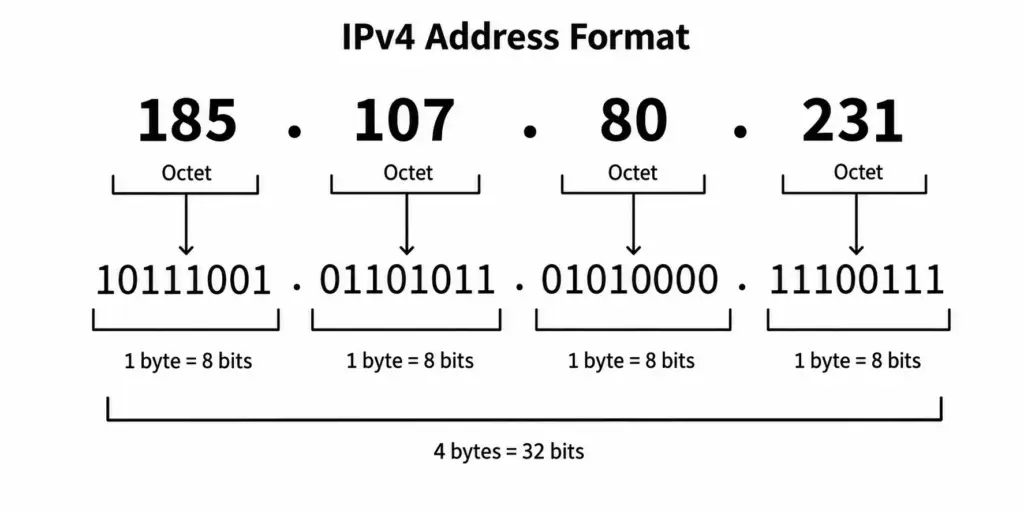
Figure : IPv4
Example of an IPv4 address
192.168.1.10
The main purpose of IPv4 is to provide logical addresses and help transfer data packets between devices connected to the same or different networks.
IPv4 is widely used in home networks, office networks, and Internet communication.
What Is IPv6?
IPv6 stands for Internet Protocol Version 6. It is the sixth version of the Internet Protocol and was developed to overcome the limitations of IPv4, particularly its limited address space.
IPv6 uses a 128-bit addressing system, which provides approximately 3.4 × 10³⁸ possible addresses.
An IPv6 address is divided into eight groups of 16 bits each. These groups are represented using hexadecimal numbers separated by colons.
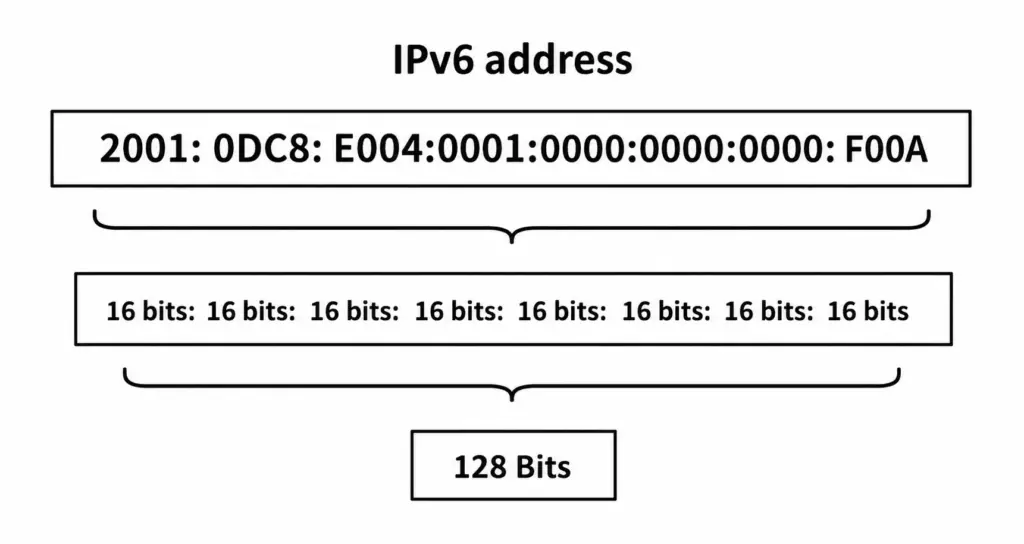
Figure : IPv6
Example of an IPv6 address
2001:DB8:0000:0000:0000:0000:0000:0001
This address can be shortened to:
2001:DB8::1
IPv6 provides a much larger address space and supports modern network communication with improved address configuration and packet handling features.
Difference Between IPv4 and IPv6
The major differences between IPv4 and IPv6 are explained below:
1. Address Size
The main difference between IPv4 and IPv6 is their address size.
- IPv4 uses a 32-bit address.
- IPv6 uses a 128-bit address.
IPv6 provides a much larger address space than IPv4, allowing more devices to connect to the Internet.
2. Address Format
IPv4 and IPv6 use different address formats.
- IPv4 uses decimal numbers separated by dots.
- IPv6 uses hexadecimal numbers separated by colons.
For example:
IPv4: 192.168.1.1
IPv6: 2001:DB8::1
3. Address Space
IPv4 provides approximately 4.3 billion possible address combinations because it uses 32 bits.
IPv6 provides approximately 3.4 × 10³⁸ possible address combinations because it uses 128 bits.
Therefore, IPv6 can support a significantly larger number of Internet-connected devices.
4. Header Size
IPv4 has a variable-length header ranging from 20 bytes to 60 bytes.
IPv6 has a fixed-size base header of 40 bytes.
IPv6 uses a simplified base header, while additional information is handled through extension headers.
5. Address Configuration
IPv4 addresses can be assigned manually or automatically using DHCP (Dynamic Host Configuration Protocol).
IPv6 supports manual configuration, Stateless Address Autoconfiguration (SLAAC), and DHCPv6.
This provides additional flexibility for configuring network devices.
6. Broadcasting
IPv4 supports broadcast communication, which allows a device to send data to all devices within a particular broadcast domain.
IPv6 does not support broadcast communication. Instead, it uses multicast and anycast addressing for group and destination communication.
7. Security
IPv4 and IPv6 can both use IPsec to provide security services such as authentication, integrity, and confidentiality.
IPv6 was designed with support for IPsec, but this does not mean that encryption is automatically enabled in every IPv6 network.
Both protocols require proper security configuration to protect network communication.
8. Fragmentation
In IPv4, routers can fragment packets when necessary and when fragmentation is permitted.
In IPv6, routers do not fragment packets. If fragmentation is required, the source device performs it using a Fragment extension header.
This reduces the packet-processing responsibility of intermediate routers.
9. NAT Support
IPv4 commonly uses Network Address Translation (NAT) because of its limited public address space.
NAT allows multiple devices using private IP addresses to share a public IPv4 address.
IPv6 generally does not require NAT for address conservation because it provides a very large address space.
10. Routing
Both IPv4 and IPv6 support routing between different networks.
IPv6 uses a hierarchical addressing structure that supports route aggregation and helps make routing more scalable.
11. Checksum
IPv4 includes a checksum field in its header to detect errors in the header.
IPv6 does not include a header checksum. Error detection for the data is handled by other protocols and mechanisms.
12. Address Resolution
IPv4 commonly uses ARP (Address Resolution Protocol) to find the MAC address associated with an IPv4 address on a local network.
IPv6 uses Neighbor Discovery Protocol (NDP), which operates through ICMPv6 messages, for address resolution and other local network functions.
Comparison Table Between IPv4 and IPv6
The following table summarizes the important differences between IPv4 and IPv6:
| Basis | IPv4 | IPv6 |
|---|---|---|
| Full Form | Internet Protocol Version 4 | Internet Protocol Version 6 |
| Address Size | 32 bits | 128 bits |
| Address Format | Decimal | Hexadecimal |
| Address Separator | Dots (.) | Colons (:) |
| Example | 192.168.1.1 | 2001:DB8::1 |
| Address Space | Approximately 4.3 billion | Approximately 3.4 × 10³⁸ |
| Header Size | 20–60 bytes | Fixed 40 bytes |
| Address Configuration | Manual or DHCP | Manual, SLAAC, or DHCPv6 |
| Broadcasting | Supported | Not supported |
| Multicasting | Supported | Supported |
| Anycasting | Not supported as a standard IP address type | Supported |
| Security | Supports IPsec | Supports IPsec |
| Fragmentation | Routers and source hosts can fragment packets | Only the source device can fragment packets |
| NAT | Commonly used | Generally not required for address conservation |
| Header Checksum | Present | Not present |
| Address Resolution | ARP | Neighbor Discovery Protocol |
| Communication | Connectionless | Connectionless |
| Routing | Supported | Supported |
| Quality of Service | Uses ToS/DSCP-related fields | Uses Traffic Class and Flow Label fields |
Advantages of IPv4
- Widely Supported: IPv4 is supported by most existing networking devices, operating systems, and applications.
- Easy to Understand: Its decimal address format is relatively simple to read and configure.
- Mature Technology: IPv4 has been used for many years, so network administrators have extensive experience managing it.
- Compatibility: It works with a wide range of network devices and services.
- NAT Support: NAT allows multiple devices to share a public IPv4 address for Internet connectivity.
Advantages of IPv6
- Large Address Space: IPv6 provides an enormous number of IP addresses to support the growing number of connected devices.
- Automatic Configuration: It supports automatic address configuration through SLAAC.
- Simplified Header: It uses a fixed 40-byte base header.
- Improved Routing Scalability: Its hierarchical addressing supports route aggregation.
- No Broadcast Traffic: It uses multicast and anycast instead of broadcast communication.
- Reduced Need for NAT: Its large address space reduces the need for NAT for address conservation.
- Improved Traffic Handling: It includes Traffic Class and Flow Label fields for handling different types of network traffic.
IPv4 and IPv6 are two important versions of the Internet Protocol used in computer networks. Both protocols provide logical addressing and help transfer data packets between devices.
The main difference between IPv4 and IPv6 is their address size. IPv4 uses a 32-bit addressing system, whereas IPv6 uses a 128-bit addressing system.
IPv4 is widely used because of its compatibility with existing network devices and applications. However, its limited address space is a major disadvantage.
IPv6 was developed to overcome this limitation by providing a much larger address space, automatic configuration features, and a simplified packet header.
Therefore, IPv6 is an important technology for supporting the growing number of Internet-connected devices and modern network communication.