The Domain Name System (DNS) is one of the most important technologies used on the internet. It helps users access websites easily without remembering complex numerical IP addresses. Instead of typing numbers, users can simply enter website names such as google.com or amazon.com. Therefore, DNS makes internet browsing faster, easier, and more user-friendly.
Moreover, DNS works like the phonebook of the internet because it connects domain names with their corresponding IP addresses. Every time a user opens a website, DNS quickly finds the correct server and connects the user to that website. As a result, DNS plays a major role in web communication, online services, and internet performance.
What is DNS (Domain Name System)?
DNS stands for Domain Name System. It is a network service that translates human-readable domain names into machine-readable IP addresses. This process helps computers locate websites and servers on the internet quickly and accurately. In addition, DNS reduces the need to memorize difficult numerical IP addresses for every website.
Working of DNS (Domain Name System)
The working of DNS is a step-by-step process that helps users access websites using easy domain names instead of difficult IP addresses. Whenever a user enters a website name in the browser, DNS translates that domain name into an IP address so the browser can connect to the correct web server. Moreover, this process happens within a few seconds and makes internet browsing simple and fast.
DNS works through multiple servers and lookup stages to find the correct website information. It uses cache memory, DNS resolvers, root servers, TLD servers, and authoritative servers to complete the request efficiently. Therefore, DNS ensures smooth communication between users and websites across the internet.
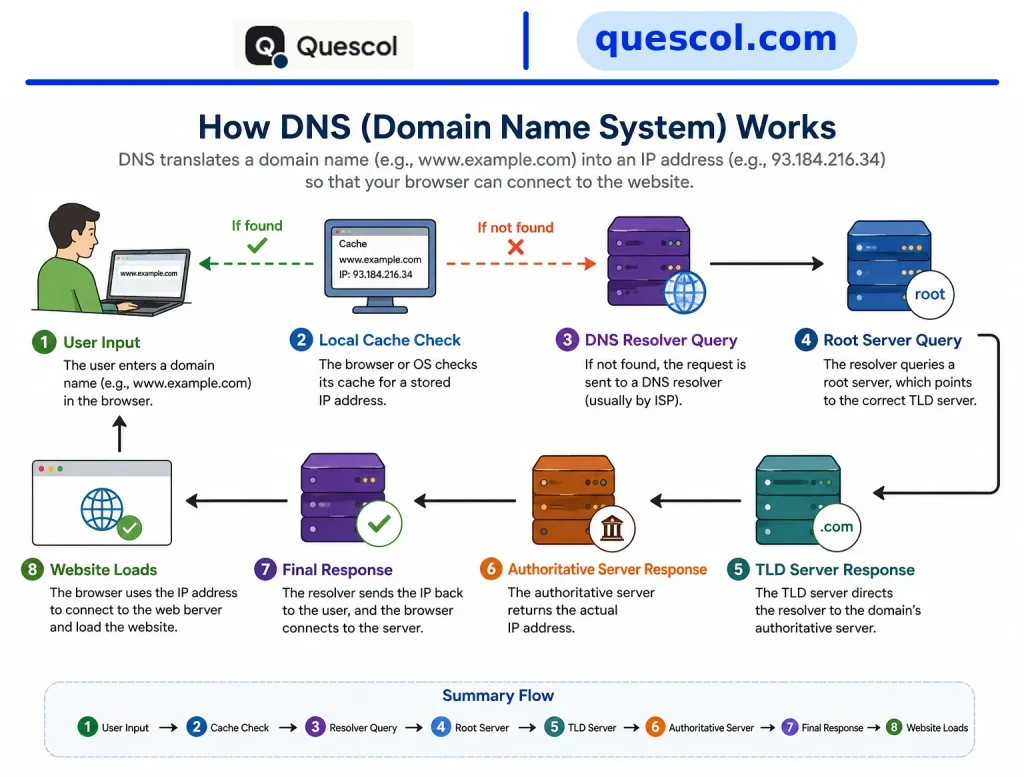
Figure: DNS
1. User Input
The DNS process starts when a user enters a domain name such as “www.google.com” into the web browser. Instead of remembering a long IP address, users simply type an easy website name. Then, the browser begins searching for the corresponding IP address.
Moreover, this step improves user convenience because people can remember names more easily than numbers. Therefore, DNS makes internet browsing more user-friendly and accessible for everyone.
For example, When a student types “www.wikipedia.org” in the browser, the system starts searching for the website’s IP address. The browser cannot connect directly using only the domain name. Therefore, it sends a DNS request to find the correct server location. Thus, DNS begins the website lookup process.
2. Local Cache Check
After receiving the request, the browser and operating system first check their local cache memory. The cache stores previously visited website IP addresses for a limited time. If the required IP address already exists in the cache, the browser uses it directly without contacting external DNS servers.
As a result, websites load faster because the browser skips additional DNS lookup steps. Moreover, caching reduces internet traffic and improves browsing efficiency.
For example, If a user recently visited “www.youtube.com,” the browser may already have its IP address stored in cache memory. Therefore, the browser quickly opens the website without performing another DNS search. Consequently, the webpage loads faster and saves network resources.
3. DNS Resolver Query
If the browser does not find the IP address in cache memory, it sends the request to a DNS resolver. Usually, the Internet Service Provider (ISP) provides this DNS resolver. The resolver acts as an intermediary between the user and other DNS servers.
Furthermore, the resolver searches different DNS servers to locate the correct IP address. Therefore, it helps simplify and manage the DNS lookup process efficiently.
For example, When a user opens a new website for the first time, the local system may not know the IP address. In this case, the request goes to the ISP’s DNS resolver. Then, the resolver starts searching for the required website information. Thus, the DNS lookup process continues.
4. Root Server Query
The DNS resolver first contacts a root DNS server when it does not know the IP address. Root servers are the highest level of the DNS hierarchy. They do not store exact website addresses, but they guide the resolver to the correct Top-Level Domain (TLD) server.
Moreover, root servers help organize internet traffic efficiently by directing requests properly. Therefore, they play a very important role in the DNS infrastructure.
For example, If the resolver searches for “www.amazon.com,” the root server identifies that “.com” is the top-level domain. Then, it directs the resolver to the correct .com TLD server. Thus, the search moves to the next DNS stage.
5. TLD Server Response
The Top-Level Domain (TLD) server manages domain extensions such as .com, .org, .net, and .edu. After receiving the request from the resolver, the TLD server provides the address of the domain’s authoritative DNS server.
In addition, TLD servers help organize domain information according to domain categories. Therefore, DNS lookups become more structured and efficient.
For example, When searching for “www.microsoft.com,” the .com TLD server identifies the authoritative DNS server responsible for Microsoft’s domain. Then, it sends that information back to the resolver. Consequently, the resolver can continue the lookup process.
6. Authoritative Server Response
The authoritative DNS server stores the actual DNS records for the requested domain name. It contains the correct IP address associated with the website. Once the resolver contacts this server, it returns the exact IP address needed to access the website.
Moreover, authoritative servers provide accurate and updated website information. Therefore, they are essential for successful internet communication.
For example, The authoritative server for “www.facebook.com” returns the correct IP address of Facebook’s web server. Then, the resolver receives this information and prepares to send it to the user’s browser. Thus, the browser can locate the website successfully.
7. Final Response
Finally, the DNS resolver sends the IP address back to the user’s browser. The browser then uses this IP address to connect to the web server hosting the website. After that, the requested webpage loads on the user’s screen.
Furthermore, the browser may store this IP address temporarily in cache memory for future use. As a result, the next visit to the same website becomes faster.
For example, After receiving the IP address of “www.netflix.com,” the browser connects directly to Netflix’s server and displays the homepage. The entire DNS process usually completes within a few milliseconds. Therefore, users experience fast and smooth website access.
Structure of DNS (Domain Name System)
The structure of DNS is hierarchical in nature, which means it is organized in different levels from top to bottom. This structure helps the internet manage millions of domain names efficiently and accurately. Moreover, DNS hierarchy allows users to access websites quickly without remembering complex IP addresses.
In addition, each level in the DNS structure has a specific role in the domain name resolution process. From the root server to hostnames, every part works together to locate the correct web server. Therefore, the hierarchical structure of DNS improves scalability, speed, and internet reliability.
1. Root Level
The root level is the highest level in the DNS hierarchy. It is represented by a dot (.) at the end of a domain name, although users usually do not see it while browsing the internet. The root server acts as the starting point for all DNS lookups and directs requests to the correct Top-Level Domain (TLD) servers.
Moreover, root servers do not store complete website information. Instead, they guide DNS resolvers toward the correct TLD server based on the domain extension such as .com, .org, or .net. Therefore, root servers play a critical role in organizing internet traffic globally.
For example, When a user types “www.amazon.com” into a browser, the DNS resolver first contacts a root server. The root server recognizes the “.com” extension and directs the request to the .com TLD server. Thus, the root level starts the DNS resolution process efficiently.
2. Top-Level Domains (TLDs)
Top-Level Domains are located directly below the root level in the DNS hierarchy. TLDs represent domain extensions such as .com, .org, .edu, .gov, and country-specific extensions like .in or .uk. These extensions help categorize websites based on purpose, organization type, or geographical location.
Furthermore, TLD servers manage information related to domains under their specific extension. As a result, DNS can organize websites more effectively and reduce confusion on the internet.
For example, In the domain name “www.wikipedia.org,” the “.org” part is the TLD. The TLD server for .org helps direct the DNS resolver to the correct authoritative server for Wikipedia. Similarly, websites ending in .edu are generally related to educational institutions. Therefore, TLDs help organize the internet systematically.
3. Second-Level Domains
The second-level domain is the main and unique name registered by an organization, company, or individual. It appears before the TLD in a domain name. For example, in “google.com,” the word “google” is the second-level domain.
Moreover, this level helps identify a specific website or organization on the internet. Businesses choose second-level domains carefully because they represent their brand identity and online presence.
For example, In “facebook.com,” the word “facebook” is the second-level domain, while “.com” is the TLD. Similarly, in “amazon.in,” the word “amazon” identifies the company and distinguishes it from other websites. Therefore, second-level domains are essential for website identification and branding.
4. Subdomains
Subdomains are extensions added before the second-level domain to organize different sections or services of a website. They help website owners separate content, applications, or departments within the same main domain.
In addition, subdomains improve website management and navigation. Different subdomains can point to different servers or services while still belonging to the same primary domain.
For example, In “mail.google.com,” the word “mail” is the subdomain used for Gmail services. Similarly, “blog.example.com” may represent the blog section of a website. Therefore, subdomains help organize websites into multiple sections efficiently.
5. Hostnames
Hostnames identify specific devices, servers, or services connected within a domain. They map directly to IP addresses using DNS records and help users or systems connect to the correct server.
Furthermore, hostnames make network management easier because administrators can assign readable names instead of using numerical IP addresses. As a result, communication between systems becomes simpler and more organized.
For example, A company may use hostnames such as “webserver1.company.com” or “ftp.company.com” for different services. The DNS system converts these hostnames into IP addresses so users can connect to the correct server. Thus, hostnames help identify and manage devices within a network.
Summary of DNS Structure
| Level | Description | Example |
|---|---|---|
| Root Level | Highest level of DNS hierarchy | . (dot) |
| Top-Level Domain | Defines domain extension | .com, .org, .in |
| Second-Level Domain | Main registered domain name | google, amazon |
| Subdomain | Organizes sections of a website | mail.google.com |
| Hostname | Identifies specific servers/devices | ftp.company.com |
Types of Domains in DNS (Domain Name System)
DNS divides domain names into different types to organize websites and internet resources efficiently. These domain types help users identify websites based on purpose, location, and network functions. Moreover, domain categorization improves internet management and makes domain resolution faster and more structured.
In addition, different types of domains support both forward DNS lookup and reverse DNS lookup. Forward lookup converts domain names into IP addresses, while reverse lookup converts IP addresses back into domain names. Therefore, domain types play a very important role in internet communication and network management.
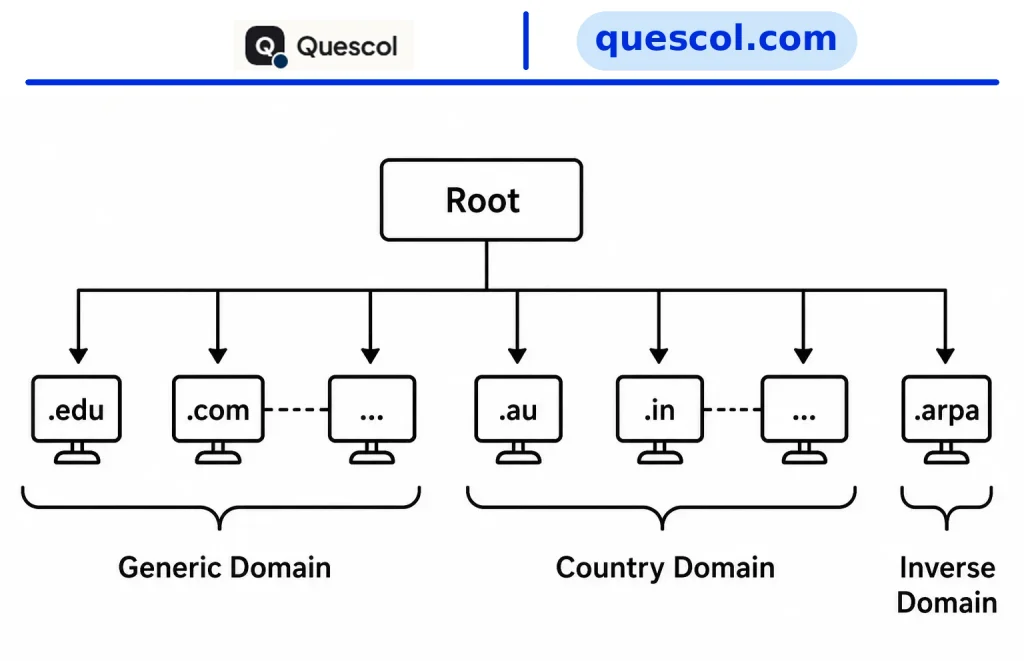
Figure: Types of DNS
1. Generic Domains (gTLDs)
Generic Top-Level Domains, also called gTLDs, are domains used for general purposes across the world. These domains are not connected to any specific country or region. They help organizations, businesses, educational institutions, and individuals create websites for different purposes.
Moreover, gTLDs are managed by international domain authorities and are widely used on the internet. Common examples include .com, .org, .net, .edu, and .info. Therefore, gTLDs provide a flexible and globally recognized naming system.
Features of Generic Domains
- Not restricted to any country
- Used worldwide for general purposes
- Easy to recognize and remember
- Supports businesses, organizations, and education
- Managed globally by domain authorities
For example, The website “www.amazon.com” uses the “.com” generic domain because it is a commercial website. Similarly, “www.wikipedia.org” uses “.org” because it represents a non-profit organization. Educational institutions often use “.edu” domains. Thus, generic domains help users identify the purpose of websites easily.
2. Country Code Domains (ccTLDs)
Country Code Top-Level Domains, also called ccTLDs, are domains assigned to specific countries or geographic regions. These domains usually contain two-letter country codes based on international standards. They help websites identify their country or regional presence on the internet.
Furthermore, each country manages its own ccTLD through national domain authorities. As a result, users can easily recognize websites related to a particular country or region.
Features of Country Code Domains
- Represents specific countries or regions
- Managed by national authorities
- Helps local businesses and organizations
- Improves regional identity on the internet
- Often used for local services and websites
For example, The domain “.in” represents India, while “.uk” represents the United Kingdom. Similarly, “.jp” is used for Japan and “.us” for the United States. For instance, “www.gov.in” is an Indian government website that uses the Indian country code domain. Therefore, ccTLDs help identify the geographical location of websites.
3. Reverse DNS Domains
Reverse DNS domains are used to perform reverse DNS lookups, where an IP address is translated back into a domain name. Unlike normal DNS lookup, which converts domain names into IP addresses, reverse DNS works in the opposite direction.
Moreover, reverse DNS helps verify server identities and improves network security and email authentication. IPv4 addresses use “in-addr.arpa,” while IPv6 addresses use “ip6.arpa” for reverse mapping. Therefore, reverse DNS is important for network management and troubleshooting.
Features of Reverse DNS
- Converts IP addresses into domain names
- Uses PTR (Pointer) records
- Helps verify server identity
- Improves email server authentication
- Supports network troubleshooting and security
For example, When an email server receives a message, it may perform a reverse DNS lookup to verify the sender’s server identity. If the IP address correctly maps back to the domain name, the email becomes more trustworthy. Similarly, network administrators use reverse DNS to identify servers and devices on a network. Thus, reverse DNS improves internet security and reliability.
Domain Name Server (DNS Server)
A Domain Name Server, also called a DNS Server, is a specialized server that stores DNS records and helps convert domain names into IP addresses. It allows users to access websites using simple names like “google.com” instead of difficult numerical IP addresses. Moreover, DNS servers play an important role in internet communication because they connect users with the correct web servers.
In addition, DNS servers work continuously in the background whenever users browse the internet, send emails, or use online applications. They receive DNS requests from clients, process the queries, and return the correct IP addresses. Therefore, DNS servers make internet browsing fast, easy, and user-friendly.
Functions of Domain Name Server
1. Stores DNS Records
A DNS server stores different types of DNS records that contain important information about domain names and servers. These records help browsers and applications locate the correct destination on the internet.
Some common DNS records include:
- A Record – Maps a domain name to an IPv4 address
- AAAA Record – Maps a domain name to an IPv6 address
- MX Record – Directs email messages to mail servers
- CNAME Record – Creates an alias for a domain name
- NS Record – Identifies the authoritative name server
- PTR Record – Used for reverse DNS lookup
Moreover, these records help websites, email systems, and online services function correctly and efficiently.
For example, When a user types “www.example.com,” the DNS server checks its A record to find the website’s IP address. Similarly, email services use MX records to deliver emails to the correct mail server. Therefore, DNS records are essential for internet communication.
2. Responds to DNS Queries
DNS servers respond to requests sent by users, browsers, or other DNS servers. When a user enters a website name, the DNS server searches its database or contacts other DNS servers to find the correct IP address.
Furthermore, DNS servers reduce internet complexity because users do not need to remember numerical addresses. As a result, website access becomes faster and more convenient.
For example, If a user opens “www.youtube.com,” the browser sends a query to the DNS server. The DNS server then returns the IP address of YouTube’s server so the browser can load the webpage. Thus, DNS servers make website access possible.
3. Operates Within Hierarchical DNS Structure
DNS servers work within a hierarchical structure that includes root servers, TLD servers, and authoritative servers. Each level in the hierarchy performs a specific role during the DNS lookup process.
Moreover, this structure improves scalability and allows the internet to manage millions of websites efficiently. Therefore, DNS servers help organize domain information systematically across the world.
For example, When searching for “www.amazon.in,” the DNS resolver first contacts the root server, then the .in TLD server, and finally the authoritative DNS server for Amazon. Consequently, the correct IP address is found step by step.
4. Performs Recursive and Authoritative Functions
A DNS server can perform recursive or authoritative functions depending on its role in the DNS system.
Recursive DNS Server
A recursive DNS server receives requests from users and searches multiple DNS servers to find the required IP address. It performs the complete lookup process on behalf of the client.
Authoritative DNS Server
An authoritative DNS server stores the official DNS records for a specific domain and provides the final answer during DNS lookup.
Therefore, both recursive and authoritative servers work together to complete DNS resolution successfully.
For example, When a browser requests the IP address of “www.microsoft.com,” the recursive server searches different DNS servers until it reaches Microsoft’s authoritative server. Then, the authoritative server provides the correct IP address.
5. Enables Communication Between Users and Web Servers
DNS servers enable communication between users and websites by supplying the correct IP addresses. Without DNS servers, users would need to remember long numerical addresses for every website.
In addition, DNS improves browsing speed and internet usability because users can access websites using simple domain names. Therefore, DNS servers are considered one of the most important parts of internet infrastructure.
For example, When a student accesses “www.wikipedia.org,” the DNS server converts the domain name into an IP address and connects the browser to Wikipedia’s web server. As a result, the webpage loads successfully within seconds.
DNS Lookup (DNS Resolution)
DNS Lookup, also called DNS Resolution, is the process of converting a domain name into its corresponding IP address. This process helps computers and devices communicate with the correct web server on the internet. Instead of remembering numerical IP addresses, users can simply type easy domain names such as “www.google.com.”
Moreover, DNS Lookup works through different DNS servers and query methods to find the required IP address quickly and efficiently. Therefore, it plays a major role in internet browsing, email services, and online communication.
Key Components of DNS Lookup
1. DNS Resolver
A DNS Resolver is the first component involved in the DNS lookup process. It acts as an intermediary between the client device and DNS servers. When a user enters a domain name in the browser, the resolver starts the DNS query process.
Furthermore, the resolver searches different DNS servers to find the correct IP address and then returns it to the client. Therefore, it helps users access websites smoothly and quickly.
2. Recursive Query
A Recursive Query is a type of DNS query in which the resolver is responsible for finding the complete answer for the client. The resolver contacts multiple DNS servers until it receives the correct IP address or an error message.
In addition, recursive queries simplify the process for client devices because the resolver performs all the lookup tasks. Therefore, users receive the final result directly.
3. Iterative Query
An Iterative Query is a DNS query where the DNS server provides the best information it has instead of finding the complete answer itself. If the server does not know the exact IP address, it directs the resolver to another DNS server.
Moreover, iterative queries help the resolver move step by step through the DNS hierarchy until it finds the correct information. Therefore, this method improves the efficiency of DNS communication.
4. Non-Recursive Query
A Non-Recursive Query occurs when the requested information is already available in the cache memory or authoritative DNS server. In this case, the DNS server immediately returns the answer without contacting other servers.
As a result, non-recursive queries are faster because they reduce additional DNS communication and lookup time.
DNS Caching
DNS Caching is a technique used to temporarily store DNS records after a domain name has been resolved. Instead of performing a new DNS lookup every time a user visits a website, the system stores the previously resolved IP address in cache memory. As a result, websites load faster and network performance improves.
Moreover, DNS caching reduces the number of requests sent to external DNS servers. This decreases internet traffic and helps servers handle fewer lookup requests. Therefore, DNS caching plays an important role in improving browsing speed and internet efficiency.
Features of DNS Caching
- Stores previously resolved domain records locally
- Reduces response time for repeated requests
- Minimizes load on external DNS servers
- Improves browsing speed and network performance
- Helps reduce unnecessary DNS traffic
For example, When a user visits “www.google.com” for the first time, the DNS resolver finds the IP address and stores it in cache memory. If the same website is opened again within a short time, the browser uses the cached record instead of performing another DNS lookup. Therefore, the website loads much faster.
TTL (Time-to-Live)
TTL, or Time-to-Live, is the duration for which a DNS record remains stored in cache memory before it expires. It is defined by the authoritative DNS server and is measured in seconds. Once the TTL period ends, the system performs a new DNS lookup to refresh the record.
In addition, TTL helps maintain updated DNS information across the internet. Short TTL values allow faster updates, while longer TTL values improve performance by reducing repeated DNS queries. Therefore, TTL balances speed and accuracy in DNS operations.
Features of TTL
- Defines how long a DNS record stays in cache
- Set by the authoritative DNS server
- Measured in seconds
- Requires a new lookup after expiration
- Helps control DNS refresh timing
For example, If the TTL value of a DNS record is set to 3600 seconds, the record remains cached for one hour. During this time, the browser or resolver uses the stored IP address directly. After one hour, a new DNS lookup is performed to get updated information.
Reverse DNS Lookup
Reverse DNS Lookup is the process of converting an IP address back into its associated domain name. It performs the opposite function of normal DNS resolution, where domain names are converted into IP addresses. Reverse DNS mainly uses PTR (Pointer) records for this mapping process.
Furthermore, reverse DNS helps network administrators identify servers and verify internet communication. It uses special domains such as “in-addr.arpa” for IPv4 and “ip6.arpa” for IPv6. Therefore, reverse DNS is important for security, troubleshooting, and server verification.
Features of Reverse DNS Lookup
- Converts IP addresses into domain names
- Uses PTR (Pointer) records
- Supports IPv4 and IPv6 mapping
- Helps identify servers and devices
- Improves network monitoring and security
For example, If a server has the IP address “192.168.1.1,” reverse DNS lookup can identify the domain name linked with that IP address. Therefore, administrators can easily determine which server or website is associated with the network connection.
Uses of Reverse DNS Lookup
1. Network Diagnostics
Reverse DNS helps network administrators analyze and troubleshoot network issues. By converting IP addresses into readable domain names, administrators can identify servers and monitor network traffic more easily.
Moreover, it improves network management because devices and servers become easier to recognize during diagnostics and monitoring.
2. Email Security
Reverse DNS is widely used in email systems to verify the authenticity of email senders. Mail servers check whether the sender’s IP address correctly maps to a domain name before accepting the email.
Furthermore, this process helps reduce spam emails, phishing attacks, and fraudulent messages. Therefore, reverse DNS improves email security and trustworthiness.
DNS Record Types
DNS records store different types of information related to domain names and servers. Each record performs a specific role in DNS communication and internet services.
1. A Record
An A Record maps a domain name to its corresponding IPv4 address. It is one of the most commonly used DNS records for website access.
For example, The domain “www.example.com” may point to the IPv4 address “192.168.1.1” using an A Record.
2. CNAME Record
A CNAME Record creates an alias that points one domain name to another domain name. It helps manage multiple domain names easily.
For example, The domain “blog.example.com” may point to “example.com” using a CNAME record.
3. MX Record
An MX Record specifies the mail server responsible for receiving emails for a domain. It helps route email messages correctly.
For example, When someone sends an email to “user@gmail.com,” the MX record directs the message to Gmail’s mail server.
4. TXT Record
A TXT Record stores text-based information for verification and authentication purposes. It is commonly used for email security and domain ownership verification.
For example, Websites use TXT records for SPF, DKIM, and domain verification services to improve email authentication and security.
Conclusion
DNS (Domain Name System) is one of the most important technologies used in modern internet communication. It converts easy-to-remember domain names into IP addresses and helps users access websites quickly and efficiently. Moreover, DNS improves internet usability by allowing people to browse websites without memorizing complex numerical addresses.
In addition, DNS works through a hierarchical structure that includes root servers, TLD servers, authoritative servers, caching systems, and DNS records. Features such as DNS Lookup, DNS Caching, Reverse DNS Lookup, and TTL help improve browsing speed, security, and network performance. Therefore, DNS plays a major role in maintaining smooth and reliable communication across the internet.
Although DNS may face challenges such as security attacks, server failures, and configuration complexity, it still remains a fundamental part of networking and web technologies. Today, websites, email systems, cloud services, streaming platforms, and online applications all depend on DNS for proper functioning. Thus, DNS acts as the backbone of the internet and ensures fast, organized, and user-friendly access to online resources.
Mail servers named by MX records are used in the SMTP address scheme.