The internet provides many communication platforms that allow users to share information, discuss ideas, and exchange knowledge globally. Before modern social media and online forums became popular, USENET was one of the earliest distributed discussion systems used on computer networks. Therefore, it played an important role in the development of online communication.
Moreover, USENET allowed users to post messages, participate in discussions, and share files through organized discussion groups called newsgroups. It connected users from universities, research centers, and organizations worldwide. As a result, USENET became an important platform for communication, collaboration, and information sharing.
USENET helped create online communities where users discussed technology, education, science, entertainment, and many other topics. Unlike modern websites, USENET worked through distributed servers that exchanged messages across networks. Therefore, it became one of the earliest examples of global online discussion systems.
What is USENET?
Usenet is a distributed discussion network organized into newsgroups. It is a distributed discussion and messaging system that allows users to exchange messages and files through newsgroups over computer networks. USENET works by distributing articles and discussion posts across multiple servers connected through the internet.
- Usenet is a distributed discussion network organized into newsgroups – It is a distributed online discussion system that allows users to exchange messages and information over computer networks and the internet.
- Uses Newsgroups for Communication – USENET organizes discussions into topic-based groups called newsgroups where users can post, read, and reply to messages.
- Supports Global Information Sharing – Users from different countries can share ideas, knowledge, files, and discussions on various subjects such as technology, education, and entertainment.
- Works Through Distributed Servers – USENET operates using multiple interconnected servers that distribute messages across the network instead of using a single central server.
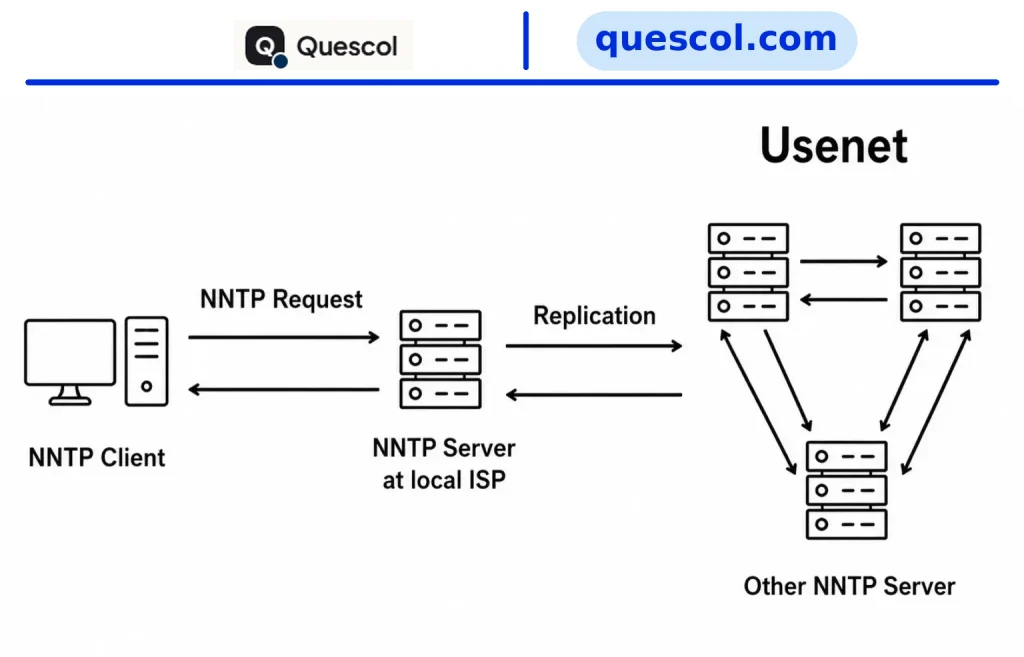
Figure: USENET
Working of USENET
USENET works using the Network News Transfer Protocol (NNTP), which helps users and servers exchange messages across networks. It allows users to read, post, and reply to messages in different newsgroups. Moreover, multiple servers communicate with each other to distribute and replicate messages globally.
1. Client/Server Communication
In USENET, users use client software or newsreader applications to connect with a news server. The client downloads the list of available newsgroups, reads messages, replies to discussions, and posts new articles.
Moreover, the news server stores these messages and manages communication between users and newsgroups. Therefore, users can participate in online discussions easily.
2. Server/Server Communication
USENET servers communicate with each other using NNTP to exchange and replicate messages. When a message is posted on one server, it automatically spreads to other connected servers across the network.
As a result, users connected to different servers can access the same discussions and information worldwide. Therefore, USENET supports distributed communication and global message sharing.
3. Message Replication
The replication process copies new messages from one server to another server. This ensures that discussions remain available across multiple USENET servers. Moreover, replication improves reliability because messages are stored on several servers instead of a single central system.
4. Reading and Replying to Messages
Users can open any newsgroup, read existing discussions, and reply to messages. These replies are then distributed to other servers through NNTP communication. Therefore, users from different locations can participate in continuous discussions and information exchange.
Advantages of USENET
1. Global Communication
USENET provides a platform for users from different parts of the world to communicate and exchange information through online discussions. Users can post messages, ask questions, share opinions, and respond to discussions without geographical limitations. Therefore, it helps people connect and share knowledge globally.
2. Organized Discussion Groups
USENET organizes discussions into separate groups called newsgroups, where each group focuses on a particular subject or area of interest. For example, users can find separate newsgroups for computer programming, science, education, and entertainment. This organized structure helps users easily locate relevant discussions and participate in conversations related to their interests.
3. Knowledge Sharing
USENET allows users to share technical information, educational resources, personal experiences, and solutions to common problems. Beginners can ask questions, while experienced users can provide suggestions and explanations. Therefore, it supports collaborative learning and helps users gain knowledge from different community members.
4. Asynchronous Communication
USENET supports asynchronous communication, which means users do not need to be online at the same time to exchange messages. A user can read a previously posted message and reply whenever convenient. This feature makes communication flexible, especially for people living in different countries and time zones.
5. Distributed Network Structure
USENET operates through multiple interconnected news servers rather than depending on a single central server. These servers exchange and distribute messages among themselves. Therefore, its distributed structure supports large-scale communication and reduces dependence on one central system.
Disadvantages of USENET
1. Lack of Central Control
USENET follows a distributed structure, so there is no single central authority responsible for controlling all discussions and content. Although individual newsgroups may have their own rules and moderation practices, enforcing common rules across the entire network can be difficult. As a result, spam, unwanted messages, and inappropriate content may appear in some groups.
2. Security Risks
Some USENET newsgroups may contain suspicious links, spam messages, malicious files, or misleading information. Downloading files from unknown sources can expose users to security threats such as malware and viruses. Therefore, users should verify the reliability of information and scan downloaded files before opening them.
3. Complex Setup
Accessing USENET may require a suitable newsreader application, a news server address, and appropriate account settings. Some users may also need to configure server details and authentication information. As a result, beginners may find USENET more difficult to use than modern web-based discussion platforms.
4. Large Volume of Messages
Popular USENET newsgroups may receive a large number of messages and replies every day. Finding a particular discussion or useful information among these messages can be time-consuming. Therefore, users may need to use search tools, message filters, and discussion threads to manage the information effectively.
5. Declining Popularity
USENET was widely used for online discussions and information sharing in the early days of the Internet. However, modern platforms such as social media networks, online forums, and instant messaging applications have become more popular. As a result, participation in many traditional USENET discussion groups has decreased.
Applications of USENET
1. Online Discussions
USENET is used to conduct online discussions on various subjects, including technology, science, education, entertainment, and current topics. Users can post questions, share opinions, and respond to messages posted by others. Therefore, it provides a platform for people worldwide to exchange ideas and participate in topic-based conversations.
2. Knowledge Sharing and Learning
USENET supports knowledge sharing by allowing users to exchange educational resources, technical information, programming solutions, and research-related discussions. Students and professionals can ask questions and learn from the experiences of other community members. Therefore, it can be useful for collaborative learning and problem-solving.
3. File Sharing
USENET supports the distribution of digital files through special newsgroups called binary newsgroups. These groups can be used to share files such as documents, images, software, and multimedia content. Large files may be divided into smaller parts before being posted and later combined by the receiving user. Therefore, USENET can be used to distribute digital content across its network.
4. Community Building
USENET allows people with similar interests to communicate through dedicated newsgroups. Users can join communities related to hobbies, professional fields, technology, education, and other subjects. By participating in discussions and sharing experiences, users can build connections and develop knowledge-based communities.