Voice over Internet Protocol (VoIP) is a modern communication technology. It allows users to make voice calls using the internet instead of traditional telephone lines. Today, many businesses and individuals use VoIP because it is fast and cost-effective. Moreover, it supports audio, video, and messaging in one platform.
In simple terms, VoIP changes voice signals into digital data. Then, it sends this data through the internet to the receiver. As a result, communication becomes easier across long distances. In addition, it reduces the need for physical phone networks.
What is Voice over IP?
Voice over Internet Protocol (VoIP) is a communication technology that allows users to make and receive voice calls over the Internet instead of using traditional telephone networks. It converts human voice signals into digital data packets and transmits them through an IP (Internet Protocol) network to the receiver.
In traditional telephone systems, voice communication takes place through dedicated telephone lines or circuit-switched networks. However, VoIP uses an Internet connection to transfer voice data between communicating devices. This makes communication more flexible, convenient, and cost-effective.
VoIP works by converting the speaker’s voice into digital signals using a process called digitization. These digital signals are divided into smaller packets and transmitted over the Internet. At the receiving end, the packets are reassembled and converted back into audio signals so that the receiver can hear the speaker’s voice.
VoIP allows users to make calls using different devices, such as computers, smartphones, laptops, and specialized VoIP phones. Popular communication applications such as WhatsApp, Skype, and Zoom use VoIP technology to support Internet-based voice communication.
One of the major advantages of VoIP is its ability to reduce communication costs, especially for long-distance and international calls. It also supports additional communication features such as video conferencing, call forwarding, voicemail, and conference calling.
For example, suppose a person wants to make a voice call to a friend living in another country. Instead of using a traditional telephone network, both users can use a VoIP application connected to the Internet. The application converts their voices into digital data packets and transfers them over the Internet, allowing them to communicate in real time.
Important Features of VoIP
1. Internet-Based Communication: VoIP uses an Internet connection to transmit voice data between users instead of relying entirely on traditional telephone networks.
2. Voice Signal Conversion: It converts analog voice signals into digital data packets that can be transmitted over IP networks. At the receiver’s end, these packets are converted back into audio signals.
3. Low Communication Cost: VoIP can reduce communication expenses, particularly for long-distance and international calls, depending on the service provider and Internet plan.
4. Multiple Device Support: It allows users to make and receive calls using smartphones, computers, laptops, tablets, and specialized VoIP phones.
5. Video Conferencing: VoIP-based applications can support video communication, allowing users to see and talk to each other through an Internet connection.
6. Call Management Features: It provides additional features such as call forwarding, call waiting, voicemail, caller identification, and conference calling.
7. Real-Time Communication: It supports voice communication with minimal delay when the network connection has sufficient bandwidth and low latency.
8. Location Flexibility: Users can make and receive calls from different locations as long as they have a suitable Internet connection and access to their VoIP service.
9. Scalability: VoIP systems can be expanded by adding more users and devices without requiring the same level of dedicated telephone-line infrastructure as traditional systems.
10. Integration with Other Services: VoIP can be integrated with messaging applications, video conferencing tools, customer support systems, and business communication platforms.
Evolution of VoIP Service
The development of VoIP (Voice over Internet Protocol) has gone through several important stages:
- In 1995, VocalTec released InternetPhone, one of the first commercial Internet telephony software products, which was the first internet-based calling system. It allowed users to make voice calls over the internet, but both users needed the same software to communicate.
- In the early stage, VoIP had many issues such as call drops, delays, and poor sound quality, which made the experience less reliable.
- In 2003, Skype was launched, which greatly improved VoIP technology and made it popular among common users. It introduced better voice quality and also supported video calling and calls to landline phones, many of them at low or no cost.
- Over time, VoIP became more stable, affordable, and widely used for both personal and business communication.
- During the COVID-19 pandemic, VoIP usage increased rapidly as many people started working from home.
- Tools like Skype, Zoom, and other teleconferencing platforms became essential for meetings, online classes, and remote work.
- Today, VoIP is an important part of modern communication systems, offering voice calls, video calls, and conferencing services over the internet.
How Voice over Internet Protocol (VoIP) Works?
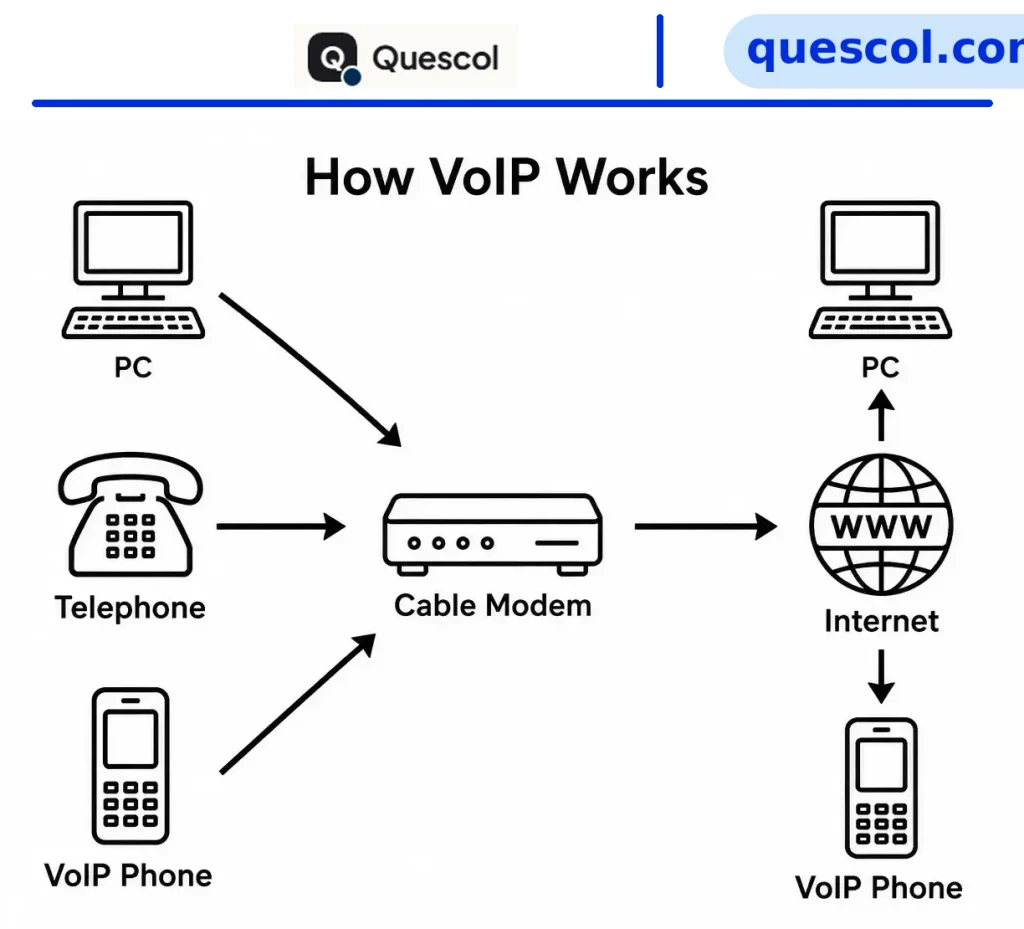
Figure: Voice over Internet Protocol (VoIP)
- First, VoIP converts your voice into a digital signal using a microphone or device like a smartphone, computer, or VoIP phone.
- Then, this digital voice data is broken into small packets for easy and fast transmission over the internet.
- After that, these data packets travel through IP networks such as Wi-Fi, broadband, or mobile internet to reach the receiver.
- If the call is made to a regular phone number, the digital signal is converted into an analog signal before reaching the telephone network.
- At the receiver’s end, all the data packets are collected and reassembled into the original voice.
- Finally, the converted voice is heard clearly on the receiver’s device in real time.
- Moreover, VoIP can be used through computers, smartphones, special VoIP phones, or even traditional phones with adapters.
- In addition, users can access VoIP services from public Wi-Fi hotspots in places like airports, cafes, hospitals, and offices.
Equipment Required in VoIP
VoIP (Voice over Internet Protocol) needs some basic equipment and a good internet setup to work properly:
- A high-speed internet connection is required for clear voice communication.
- Internet can be accessed through cable modem, LAN, or other broadband services.
- Users need compatible devices such as a computer, smartphone, VoIP adapter, or a dedicated VoIP phone.
- Some VoIP services work only on a specific computer or VoIP-supported phone.
- A VoIP adapter allows a normal telephone to connect to the internet for calls.
- For computer-based VoIP, software, speakers/headphones, and a microphone are needed.
- VoIP phones can connect directly to a broadband internet connection and work like regular telephones.
- With a VoIP adapter, users can dial numbers normally and make voice calls over the internet.
Local Call vs Long Distance Call (VoIP)
VoIP services treat local and long-distance calls in different ways, depending on the provider and plan:
- Some VoIP providers offer free calls, but usually only to other users of the same service.
- In VoIP, users may be able to choose a different area code from their actual location.
- A local call generally refers to calls made within the same service area or to users on the same VoIP network, and these are often free or very low cost.
- A long-distance call refers to calls made outside the service area or to different networks, which may be charged by some VoIP providers.
- Like traditional phone systems, some VoIP companies apply extra charges for long-distance calls based on the destination.
- Other VoIP services offer fixed plans, where users can make calls anywhere for a set number of minutes or at a fixed monthly rate.
| Basis | Local Call (VoIP) | Long Distance Call (VoIP) |
|---|---|---|
| Meaning | Calls made within the same service area or same VoIP network | Calls made outside the local area or to different regions/countries |
| Cost | Usually free or very low cost | May be charged or included in special plans |
| Area Code Effect | Same or nearby area code is used | Different area codes or international numbers |
| Service Provider Policy | Often included in basic VoIP service | May require extra charges depending on provider |
| Usage | Common for everyday communication | Used for distant communication (national/international) |
| Example | Calling a colleague using same VoIP service | Calling someone in another country or region |
Regulation of VoIP Services by the FCC
VoIP services, especially interconnected VoIP services (which allow users to make and receive calls to and from the regular telephone network), are regulated by the Federal Communications Commission (FCC).
- In June 2005, the FCC made it mandatory for VoIP providers to support 911 emergency calling services.
- However, VoIP 911 calls work differently from traditional phone 911 services and may not always provide exact location details.
- The FCC also requires VoIP providers to follow the Communications Assistance for Law Enforcement Act (CALEA), 1994, which helps law enforcement agencies access communications when legally authorized.
- VoIP providers must contribute to the Universal Service Fund (USF), which supports affordable communication services for low-income users and people in high-cost or rural areas.
Advantages of VoIP
- Low cost communication – VoIP calls are usually cheaper than traditional telephone calls, especially for long-distance and international calls.
- Internet-based calling – It uses the internet instead of telephone lines, reducing infrastructure costs.
- Portability – Users can make and receive calls from anywhere with an internet connection.
- Multiple features – VoIP supports video calls, call forwarding, voicemail, conferencing, and file sharing.
- Easy setup – It requires only basic devices like a smartphone, computer, or VoIP phone with internet access.
- Scalability – Easy to add or remove users, making it suitable for both small and large organizations.
- Better communication options – Supports voice, video, and messaging in one platform.
- Flexibility – Can work on different devices such as PCs, mobiles, and IP phones.
Disadvantages of VoIP
- Depends on internet connection – VoIP requires a stable and high-speed internet connection; poor internet affects call quality.
- Power dependency – If there is a power outage and no backup, VoIP services will not work.
- Call quality issues – Delay, echo, and voice distortion may occur during weak network conditions.
- Emergency calling limitations – VoIP 911 services may not always provide accurate location details compared to traditional phones.
- Security risks – VoIP can be vulnerable to hacking, eavesdropping, and phishing attacks if not properly secured.
- Network congestion impact – Heavy internet traffic can reduce voice clarity and performance.
- Hardware and setup requirements – Some systems need special devices or adapters, which may add cost.
- Service dependency – VoIP service depends on providers, so outages or server issues can affect communication.
Difference between VoIP and Traditional Phone Services
| Features | VoIP | Traditional Phone Services |
|---|---|---|
| Method of transmission | Digital signals over the internet | Analog signals over telephone lines |
| Internet requirement | Yes, requires high-speed broadband | No internet required |
| Cost | Lower cost, especially for long-distance calls | Higher cost for long-distance calls |
| Features and services | Offers advanced features like video calls, conferencing, voicemail, etc. | Limited features |
| Power outages | May not work without power or backup | Usually works during power outages |
| Emergency services access | May not provide accurate location or direct connection | Direct and reliable connection to emergency services |
| Directory assistance | May or may not be available depending on provider | Usually available |
Conclusion
VoIP is a modern communication technology that has significantly changed the way people make voice and video calls. By using the internet instead of traditional telephone lines, it provides a cost-effective and flexible solution for personal as well as business communication. It also supports advanced features like conferencing, messaging, and video calling, which make communication more convenient and efficient.
However, VoIP also depends heavily on a stable internet connection and may face issues such as call quality problems or limited emergency service accuracy. Despite these limitations, it has become an essential part of today’s digital communication systems and continues to grow in importance worldwide.
Why that has not retired the telephone network is in the problems of full VoIP.