RSA (Rivest–Shamir–Adleman) is an asymmetric encryption algorithm used to secure data by converting it into an unreadable format during transmission. It uses a pair of keys: a public key, which is shared openly, and a private key, which is kept secret. The main idea behind RSA is that data encrypted with the public key can only be decrypted using the matching private key.
The security of RSA depends on the difficulty of factoring large numbers into their prime components. This makes it very hard for attackers to break the encryption. RSA is widely used in secure communication systems, including HTTPS websites, banking transactions, and digital signatures. It ensures confidentiality, integrity, and authentication of data in modern network systems.
What is RSA (Rivest–Shamir–Adleman)?
RSA is one of the most widely used asymmetric key cryptography algorithms. It uses two different keys, namely a public key and a private key, for secure communication. The public key is used to encrypt data, while the private key is used to decrypt it. Therefore, RSA provides strong security for digital communication and online transactions.
RSA was developed by Ron Rivest, Adi Shamir, and Leonard Adleman, and the algorithm is named after their surnames. It is based on mathematical calculations involving large prime numbers, which makes it difficult for attackers to break the encryption. Thus, RSA is considered highly secure for transmitting sensitive information over networks.
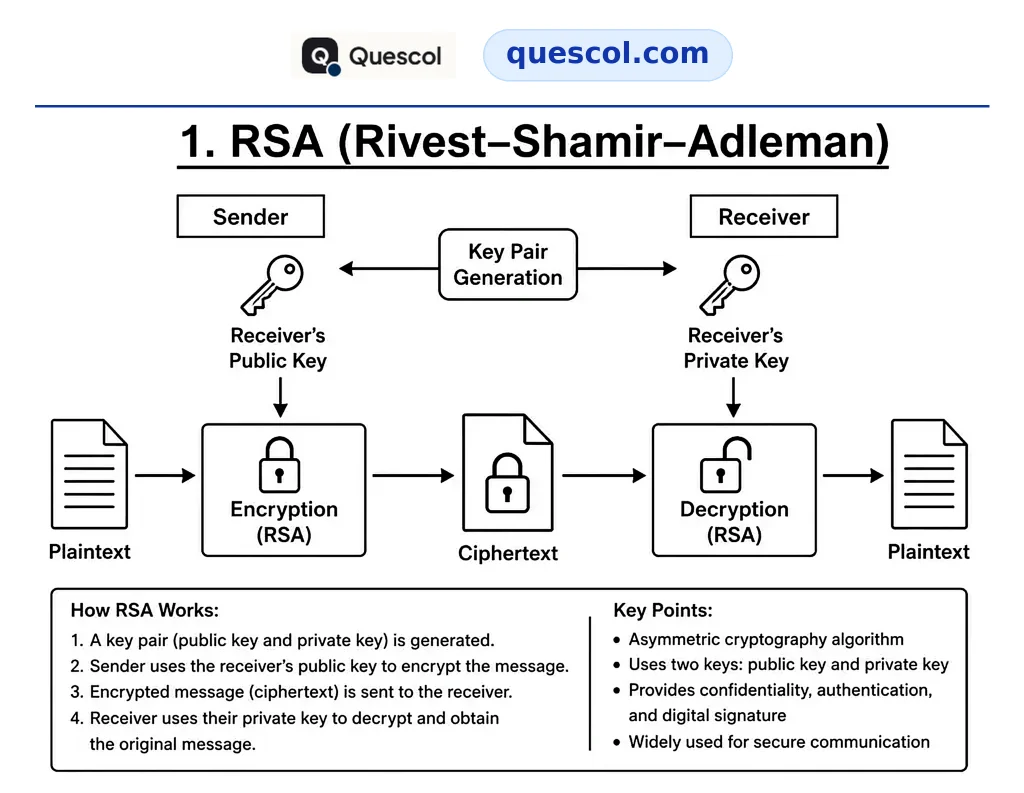
Figure: RSA (Rivest–Shamir–Adleman)
RSA Algorithm (Public Key Cryptography)
The RSA Algorithm is one of the most widely used cryptographic techniques in computer networks. It is based on the mathematical concept of large prime number factorization and modular arithmetic. RSA is an asymmetric encryption method, which means it uses two different keys: a public key for encryption and a private key for decryption. It is mainly used to secure data transmission over the internet.
RSA works in three main stages: Key Generation, Encryption, and Decryption. These steps ensure that data remains secure and can only be accessed by the intended receiver.
1. Key Generation
Key generation is the first and most important step in RSA. It creates the public and private keys used for secure communication.
- First, two large prime numbers are selected, say p and q, and they must be kept secret.
- The product of these primes is calculated as n = p × q, which becomes part of both keys.
- Then, Euler’s Totient Function is calculated as Φ(n) = (p − 1)(q − 1).
- An encryption key e is chosen such that 1 < e < Φ(n) and gcd(e, Φ(n)) = 1.
- Finally, the decryption key d is calculated using (d × e) ≡ 1 mod Φ(n).
- Public Key = (n, e)
- Private Key = (n, d)
2. Encryption
Encryption is the process of converting plain text into unreadable cipher text using the public key.
- The original message M is first converted into a numerical format using encoding methods like ASCII.
- The sender uses the public key (n, e) to encrypt the message.
- The encryption formula is: C = M^e mod n.
- Here, C represents the encrypted cipher text that is sent over the network securely.
3. Decryption
- Decryption is the reverse process where cipher text is converted back into the original message using the private key.
- Only the receiver with the private key can perform this step, ensuring security.
- The receiver uses the private key (n, d) to decrypt the message.
- The cipher text C is processed using the formula: M = C^d mod n.
- This operation retrieves the original message in readable form.
For example,
Step 1: Choose Prime Numbers
Choose two prime numbers:Now calculate the value of :
The value of is used in both the public and private keys.
Step 2: Calculate Euler’s Totient Function
Now compute Euler’s function:
This value helps in generating encryption and decryption keys.
Step 3: Choose Public Key Value (e)
Choose a number such that:Let:So, the public key becomes:
Step 4: Calculate Private Key Value (d)
Find a value of such that:
Choose:Verification:Thus, the private key becomes:
Encryption Process
Suppose the message is:The message must be less than .
Encryption formula:Therefore:
Decryption Process
Now decrypt the ciphertext using the private key:Using modular exponentiation:Therefore:The original message is successfully recovered after decryption.
Idea Behind RSA Algorithm
- RSA security is based on the fact that factoring a very large number is extremely difficult in practice.
- The public key is (n, e), where n = p × q and both values are public.
- The private key is (n, d), where d is kept secret by the receiver only.
- Encryption and decryption depend on the relation: (d × e) ≡ 1 mod Φ(n).
- To find d, one must calculate Φ(n) = (p − 1)(q − 1).
- This requires knowing p and q, which are hidden inside n.
- Although n is public, it is formed by multiplying two very large prime numbers.
- Factoring such a large number n into p and q is computationally very hard.
- This difficulty is the main security strength of RSA.
- RSA commonly uses keys of at least 2048 bits; 1024-bit RSA is deprecated.
- If someone finds p and q, they can easily compute d and break the encryption.
- Therefore, RSA remains secure as long as factorization of n stays infeasible.
Advantages of RSA Algorithm
1. High Security
RSA is considered a very secure encryption algorithm. It is widely used for protecting sensitive data during transmission. The security is based on the difficulty of factoring the product of two large primes. This makes it very hard for attackers to break.
2. Public Key Cryptography
RSA uses two different keys: a public key for encryption and a private key for decryption. This makes communication more secure and flexible. Users can share the public key openly without risk. Only the private key owner can decrypt the data.
3. Secure Key Exchange
RSA allows secure exchange of secret keys between two parties. The key is never sent directly over the network. Instead, it is encrypted using the public key. This prevents unauthorized access during transmission.
4. Digital Signatures
RSA is widely used to create digital signatures. A sender signs data using their private key, and the receiver verifies it using the public key. This ensures authenticity and integrity of the message. It helps in preventing tampering.
5. Widely Used
RSA is used in many real-world applications like online banking, e-commerce, and secure communication systems. It is a trusted standard in cybersecurity. Many websites use RSA in HTTPS security. It is highly reliable in practice.
Disadvantages of RSA Algorithm
1. Slow Processing Speed
RSA is slower compared to other encryption algorithms. It requires more time to encrypt and decrypt data. This makes it less suitable for large data transfers. Performance can be affected in real-time systems.
2. Large Key Size Requirement
RSA requires large key sizes (1024-bit, 2048-bit or more) for strong security. This increases computational load and storage requirements. It also slows down processing. Larger keys improve security but reduce efficiency.
3. Vulnerability to Side-Channel Attacks
RSA can be attacked using side-channel techniques. Attackers may analyze power consumption, timing, or electromagnetic signals. This can help them extract private keys. It requires extra protection measures.
4. Not Suitable for Large Data
RSA is not efficient for encrypting large amounts of data. Due to its slow speed, it is mainly used for small data like keys. Symmetric encryption is preferred for bulk data encryption. This limits its usage.
5. Complex Algorithm
RSA is based on complex mathematical concepts. It can be difficult for beginners to understand and implement. Proper implementation requires strong technical knowledge. Errors can lead to security issues.
6. Key Management Issues
Managing and protecting private keys is very important in RSA. If the private key is lost or exposed, security is completely broken. Secure storage and handling are challenging. It requires strict security practices.
7. Vulnerability to Quantum Computing
Future quantum computers may break RSA encryption easily. They can solve large factorization problems much faster. This poses a long-term security threat. New quantum-safe algorithms may be needed in future.
Conclusion
RSA algorithm is one of the most important and widely used public key cryptographic techniques in computer networks. It provides strong security by using two different keys, where the public key is used for encryption and the private key is used for decryption. Its security mainly depends on the difficulty of factoring large prime numbers, which makes it highly reliable for protecting sensitive data.
Overall, RSA is widely used in secure communication systems such as online banking, e-commerce, and digital signatures. Although it has some limitations like slow processing speed and large key size requirements, its strong security features make it a trusted algorithm. Therefore, RSA plays a crucial role in ensuring safe, authenticated, and secure data transmission in modern digital communication systems.