Cryptography is an important technique used to protect data and communication in computer networks. It converts readable information into a secret coded form so that unauthorized users cannot access it. This process helps maintain privacy, security, and confidentiality of digital information. Therefore, cryptography plays a major role in modern communication systems and internet security.
In addition, cryptography is widely used in online banking, email security, passwords, digital signatures, and e-commerce applications. It ensures that only authorized users can read or modify sensitive information. Different cryptographic methods are used based on security requirements and communication needs. Among them, symmetric key cryptography and asymmetric key cryptography are the two main types used in secure communication systems.
What is Cryptography?
Cryptography is the process of securing information by converting readable data into an unreadable coded form called ciphertext. It protects sensitive data from unauthorized access during storage and transmission. Only authorized users with the correct key can convert the coded data back into its original form. Therefore, cryptography helps maintain data security, privacy, integrity, and confidentiality in computer networks and digital communication systems.
- Converts plaintext into ciphertext using algorithms and keys
- Ensures confidentiality, integrity, authentication, and non-repudiation
- Used in secure communication, digital signatures, passwords, and online transactions
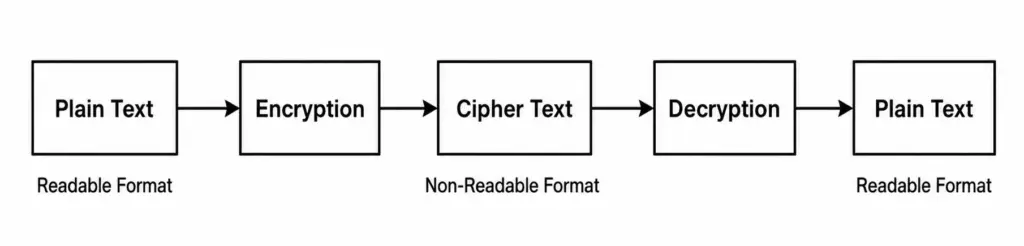
Figure: Cryptography
Features of Cryptography
1. Data Confidentiality
Cryptography keeps information private by converting readable data into secret coded form. Only authorized users with the correct key can access the original data. Therefore, sensitive information remains protected from unauthorized access.
2. Data Integrity
Cryptography ensures that data is not modified or damaged during transmission. It helps detect unauthorized changes in the information. Thus, users receive accurate and trustworthy data.
3. Authentication
This feature verifies the identity of users, devices, or systems during communication. It ensures that data is exchanged between trusted parties only. Therefore, fake or unauthorized users can be prevented.
4. Non-Repudiation
Cryptography prevents users from denying their actions after sending a message or transaction. Digital signatures provide proof of communication and data transfer. Hence, accountability and trust increase in digital systems.
5. Secure Communication
Cryptography protects data while it travels across networks and the internet. It reduces the risk of hacking, data theft, and cyber attacks. Therefore, communication becomes safer and more reliable.
6. Access Control
This feature allows only authorized users to access protected information. Encryption keys and passwords help restrict unauthorized access. Thus, system security improves significantly.
7. Privacy Protection
Cryptography safeguards personal and confidential information from exposure. It protects banking details, passwords, and private messages. Therefore, users can maintain privacy in digital communication.
8. Digital Signature Support
Cryptography supports digital signatures for verifying message authenticity. It confirms that the message comes from the original sender. Hence, secure and trustworthy communication becomes possible.
Working of Cryptography
1. Plaintext Creation
The original readable information is called plaintext. This data may include messages, passwords, banking details, or files. Therefore, plaintext is the actual information that needs protection.
2. Encryption Process
During encryption, cryptographic algorithms convert plaintext into an unreadable coded form called ciphertext. A key is used to perform this conversion securely. Thus, unauthorized users cannot understand the data.
3. Transmission of Ciphertext
After encryption, the ciphertext is transmitted through the network or stored securely. Even if attackers access the data, they cannot read it without the correct key. Therefore, data remains protected during communication.
4. Decryption Process
At the receiver’s side, the ciphertext is converted back into readable form using a decryption key. This process restores the original information for authorized users. Hence, the receiver can access the actual data correctly.
5. Use of Cryptographic Keys
Cryptography uses keys to encrypt and decrypt information securely. These keys control access to protected data. Therefore, only authorized users with the correct key can read the information.
6. Authentication Verification
Cryptography also verifies the identity of users and systems during communication. It ensures that data comes from a trusted source. Thus, fake users and unauthorized access can be prevented.
7. Integrity Checking
The system checks whether the data was modified during transmission. If any changes are detected, the receiver is informed immediately. Therefore, data integrity and accuracy are maintained.
8. Secure Data Delivery
Finally, cryptography ensures that sensitive information reaches the correct user safely and securely. It protects communication from hacking, theft, and cyber attacks. Hence, digital communication becomes reliable and trustworthy.
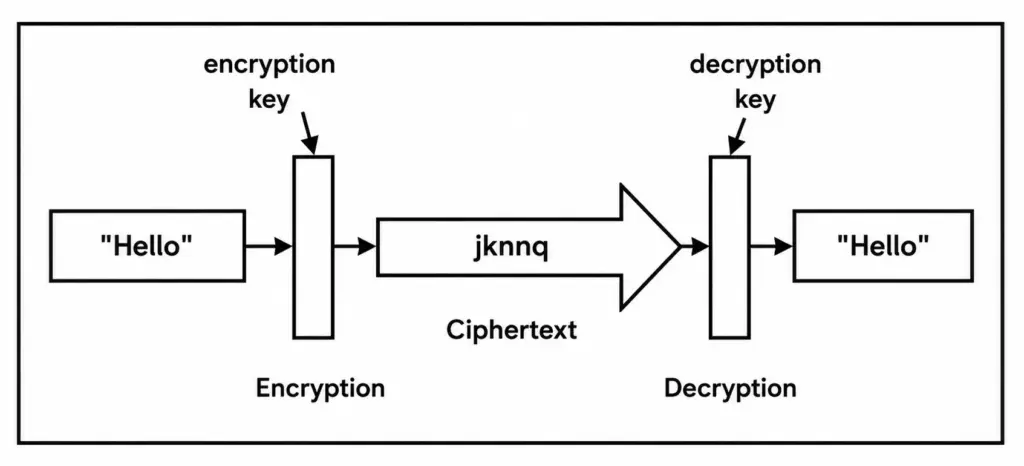
Figure: Working Of Cryptography
"Hello" is a plaintext and convert into ciphertext "jknnq" with the help of cryptographic key and then decrypt into "Hello".
Applications of Cryptography
Cryptography has wide area of applications in the modern world, where the technology is rapidly evolving. These are some of the most common applications of cryptography listed below:
- 1. Password Security: Passwords are hashed before storage to prevent exposure even if the database is leaked.
- 2. Digital Currencies: Bitcoin and other cryptocurrencies use cryptography for transaction integrity and identity protection.
- 3. Secure Web Browsing (HTTPS): SSL/TLS protocols encrypt communication between browser and server.
- 4. Electronic Signatures: Legally valid digital signatures created using public-key cryptography.
- 5. Authentication Systems: Used in bank logins, secure networks, and access control systems.
- 6. End-to-End Encryption: Messaging apps like WhatsApp and Signal ensure only intended users read the messages.
Types of Cryptography
1. Symmetric Key Cryptography
Symmetric key cryptography uses the same key for both encryption and decryption of data. The sender and receiver share a common secret key for secure communication. This method is faster and suitable for large data transmission. Therefore, it is widely used in file encryption and secure communication systems.
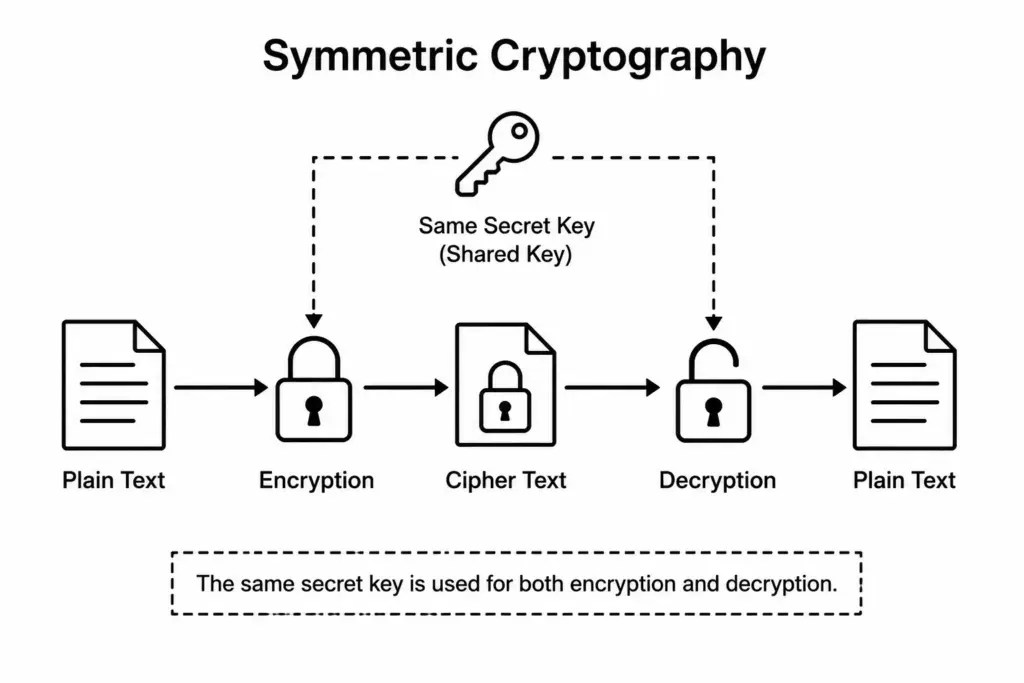
Figure: Symmetric Key Cryptography
Examples of Symmetric Key Algorithms
1. DES (Data Encryption Standard)
DES is one of the earliest symmetric key encryption algorithms developed for securing digital data. It uses a 56-bit secret key to encrypt and decrypt information. This algorithm converts plaintext into ciphertext through multiple encryption rounds. Therefore, it was widely used in banking systems and secure communication in earlier computer networks.
DES provides fast encryption and was considered highly secure during its initial years. However, with the growth of modern computing power, attackers can now break DES more easily using brute-force attacks. As a result, DES is no longer considered fully secure for modern applications. Still, it played an important role in the development of modern cryptography systems.
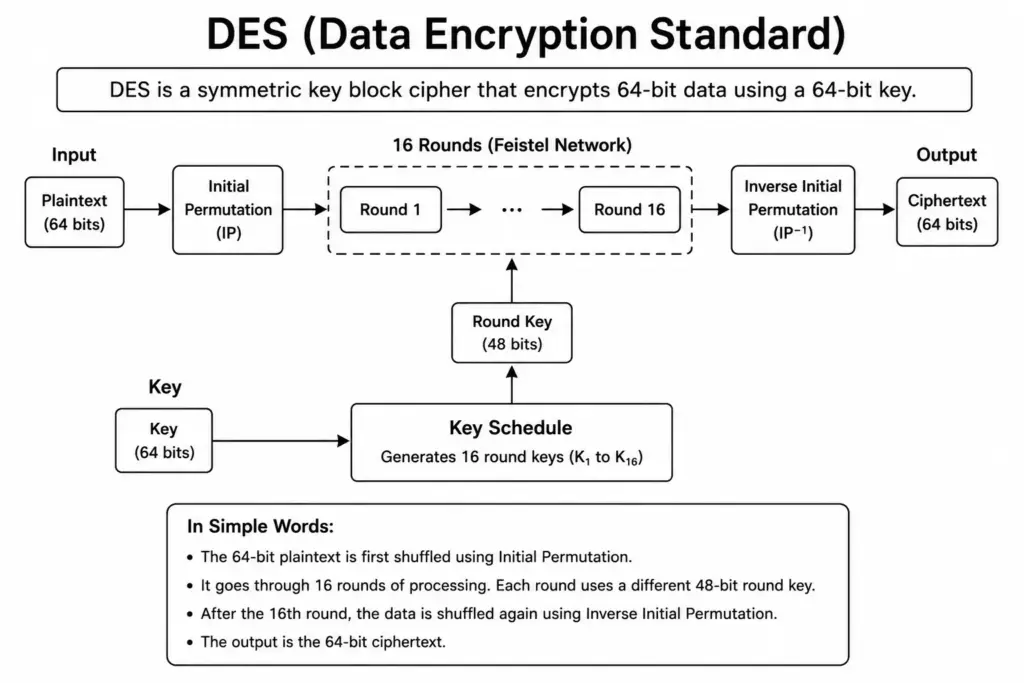
Figure: DES (Data Encryption Standard)
For example,
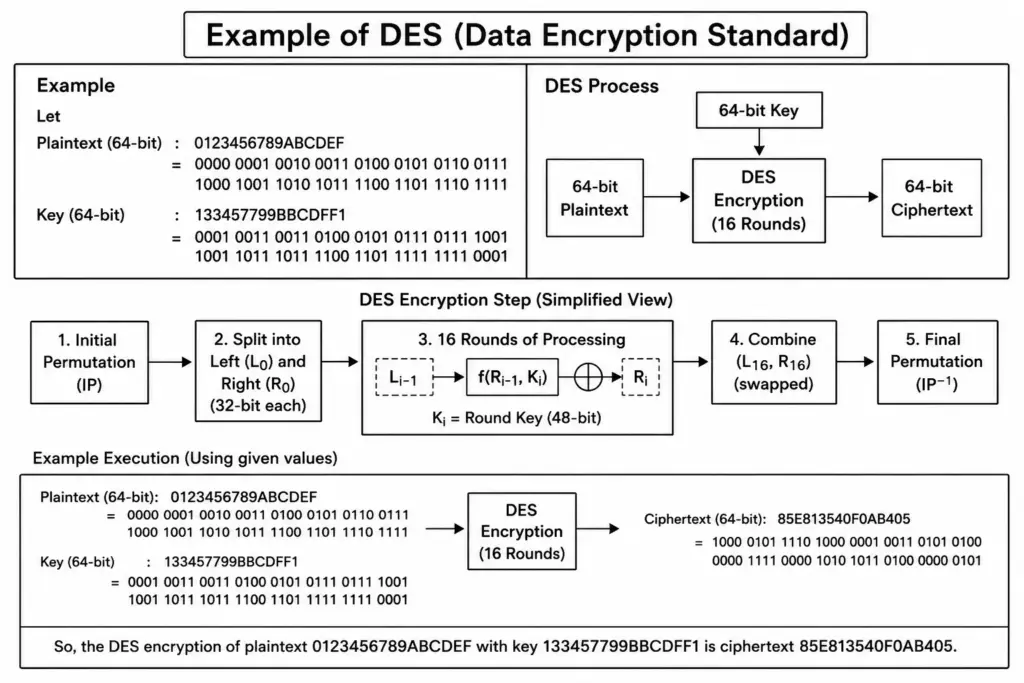
Figure: DES tool example
2. AES (Advanced Encryption Standard)
AES is a modern symmetric key encryption algorithm widely used for secure communication and data protection. It supports key sizes of 128-bit, 192-bit, and 256-bit, which provide strong security against cyber attacks. AES encrypts data through several transformation rounds to produce highly secure ciphertext. Therefore, it is one of the most trusted encryption standards in the world.
AES is faster, stronger, and more efficient than DES. It is widely used in banking systems, wireless networks, cloud security, and government applications. In addition, AES requires less processing power while providing high security. Thus, it has become the standard encryption method for modern digital communication and data storage.
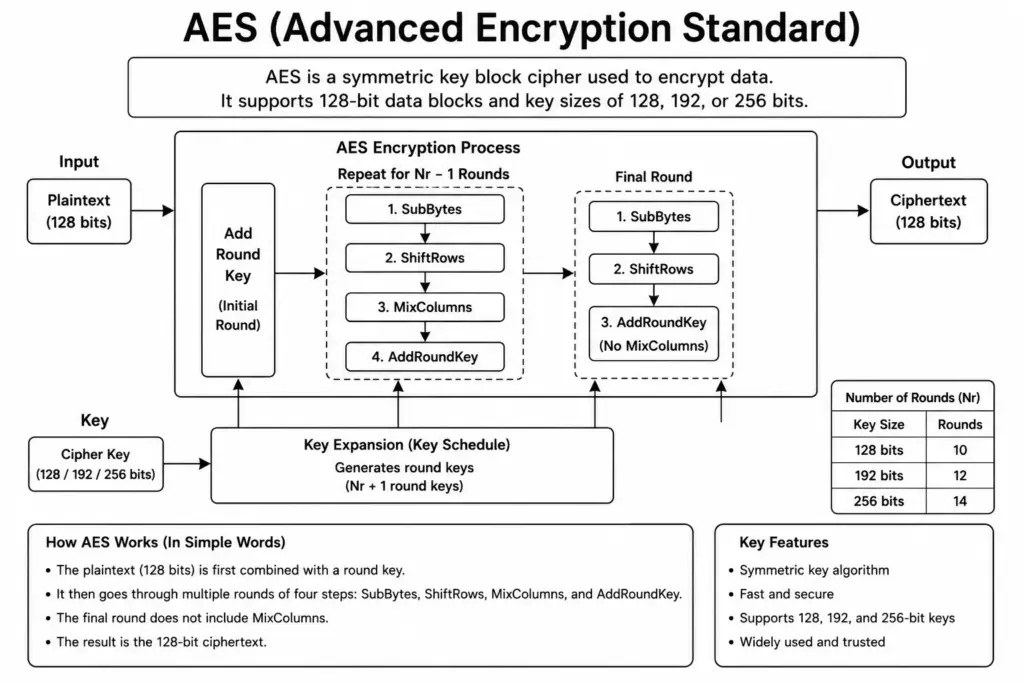
Figure: AES (Advanced Encryption Standard)
For example,
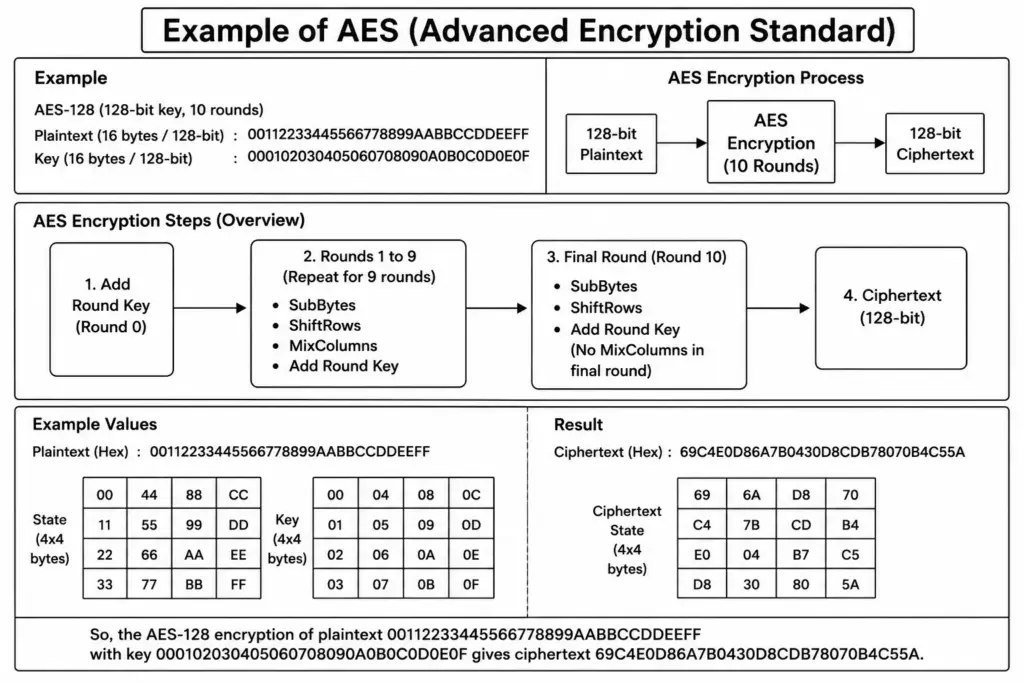
Figure: AES tool example
3. Triple DES (3DES)
Triple DES, also known as 3DES, is an improved version of the DES algorithm. It applies the DES encryption process three times using either two or three different keys. This multiple encryption process increases security compared to standard DES. Therefore, 3DES provides stronger protection for sensitive data.
3DES was introduced to overcome the security weaknesses of DES without completely changing the existing system. It offers better security but works slower because data is encrypted multiple times. Although more secure than DES, it is less efficient than AES in modern systems. Hence, many organizations now prefer AES instead of 3DES for advanced security applications.
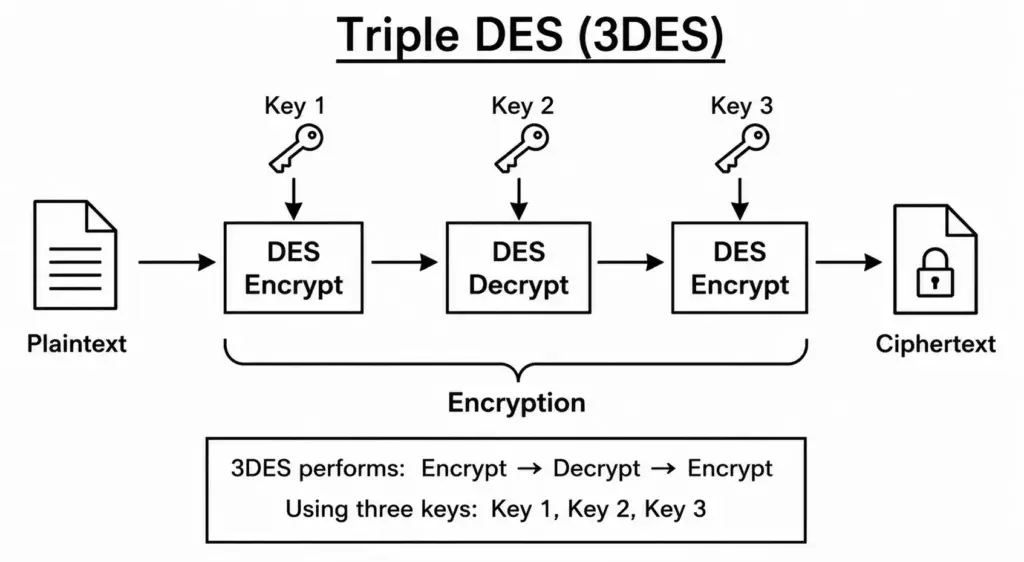
Figure: Triple DES (3DES)
For example,
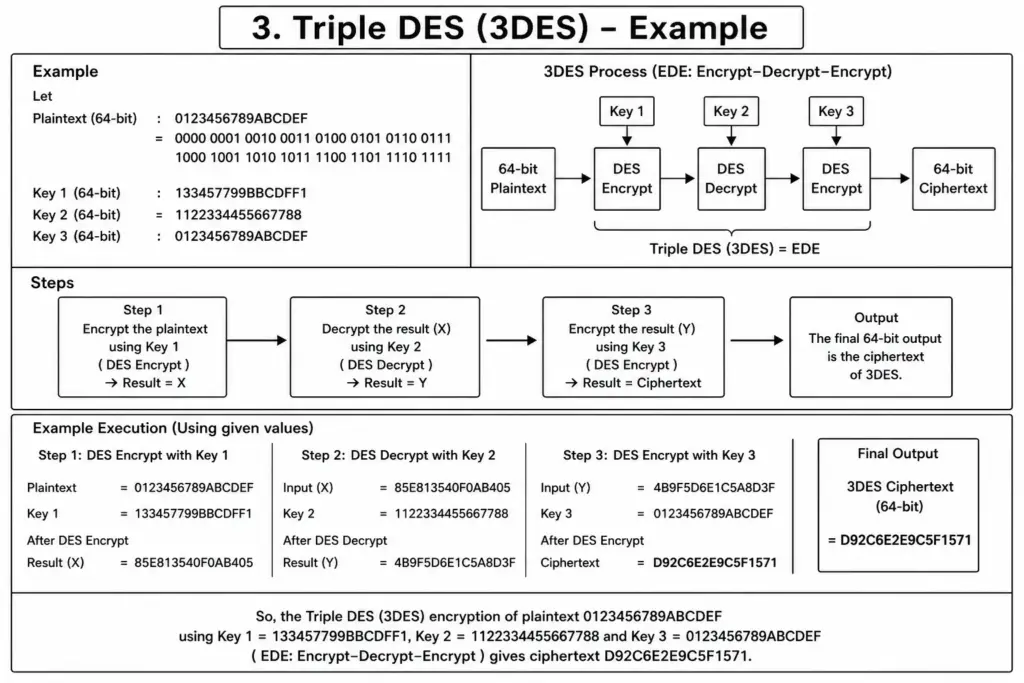
Figure: Triple DES (3DES) example
Working of Symmetric Key Cryptography
1. Creation of Plaintext
The original readable data is called plaintext. This information may include messages, files, passwords, or documents. Therefore, plaintext is the data that needs protection.
2. Encryption Using Secret Key
The sender uses a secret key and encryption algorithm to convert plaintext into ciphertext. The ciphertext becomes unreadable to unauthorized users. Thus, sensitive information remains secure.
3. Transmission of Ciphertext
The encrypted data is transmitted through the network to the receiver. Even if attackers access the ciphertext, they cannot understand it without the secret key. Therefore, communication remains protected.
4. Decryption Using Same Key
The receiver uses the same shared key to decrypt the ciphertext into plaintext. This restores the original readable information successfully. Hence, authorized users can access the data correctly.
Features of Symmetric Key Cryptography
1. Single Shared Key
It uses one common key for both encryption and decryption processes. The sender and receiver must keep this key secret. Therefore, secure key management becomes important.
2. Fast Encryption Process
Symmetric encryption works faster compared to asymmetric encryption. It can handle large amounts of data efficiently. Thus, it is suitable for high-speed communication systems.
3. Simple Implementation
The encryption and decryption processes are less complex. This makes symmetric cryptography easier to implement and manage. Therefore, it is widely used in many applications.
4. High Performance
This method requires less computational power during encryption. As a result, system performance remains efficient even with large files. Hence, data processing becomes faster.
Advantages of Symmetric Key Cryptography
1. Faster Data Encryption
Symmetric encryption processes data quickly because it uses a single key. Therefore, it supports high-speed communication and file transfer.
2. Efficient for Large Data
This method can encrypt large files and databases efficiently. Thus, it is widely used in storage systems and secure communication.
3. Less Computational Power
Symmetric cryptography requires fewer system resources during encryption and decryption. Therefore, devices perform operations faster and more efficiently.
4. Easy to Implement
The encryption process is simple compared to complex cryptographic systems. Hence, implementation and maintenance become easier.
Disadvantages of Symmetric Key Cryptography
1. Key Distribution Problem
The sender and receiver must share the secret key securely before communication. If the key is intercepted, data security becomes weak. Therefore, secure key exchange is difficult.
2. Lower Security in Large Networks
Managing secret keys becomes difficult when many users are involved. Different users require separate keys for communication. Thus, security management becomes complex.
3. No Digital Signature Support
Symmetric cryptography does not support digital signatures for authentication. Therefore, it cannot fully verify the identity of the sender.
4. Risk of Key Exposure
If the shared key becomes known to unauthorized users, all encrypted data can be accessed. Hence, protecting the key is very important.
Applications of Symmetric Key Cryptography
1. File Encryption
Symmetric encryption is used to protect files and documents from unauthorized access. Therefore, sensitive information remains secure.
2. Secure Data Storage
Many storage systems use symmetric encryption to protect stored data. Thus, users can safely store important files and information.
3. Banking Systems
Banks use symmetric encryption for securing financial transactions and customer data. Therefore, online banking communication remains protected.
4. Wireless Network Security
Wi-Fi security protocols use symmetric cryptography to protect wireless communication. Hence, network users can communicate securely.
2. Asymmetric Key Cryptography
Asymmetric key cryptography uses two different keys, known as a public key and a private key. The public key encrypts the data, while the private key decrypts it. This method provides higher security and supports digital signatures. Thus, it is commonly used in online banking and secure internet communication.
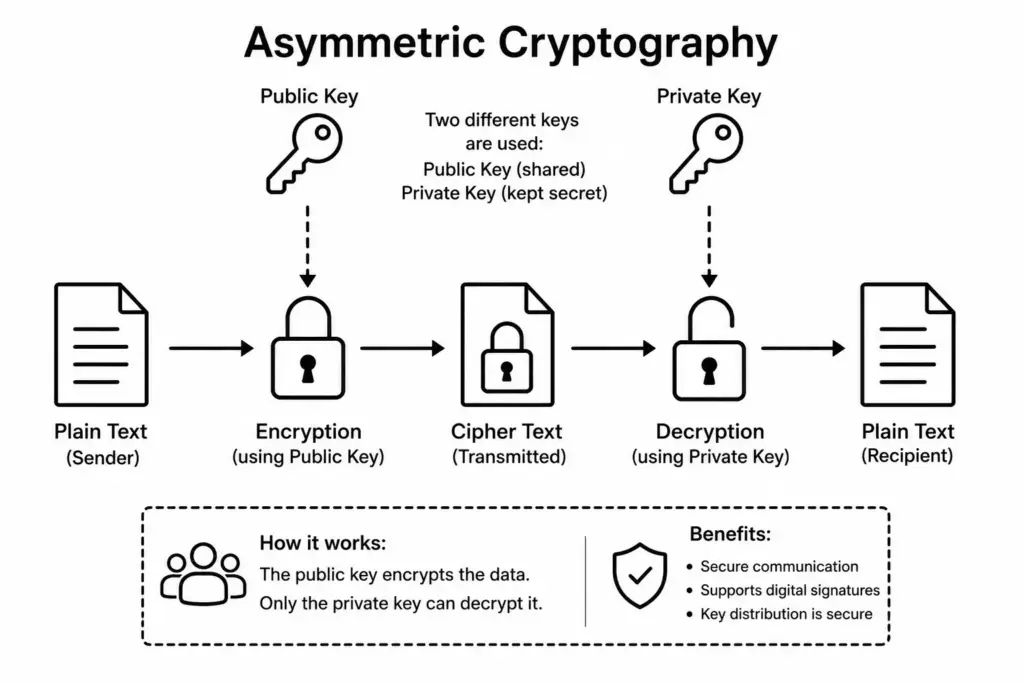
Figure: Asymmetric Cryptography
Examples of Asymmetric-Key Algorithms
1. RSA (Rivest–Shamir–Adleman)
RSA is one of the most widely used asymmetric key cryptography algorithms. It uses two different keys, namely a public key and a private key, for secure communication. The public key is used to encrypt data, while the private key is used to decrypt it. Therefore, RSA provides strong security for digital communication and online transactions.
RSA was developed by Ron Rivest, Adi Shamir, and Leonard Adleman, and the algorithm is named after their surnames. It is based on mathematical calculations involving large prime numbers, which makes it difficult for attackers to break the encryption. Thus, RSA is considered highly secure for transmitting sensitive information over networks.
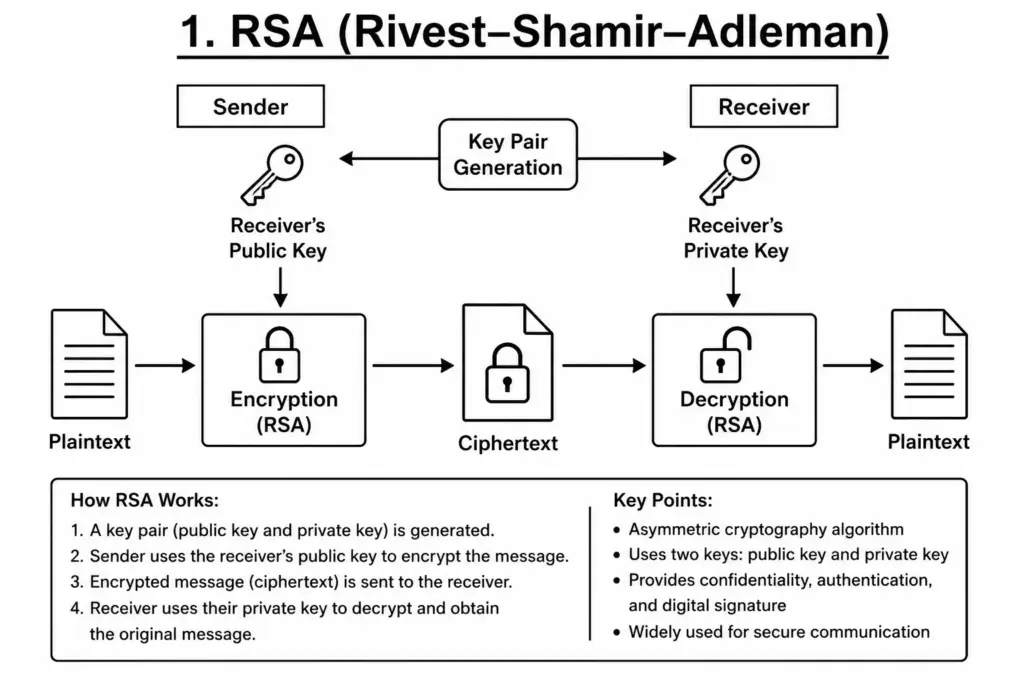
Figure: RSA (Rivest–Shamir–Adleman)
For example,
Step 1: Choose Prime Numbers
Choose two prime numbers:Now calculate the value of n:
The value of n is used in both the public and private keys.
Step 2: Calculate Euler’s Totient Function
Now compute Euler’s function:
This value helps in generating encryption and decryption keys.
Step 3: Choose Public Key Value (e)
Choose a number e such that:Let:So, the public key becomes:
Step 4: Calculate Private Key Value (d)
Find a value of d such that:
Choose:Verification:Thus, the private key becomes:
Encryption Process
Suppose the message is:The message must be less than n.
Encryption formula:Therefore:
Decryption Process
Now decrypt the ciphertext using the private key:Using modular exponentiation:Therefore:
The original message is successfully recovered after decryption.
2. ECC (Elliptic Curve Cryptography)
Elliptic Curve Cryptography (ECC) is a modern asymmetric encryption technique that provides strong security using smaller key sizes. It is faster and more efficient than many traditional algorithms like RSA. Therefore, ECC is highly suitable for smartphones, IoT devices, smart cards, and blockchain systems.
ECC uses mathematical points on elliptic curves to perform encryption and decryption operations. Because of smaller key sizes, it consumes less memory, power, and bandwidth. Thus, ECC provides secure and lightweight communication in modern digital systems.
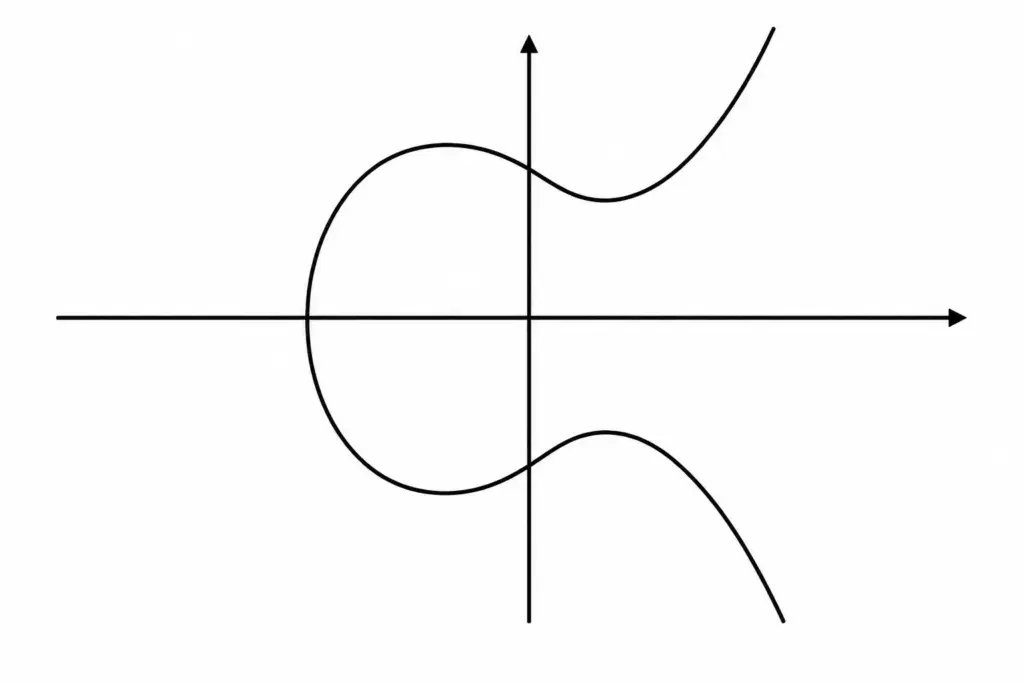
Figure: Elliptic Curve
Elliptic Curve Equation
ECC commonly uses the standard elliptic curve equation:
Choose the following values:
- Prime Field:
- Curve Parameters:
Therefore, the elliptic curve equation becomes:
This equation is used to generate points on the elliptic curve for secure cryptographic operations.
Features of Asymmetric Key Cryptography
1. Two-Key System
It uses separate public and private keys for encryption and decryption. This increases security and reduces the risk of unauthorized access.
2. High Security
The private key is never shared publicly, which improves communication security. Therefore, it is safer for internet-based communication.
3. Digital Signature Support
Asymmetric cryptography supports digital signatures for authentication and verification. This ensures message authenticity and prevents forgery.
4. Secure Key Exchange
It allows secure exchange of encryption keys over public networks. Thus, communication becomes safer without sharing secret keys directly.
Working of Asymmetric Key Cryptography
1. Public Key Encryption
The sender uses the receiver’s public key to encrypt the data before transmission. This converts readable information into coded form. Therefore, unauthorized users cannot understand the message.
2. Data Transmission
After encryption, the ciphertext is sent through the network or internet. Even if attackers intercept the message, they cannot read it without the private key. Thus, communication remains secure.
3. Private Key Decryption
The receiver uses a private key to decrypt the encrypted message. This converts the ciphertext back into readable plaintext. Therefore, only the authorized receiver can access the original information.
4. Authentication and Security
Asymmetric cryptography also supports digital signatures and authentication. It verifies the identity of users and ensures trusted communication. Hence, it improves data security and integrity.
Advantages of Asymmetric Key Cryptography
1. High Security
Asymmetric cryptography provides strong security because it uses two separate keys for encryption and decryption. The private key remains secret and cannot be easily accessed by attackers. Therefore, sensitive information stays protected.
2. Secure Key Distribution
The public key can be shared openly without compromising security. There is no need to transmit the private key through the network. Thus, the risk of key theft decreases significantly.
3. Supports Digital Signatures
This method supports digital signatures for verifying the identity of the sender. It helps confirm message authenticity and prevents forgery. Therefore, trust and accountability improve in communication systems.
4. Better Authentication
Asymmetric cryptography verifies users and systems before communication begins. This reduces the chances of unauthorized access and cyber attacks. Hence, communication becomes safer and more reliable.
5. Suitable for Internet Communication
It is widely used in online banking, email security, and secure websites. The method protects confidential information over public networks. Therefore, it supports secure internet communication effectively.
6. Ensures Data Integrity
This cryptography method checks whether the transmitted data has been modified during communication. It helps maintain accuracy and reliability of information. Thus, users receive original and unchanged data.
Disadvantages of Asymmetric Key Cryptography
1. Slower Processing Speed
Asymmetric cryptography requires complex mathematical calculations for encryption and decryption. Because of this, data processing becomes slower compared to symmetric cryptography. Therefore, it may reduce communication speed.
2. High Computational Cost
This method consumes more processing power and system resources. Advanced hardware may be needed for efficient performance. Hence, implementation costs become higher.
3. Complex Key Management
Managing public and private keys securely can be difficult in large systems. Loss of private keys may lead to communication problems. Therefore, proper key management is necessary.
4. Not Suitable for Large Data Encryption
Encrypting large amounts of data using asymmetric cryptography can be slow and inefficient. It is mainly used for small data or secure key exchange. Thus, it is less practical for bulk data transfer.
5. Larger Key Size Requirement
Asymmetric cryptography requires larger key sizes to maintain strong security. This increases storage and processing requirements. Therefore, system complexity also increases.
6. Risk of Private Key Loss
If the private key is lost or stolen, encrypted data cannot be decrypted securely. This may lead to data access problems or security risks. Hence, private keys must be protected carefully.
Applications of Asymmetric Key Cryptography
1. Online Banking
Banks use asymmetric cryptography to protect financial transactions and customer information. It ensures secure communication between users and banking servers. Therefore, online banking becomes safe and reliable.
2. Secure Websites
HTTPS websites use asymmetric encryption to protect user data during internet browsing. It secures passwords, payment details, and personal information. Thus, users can browse securely.
3. Digital Signatures
Asymmetric cryptography supports digital signatures for document verification and authentication. It confirms the originality of digital documents and messages. Therefore, it improves trust in online communication.
4. Email Security
Secure email systems use asymmetric encryption to protect confidential messages. Only authorized receivers can read the encrypted emails. Hence, email privacy and security improve significantly.
5. E-Commerce Applications
Online shopping platforms use asymmetric cryptography for secure payment processing. It protects customer information and transaction details from hackers. Therefore, electronic commerce becomes more secure.
6. Virtual Private Networks (VPNs)
VPN services use asymmetric encryption for secure remote communication. It protects internet traffic from unauthorized access. Thus, users can communicate safely over public networks.
Difference Between Symmetric and Asymmetric Key Cryptography
| Basis of Comparison | Symmetric Key Cryptography | Asymmetric Key Cryptography |
|---|---|---|
| Definition | Symmetric cryptography uses the same key for both encryption and decryption. | Asymmetric cryptography uses two different keys: a public key and a private key. |
| Number of Keys | Only one secret key is used. | Two separate keys are used. |
| Speed | It is faster because fewer calculations are required. | It is slower due to complex mathematical operations. |
| Security Level | Security depends on the algorithm, key size, implementation, and secure distribution of the shared key. | Security depends on the algorithm, key size, implementation, private-key protection, and authentic public-key distribution. |
| Key Distribution | Sharing the secret key securely is difficult. | Public keys can be shared openly, but they must be authentic. |
| Encryption Process | The same key encrypts and decrypts data. | One key encrypts data and another key decrypts it. |
| Complexity | It is simple and easy to implement. | It is more complex and computationally intensive. |
| Performance | Suitable for large amounts of data because of high speed. | Suitable for secure communication and authentication. |
| Examples | DES, AES, Triple DES (3DES), Blowfish | RSA, ECC, Diffie–Hellman, DSA |
| Applications | Used in file encryption, database security, and VPNs. | Used in digital signatures, SSL/TLS, and online banking. |
| Key Management | Managing many secret keys becomes difficult in large networks. | Key management is easier because public keys are openly distributed. |
| Main Advantage | Provides fast encryption and decryption. | Provides better security and authentication. |
| Main Disadvantage | Secret key sharing creates security risks. | Slower performance compared to symmetric encryption. |
Classical Ciphers
Ciphers are techniques used to convert readable data (plaintext) into unreadable data (ciphertext). Only authorized users can decode it back to the original message.
Examples:
- Military communication (e.g., Enigma machine)
- CTF and hacking challenges
- Simple malware obfuscation techniques
Types of Classical Ciphers:
1. Substitution Cipher:
In this method, each letter is replaced with another letter based on a fixed rule.
Example: In Caesar Cipher, A → D, B → E.
Used in puzzles and basic encryption tasks.
2. Transposition Cipher:
In this method, the positions of letters are rearranged without changing the letters themselves.
Example: Rail Fence Cipher (zigzag pattern).
Used to make messages harder to read.
| Cipher Name | Description | Real-life / CTF Use |
|---|---|---|
| Caesar Cipher | Each letter is shifted by a fixed number of places. | Hidden messages in simple malware, games, or emails. |
| Vigenère Cipher | Uses a keyword to shift letters, making it stronger than Caesar. | Used in older secret messages and CTF puzzles. |
| Atbash Cipher | Reverses the alphabet (A ↔ Z, B ↔ Y, etc.). | Seen in basic cryptography and steganography challenges. |
| ROT13 | A Caesar cipher with a fixed shift of 13. | Used for hiding spoilers and light obfuscation online. |
| Rail Fence Cipher | A transposition cipher that rearranges letters in a zigzag pattern. | Used in simple puzzles and message scrambling. |
Conclusion
Cryptography is an essential technique used to protect sensitive information and secure communication in computer networks. It converts readable data into coded form so that unauthorized users cannot access it. Therefore, cryptography helps maintain confidentiality, integrity, authentication, and privacy in modern digital systems. Today, it is widely used in banking, e-commerce, email security, and online communication.
Symmetric and asymmetric key cryptography are the two major types of cryptographic methods used for securing data. Symmetric key cryptography uses a single key for both encryption and decryption, making it faster and suitable for large data transmission. On the other hand, asymmetric key cryptography uses two different keys, which provide higher security and support secure key exchange and digital signatures. Thus, both methods play important roles based on different security requirements.
In addition, modern security systems often combine both symmetric and asymmetric cryptography to achieve better performance and stronger protection. Algorithms such as DES, AES, RSA, and ECC are widely used in secure communication systems across the world. Therefore, cryptography remains one of the most important technologies for protecting digital information and ensuring safe communication over networks and the internet.
The block diagrams for both types are in cryptography with block diagrams.