The transport layer in computer networks plays a very important role in enabling communication between applications running on different devices. It is responsible for transferring data from the source device to the destination device in a smooth, organized, and efficient manner. It receives data from the application layer, divides it into smaller units when required, and delivers it to the appropriate application running on the receiving device.
The transport layer also provides important services such as end-to-end communication, error detection, flow control, data segmentation, and reliable data delivery. It uses port numbers to identify different applications and ensure that the received data reaches the correct application.
There are two major protocols used at the transport layer: TCP (Transmission Control Protocol) and UDP (User Datagram Protocol).
Both TCP and UDP are responsible for delivering data between applications over a network, but they follow different approaches. TCP focuses on reliable and ordered data delivery by using acknowledgments, retransmission, and flow control. On the other hand, UDP focuses on faster communication with less overhead and does not guarantee that every packet will reach its destination.
The choice between TCP and UDP depends on the requirements of the application. For example, TCP is commonly used for web browsing, email, and file transfers, where reliable data delivery is important. UDP is commonly used in online gaming, live video streaming, and voice calls, where low latency and fast communication are often more important than retransmitting lost data.
What is TCP (Transmission Control Protocol)?
TCP (Transmission Control Protocol) is a connection-oriented protocol used in the transport layer of computer networks. It is designed to provide reliable communication between two devices connected through a network. TCP ensures that data is delivered accurately, completely, and in the correct order from the sender to the receiver without missing or duplicating data.
Before transmitting data, TCP establishes a connection between the sender and receiver using a process called the Three-Way Handshake. During this process, both devices exchange control messages to establish the connection and synchronize their sequence numbers. Once the connection is established, data transmission begins.
TCP divides large amounts of data into smaller units called segments before sending them over the network. Each segment contains important information, such as source and destination port numbers, sequence numbers, acknowledgment numbers, and control flags. These fields help TCP manage communication and ensure that data reaches the correct application.
TCP also provides several mechanisms to maintain reliable data transmission. It uses error detection to identify corrupted segments and acknowledgments (ACKs) to confirm successful data reception. If a segment is lost or damaged, TCP can retransmit the missing data. It also uses sequence numbers to arrange received data in the correct order, even if segments arrive at the destination in a different order.
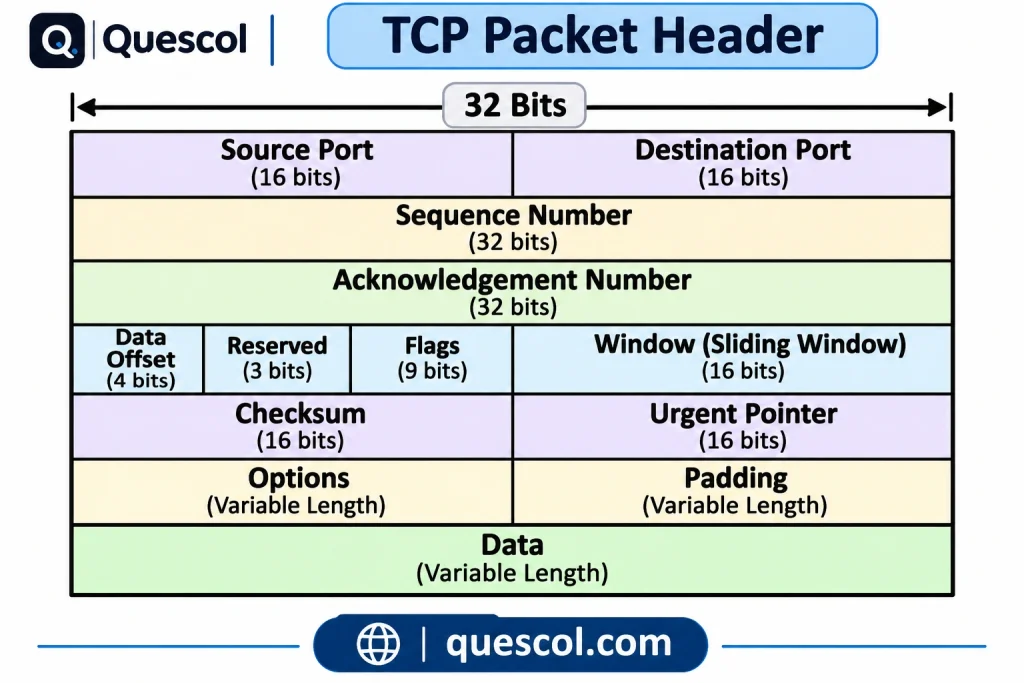
Figure: TCP Header Format
Working of TCP Header
1. Connection Establishment (Three-Way Handshake)
TCP starts communication using the Three-Way Handshake process. First, the sender sends a SYN signal to request a connection. Then, the receiver replies with a SYN-ACK signal to confirm readiness. Finally, the sender sends an ACK signal to complete the connection. This ensures both sides are synchronized and ready for reliable communication.
2. Segmentation of Data
In this step, large data is divided into smaller segments before transmission. Each segment is given a sequence number for proper identification. This helps in tracking the correct order of data at the receiver side. As a result, data transmission becomes more organized and efficient.
3. Data Transmission
After segmentation, data is sent across the network in TCP segments. Each segment carries a TCP header containing important details like ports, sequence numbers, and flags. These details help in routing and managing the data properly. Therefore, TCP ensures safe and accurate delivery of data.
4. Acknowledgement Mechanism
TCP uses acknowledgements to confirm successful data delivery. When the receiver gets data correctly, it sends an ACK signal back to the sender. The ACK number indicates the next expected byte. This process ensures reliable and continuous communication.
5. Error Control and Retransmission
TCP detects errors using sequence numbers and acknowledgements. If any segment is lost or corrupted during transmission, it is identified easily. Then TCP automatically retransmits the missing data. This guarantees complete and error-free delivery of information.
6. Flow Control
Flow control manages the speed of data transfer in TCP. The receiver informs the sender about how much data it can handle using a window size. This prevents overload at the receiver side. Therefore, communication remains smooth and efficient.
7. Connection Termination
TCP closes the connection using FIN and ACK signals. Both sender and receiver confirm that all data has been successfully transferred. After confirmation, the connection is properly closed. This ensures a clean and safe end to communication.
What is UDP (User Datagram Protocol)?
UDP (User Datagram Protocol) is a connectionless protocol used in the transport layer of computer networks. It is designed to provide fast and simple communication between devices over a network. Unlike TCP, UDP does not establish a connection between the sender and receiver before transmitting data. Instead, it directly sends data packets called datagrams to the destination without performing a connection establishment process.
UDP is a lightweight protocol because it has a smaller header size of 8 bytes and requires less processing compared to TCP. It does not use acknowledgments or retransmission mechanisms to guarantee the delivery of data. As a result, some datagrams may be lost, duplicated, or received in a different order during transmission.
UDP provides basic error detection using a checksum to identify corrupted data. However, it does not provide error recovery or guarantee that data will reach the destination successfully. It also does not provide built-in flow control or congestion control like TCP.
One of the main advantages of UDP is its high transmission speed and low communication delay. Since it does not establish connections or wait for acknowledgments, data can be transmitted quickly with less overhead. This makes UDP suitable for applications where fast communication is more important than guaranteed delivery.
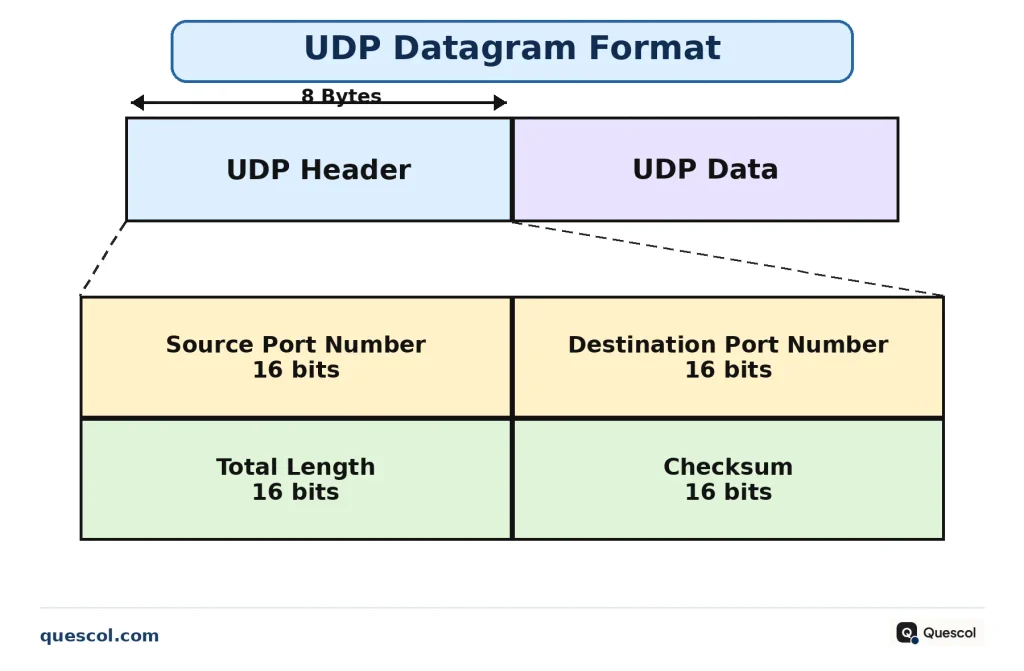
Figure: UDP Header
Working of UDP
1. No Connection Establishment
UDP does not establish any connection before sending data. There is no handshake process like in TCP, so communication starts immediately. This reduces delay and makes transmission faster. It is useful for real-time applications where quick delivery is important.
2. Data Transmission (Datagrams)
UDP sends data in the form of small packets called datagrams. Each datagram is independent and carries its own header information. These packets travel separately through the network. This independence allows fast transmission but may lead to loss or disorder.
3. No Acknowledgement
UDP does not send acknowledgements after receiving data. The sender does not get confirmation whether the data reached the receiver. This reduces overhead and increases speed. However, it makes communication unreliable.
4. No Error Recovery
UDP does not provide any mechanism to recover lost or corrupted data. It only uses a checksum to detect errors in transmission. If an error is found, the packet is simply discarded. There is no retransmission of lost data.
5. No Flow Control
UDP does not control the rate of data transmission. The sender continues to send data without checking the receiver’s capacity. This can sometimes overload the receiver. However, it helps maintain high speed in communication.
6. No Ordering Guarantee
UDP does not ensure that packets arrive in the correct order. Datagrams may reach the destination in a different sequence. The protocol does not rearrange them. If ordering is needed, it must be handled by the application itself.
Difference Between TCP and UDP
| Basis | TCP (Transmission Control Protocol) | UDP (User Datagram Protocol) |
|---|---|---|
| Connection Type | TCP is connection-oriented protocol. | UDP is connectionless protocol. |
| Reliability | It provides reliable data delivery. | It is not reliable and may lose data. |
| Speed | TCP is slower due to error checking and connection setup. | UDP is faster as it sends data directly. |
| Order of Data | Data arrives in proper sequence. | Data may arrive in random order. |
| Error Checking | TCP uses checksum-based error detection and recovers from lost or corrupted segments through retransmission. | Limited or no error checking. |
| Data Transfer | Data is sent as a stream of packets. | Data is sent as independent datagrams. |
| Overhead | High overhead due to control mechanisms. | Low overhead and lightweight protocol. |
| Acknowledgement | Acknowledgement is required after delivery. | No acknowledgement is required. |
| Flow Control | Flow control is present. | Flow control is not present. |
| Usage | Used in email, web browsing, file transfer. | Used in video streaming, gaming, voice calls. |