The transport layer is an important part of the OSI model because it ensures smooth communication between devices. It works between the network layer and the application layer. In simple terms, it helps deliver data from one system to another without errors. As a result, users can enjoy reliable communication over the internet.
Moreover, the transport layer controls how data is sent and received. It breaks large data into smaller pieces and then sends them efficiently. At the same time, it also checks for errors and ensures correct delivery. Therefore, it plays a key role in maintaining data accuracy and speed.
What is the transport layer?
The transport layer is the fourth layer of the OSI model that provides end-to-end communication between devices. It provides process-to-process delivery using ports, segmentation, and multiplexing. Connection-oriented protocols such as TCP add reliable, ordered delivery, flow control, and retransmission, while connectionless protocols such as UDP do not guarantee delivery or ordering.
- The transport layer is the fourth layer of the OSI model and it ensures end-to-end communication between devices.
- It breaks large data into smaller segments before sending, so transmission becomes easier and faster.
- It reassembles the data segments at the receiver side in the correct order.
- It provides flow control, so the sender does not overwhelm the receiver with too much data.
- It performs error detection and correction, which helps maintain data accuracy.
- It ensures reliable communication using protocols like TCP and faster communication using UDP.
- It adds port numbers to identify different applications running on a device.
- It manages connection establishment, maintenance, and termination between devices.
- It improves overall data transmission efficiency and reliability in the network.
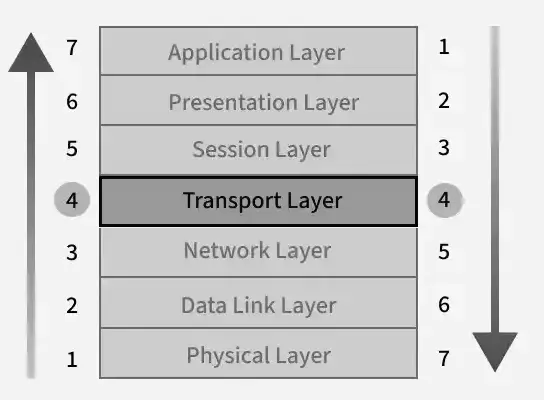
Figure: Transport Layer
Functions of Transport Layer
The transport layer plays a vital role in ensuring reliable communication between devices in a network. It acts as a bridge between the application layer and the network layer. In addition, it manages how data is sent, received, and verified. Therefore, it helps maintain smooth and error-free data transmission.
Moreover, the transport layer focuses on end-to-end delivery of data. TCP can ensure that information reaches the correct destination without loss or duplication; UDP does not provide that guarantee. At the same time, it improves efficiency by controlling speed and handling errors. Thus, it becomes essential for modern communication systems.
1. Segmentation and Reassembly
- The transport layer divides large data into smaller segments.
- This makes transmission easier and faster across the network.
- After transmission, it reassembles the segments at the receiver side.
- With TCP, this supports complete and ordered data delivery; UDP does not guarantee either.
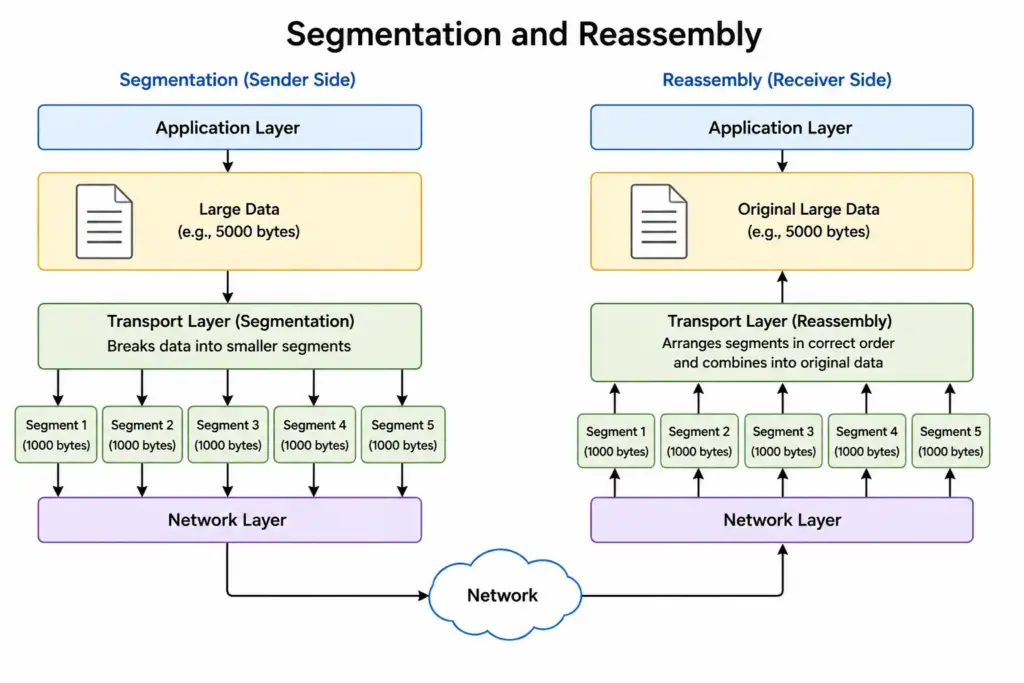
Figure: Segmentation and Reassembly
2. Flow Control
- It controls the rate of data transmission between sender and receiver.
- This prevents the receiver from getting overloaded.
- As a result, data loss is reduced.
- Therefore, communication becomes stable and efficient.
3. Error Control
- It detects errors during data transmission.
- When TCP detects loss, it requests retransmission of data; UDP does not.
- Hence, it maintains data accuracy.
- Thus, reliable communication is ensured.
4. End-to-End Communication
- It provides communication directly between source and destination.
- Unlike lower layers, TCP can ensure complete delivery of data; UDP cannot.
- Therefore, data reaches the correct application.
- This improves communication quality.
5. Multiplexing and Demultiplexing
- It allows multiple applications to use the network at the same time.
- Data from different applications is combined for transmission.
- At the receiver side, it separates the data correctly.
- Thus, efficient data handling is achieved.
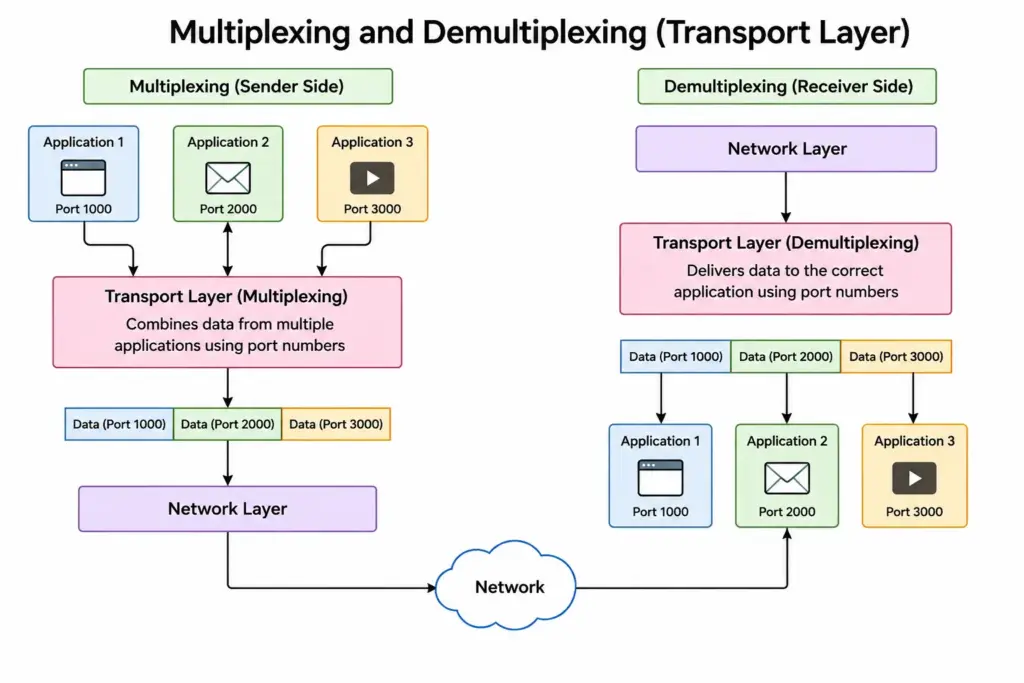
Figure: Multiplexing and Demultiplexing
6. Connection Control
- It establishes, maintains, and terminates connections.
- It ensures proper coordination between devices.
- Both connection-oriented and connectionless services are supported.
- Therefore, flexibility in communication is provided.
Working of Transport Layer
1. Data Segmentation
- First, the transport layer receives data from the application layer.
- Then, it breaks the large data into smaller segments.
- This makes it easier to send data over the network.
- Hence, transmission becomes faster and efficient.
2. Adding Header Information
- Next, it adds a header to each segment.
- Transport headers include source and destination ports; TCP also includes sequence and acknowledgment numbers, while UDP does not.
- These details help in identifying and ordering data.
- Therefore, proper delivery is ensured.
3. Data Transmission
- After that, the segments are sent to the network layer.
- The network layer forwards them to the destination.
- During this process, multiple paths may be used.
- Thus, data reaches the receiver through the network.
4. Error and Flow Control
- Meanwhile, the transport layer checks for errors.
- If a TCP segment is lost, TCP requests retransmission; UDP does not.
- It also controls the speed of data flow.
- Hence, communication remains stable and reliable.
5. Reassembly of Data
- Finally, the receiver collects all segments.
- TCP then arranges them in the correct order; UDP does not guarantee ordered delivery.
- After that, it combines them into original data.
- Thus, complete information is delivered to the application layer.
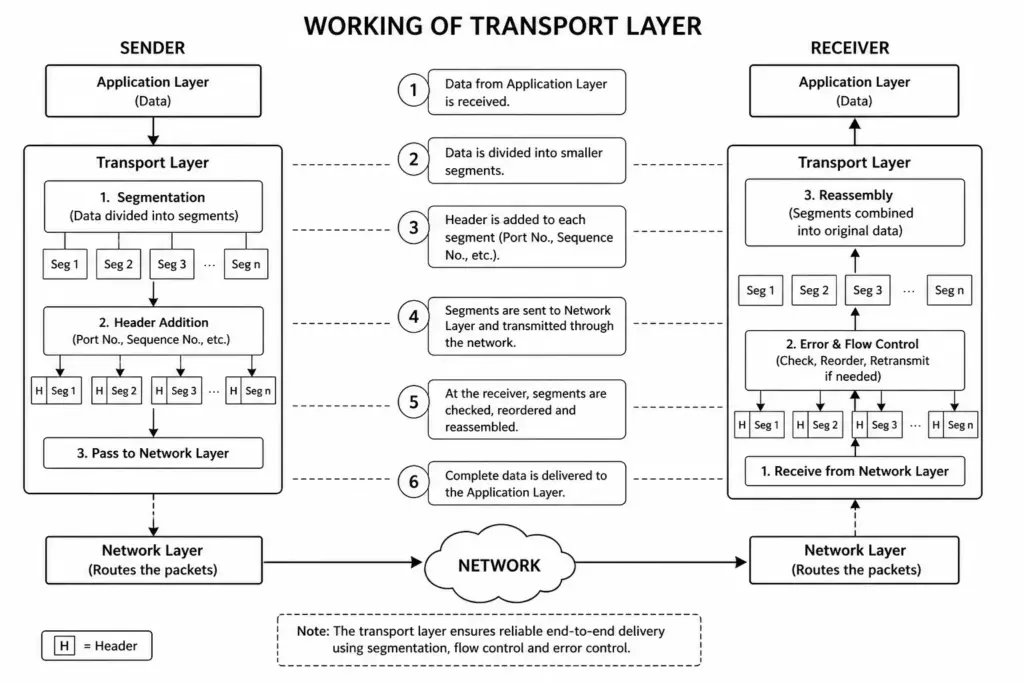
Figure: Working of Transport Layer
Transport Layer Protocols
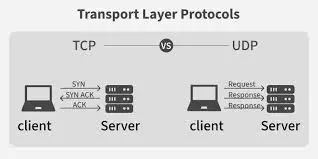
Figure: Transport Layer Protocols
1. Transmission Control Protocol (TCP)
- TCP is a connection-oriented protocol.
- It establishes a connection before sending data.
- TCP supports reliable, ordered data delivery; UDP does not guarantee delivery or ordering.
- Therefore, it is used in applications like web browsing and email.
2. User Datagram Protocol (UDP)
- UDP is a connectionless protocol.
- It sends data without establishing a connection.
- It is faster but does not guarantee reliability.
- Thus, it is used in video streaming and online gaming.
Key Differences Between TCP and UDP
TCP
- Reliable and ordered communication
- Slower due to error checking
- Connection-oriented
- Used for important data transfer
UDP
- Fast and efficient communication
- No guarantee of delivery
- Connectionless
- Used for real-time applications
Three-Way Handshake (TCP Connection)
The Three-Way Handshake is a process used by TCP to establish a reliable connection between a client and a server. It ensures that both sides are ready to send and receive data. In addition, it helps in synchronizing sequence numbers, which are important for ordered data delivery. Therefore, it creates an established TCP connection with synchronized initial sequence numbers.
Moreover, this process happens before actual data transmission begins. It involves three important steps using control signals. Each step confirms that both devices are active and prepared. Thus, it ensures a safe and reliable start to communication.
Steps in Three-Way Handshake
1. SYN (Synchronization)
- First, the client sends a SYN message to the server.
- This message indicates a request to start communication.
- It also includes an initial sequence number.
- Thus, the connection process begins.
2. SYN-ACK (Synchronization Acknowledgment)
- Next, the server responds with a SYN-ACK message.
- It acknowledges the client’s request.
- It also sends its own sequence number.
- Therefore, the server confirms it is ready.
3. ACK (Acknowledgment)
- Finally, the client sends an ACK message back to the server.
- This confirms that the connection is established.
- Now both sides are synchronized.
- Thus, data transmission can start.
Conclusion
In conclusion, the transport layer plays a crucial role in computer networks by ensuring reliable and efficient end-to-end communication. It manages important tasks such as segmentation, flow control, error control, and data reassembly. In addition, it uses protocols like TCP and UDP to provide both reliability and speed based on application needs. Therefore, it helps maintain smooth and accurate data transmission.
Overall, the transport layer improves communication quality by handling errors, controlling data flow, and establishing TCP connection state through the three-way handshake. Although it adds some complexity and delay, its benefits are essential for modern networking. Thus, it becomes a key layer for ensuring dependable and effective data exchange.
How TCP opens that connection is in the three-way handshake.