In earlier communication systems, most telephone networks relied on analog technology, which was mainly designed to transmit voice signals. As communication requirements increased, users started expecting more than just voice communication. They needed a reliable way to transfer data, send text, share images, and communicate through video.
Traditional analog networks had limitations when handling different types of communication services. Using separate networks or connections for different services could also increase complexity and make communication less efficient. Therefore, there was a growing need for a digital communication system that could support multiple services through a common network.
To overcome these limitations, Integrated Services Digital Network (ISDN) was introduced. It uses digital technology to transmit voice, data, text, images, and video through telephone networks. Instead of depending entirely on separate communication systems, ISDN integrates multiple services into a single digital network.
ISDN provides better signal quality, reliable communication, and efficient use of network resources. It also supports multiple communication channels, allowing users to make voice calls and transfer data simultaneously, depending on the ISDN connection and services available.
Because of these features, ISDN became useful for both home users and business organizations. It was used in applications such as digital telephone services, internet access, fax transmission, and video conferencing.
Thus, ISDN was introduced to overcome the limitations of traditional analog telephone networks and provide an integrated digital communication system capable of supporting different types of communication services.
What is ISDN?
ISDN (Integrated Services Digital Network) is a digital communication system that allows the transmission of voice, data, text, and video over standard telephone lines. It integrates multiple services into a single network, which improves efficiency and performance.
Moreover, ISDN converts analog signals into digital form, which reduces noise and increases clarity. It supports simultaneous communication using separate channels for data and control.
For example, A company uses ISDN to connect its head office with branch offices. First, employees make voice calls while also transferring important files at the same time. Then, the system uses B channels for data and voice, while the D channel manages signaling. As a result, communication becomes faster, clearer, and more efficient without using separate lines.
Features of ISDN
1. Digital Transmission
ISDN uses pure digital signals, so it avoids the noise and distortion common in analog systems. Therefore, voice calls sound clearer and data arrives with fewer errors. Moreover, digital transmission supports consistent quality over long distances. As a result, users experience reliable communication for both voice and data services.
2. Integration of Services
ISDN integrates voice, data, video, and text on a single network connection. Therefore, organizations do not need separate lines for telephone, fax, and internet. In addition, this integration simplifies network management and reduces infrastructure complexity. As a result, communication becomes more efficient and cost-effective.
3. Multiple Channel Support
ISDN divides bandwidth into B (Bearer) channels and a D (signaling) channel. Therefore, it can carry multiple streams simultaneously—such as a call on one B channel and data on another. Moreover, users can bond (combine) B channels to increase speed (e.g., 64 kbps + 64 kbps = 128 kbps). Hence, it offers both flexibility and better performance when needed.
4. Faster Call Setup
ISDN uses the D channel for signaling and call control, which speeds up connection establishment. Therefore, users do not wait long for a line to connect, unlike traditional dial-up systems. In addition, quick setup improves user experience for time-sensitive tasks. As a result, communication feels more responsive and efficient.
5. High Reliability
ISDN provides stable and consistent connections because it uses digital signaling and structured channels. Moreover, it is less affected by electrical interference and line noise. Therefore, the chances of dropped calls or corrupted data are lower. As a result, it is suitable for business communication that requires dependability.
6. Flexibility
ISDN offers BRI (Basic Rate Interface) for small users and PRI (Primary Rate Interface) for large organizations. Therefore, it can scale based on user requirements. In addition, different devices—such as ISDN phones, fax machines, and computers—can share the same connection. Hence, it adapts well to various environments.
7. Simultaneous Voice and Data
ISDN allows users to talk and transfer data at the same time using separate channels. Therefore, a person can be on a call while sending files or browsing the internet. Moreover, this parallel usage improves productivity in offices. As a result, tasks can be completed faster without interrupting communication.
8. Global Standardization
ISDN follows international standards, which ensures compatibility across different networks and countries. Therefore, devices and services can work together without major issues. In addition, standardization simplifies deployment and maintenance. Hence, ISDN supports interoperable and wide-area communication.
Functions of the ISDN User-Network Protocol Layers
SDN (Integrated Services Digital Network) uses a standardized three-layer protocol architecture to manage communication between user equipment and the network. These layers are based on the OSI reference model and perform different functions to ensure reliable data transmission and call management.
The three main layers are:
- Physical Layer
- Data Link Layer
- Network Layer
Each layer performs a specific task and works with the other layers to establish, maintain, and terminate communication.
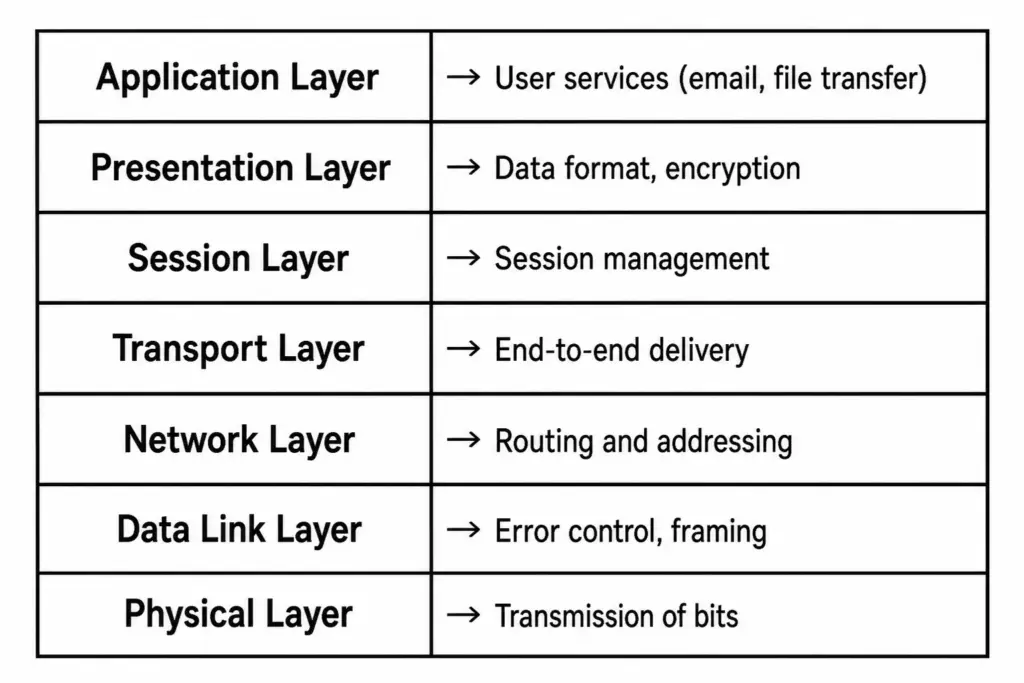
Figure: ISDN Functions
The standardized ISDN user-network protocol architecture defines Layers 1-3; higher-layer application functions depend on the service and are not defined by ISDN itself.
1. Physical Layer (Layer 1)
The physical layer is the first layer of the ISDN protocol architecture. It is responsible for transmitting raw bits between user equipment and the ISDN network through the physical communication interface.
It defines the electrical and physical characteristics of the connection, including signal levels, transmission speed, framing, timing, and synchronization.
The physical layer supports two main types of ISDN access: Basic Rate Interface (BRI) and Primary Rate Interface (PRI). It also manages the activation and deactivation of the physical connection.
Functions:
- Bit Transmission: Transfers raw binary data (0s and 1s) between the user’s equipment and the ISDN network.
- Electrical Characteristics: Defines signal levels, electrical requirements, and physical interface specifications for communication.
- Framing: Organizes transmitted bits into frames so that the receiving equipment can identify and interpret the information correctly.
- Activation and Deactivation: Controls the activation and deactivation of the physical interface when communication is started or stopped.
- Timing and Synchronization: Maintains proper timing between the sender and receiver to ensure accurate data transmission.
- Transmission Support: Provides the physical connection required for transmitting voice and data over the ISDN interface.
2. Data Link Layer (Layer 2)
The data link layer is the second layer of the ISDN protocol architecture. It is responsible for providing reliable communication between user equipment and the network at the data-link level.
ISDN uses a protocol called LAPD (Link Access Procedure for the D-channel) at this layer. LAPD is mainly used to transfer signaling information through the D-channel.
The data link layer organizes information into frames and manages addressing, error detection, and retransmission when required. It helps ensure that signaling messages are exchanged correctly between the user and the network.
Functions:
- Frame Formation: Organizes signaling information into frames before transmitting it through the D-channel.
- Addressing: Uses data-link addresses to identify the communication endpoint and service access point.
- Error Detection: Detects transmission errors in frames using error-checking techniques.
- Sequencing: Uses sequence numbers to maintain the correct order of signaling frames.
- Retransmission: Retransmits frames when errors or transmission failures are detected.
- Link Management: Establishes, maintains, and releases the data-link connection between user equipment and the network.
3. Network Layer(Layer 3)
The network layer is the third layer of the ISDN protocol architecture. It is responsible for managing call control and establishing communication between the user and the ISDN network.
ISDN uses the Q.931 signaling protocol at this layer. It manages the complete call-control process, including call establishment, call maintenance, and call termination.
The network layer also carries important information about the called party, the type of service requested, and the communication capabilities required for the connection.
Functions:
- Call Establishment: Uses Q.931 signaling messages to request and establish a connection between the caller and receiver.
- Call Maintenance: Manages the status of an active call and handles signaling information during communication.
- Call Release: Terminates the connection when communication ends and releases the resources allocated to the call.
- Called-Party Information: Carries information about the destination number or called party to establish the required connection.
- Bearer Capability: Identifies the type of communication service required, such as voice or data transmission.
- Call Management: Handles call-control messages and manages the different stages of a communication session.
Types of ISDN
ISDN is mainly classified into two types based on the number of communication channels provided and the capacity required by users. These types are designed to support different communication needs, ranging from individual users and small businesses to large organizations.
The two main types of ISDN are:
- Basic Rate Interface (BRI)
- Primary Rate Interface (PRI)
1. Basic Rate Interface (BRI)
Basic Rate Interface (BRI) is a type of ISDN service designed mainly for home users, small businesses, and offices that require basic digital communication services.
BRI consists of two B (Bearer) channels and one D (Delta or signaling) channel, commonly represented as 2B + D.
- Each B channel provides a data transmission speed of 64 kbps.
- The D channel provides a signaling speed of 16 kbps.
- The two B channels are used to carry voice, data, and other communication information.
- The D channel is used to carry signaling information required for call establishment, management, and termination.
The total transmission capacity of BRI is 144 kbps (2 × 64 kbps + 16 kbps). However, the D channel is primarily used for signaling rather than ordinary user data.
BRI allows users to make two separate calls simultaneously because it provides two independent B channels. Alternatively, both B channels can be combined to provide a data transmission rate of up to 128 kbps.
Characteristics of BRI:
- Two Bearer Channels: Provides two B channels, each with a capacity of 64 kbps, for voice and data transmission.
- One Signaling Channel: Provides one D channel with a capacity of 16 kbps for controlling communication.
- Simultaneous Communication: Allows two separate voice or data connections to operate at the same time.
- Low Cost: Requires fewer channels and is more economical than PRI.
- Easy Installation: Suitable for small offices and home environments with basic communication requirements.
2. Primary Rate Interface (PRI)
Primary Rate Interface (PRI) is a type of ISDN service designed for large organizations, enterprises, call centers, and businesses that require multiple simultaneous communication connections.
PRI provides a larger number of B (Bearer) channels along with one D (Delta or signaling) channel. The number of channels depends on the digital transmission standard used in a particular country.
There are two commonly used PRI configurations:
A. T1-Based PRI (23B + 1D)
- Consists of 23 B channels and one D channel.
- Each B channel provides 64 kbps.
- The D channel provides 64 kbps for signaling.
- Total line capacity is 1.544 Mbps.
- Commonly used in North America and Japan.
B. E1-Based PRI (30B + 1D)
- Consists of 30 B channels and one D channel.
- Each B channel provides 64 kbps.
- The D channel provides 64 kbps for signaling.
- Total line capacity is 2.048 Mbps.
- Commonly used in Europe, India, and many other countries.
PRI allows multiple users to make telephone calls or establish data connections simultaneously through different B channels. The D channel manages the signaling required to establish, maintain, and terminate these connections.
Characteristics of PRI:
- Multiple Bearer Channels: Provides 23 or 30 B channels depending on the transmission standard.
- Dedicated Signaling Channel: Uses one D channel to manage call-control information.
- High Communication Capacity: Supports multiple simultaneous voice and data connections.
- Enterprise Support: Suitable for organizations with large communication requirements.
- Reliable Connectivity: Provides a structured digital communication connection for business operations.
Advantages of ISDN
- High-Quality Digital Communication – ISDN uses digital signals instead of analog, so it provides clear voice and accurate data. Moreover, it reduces noise and distortion, which improves overall communication quality.
- Supports Multiple Services – ISDN can carry voice, data, video, and text on a single line. Therefore, users do not need separate connections, and communication becomes more efficient.
- Simultaneous Communication – ISDN allows multiple channels to work at the same time. For example, users can make calls and transfer data together, which improves productivity.
- Faster Connection Setup – ISDN sets up connections quickly using signaling channels. Hence, users experience less delay compared to traditional systems.
- Better Bandwidth Utilization – ISDN divides communication into channels like B and D. As a result, it uses available bandwidth efficiently and can combine channels for higher speed.
- Reliable Communication – ISDN provides stable and consistent communication. Moreover, it is less affected by interference, which ensures fewer errors and better performance.
Disadvantages of ISDN
- High Cost – ISDN installation and service charges are higher than traditional telephone systems. Therefore, it may not be affordable for all users, especially small businesses.
- Requires Special Equipment – ISDN needs specific devices such as ISDN phones and terminal adapters. As a result, normal analog devices cannot be used directly.
- Limited Speed – Although ISDN is faster than dial-up, it is much slower than modern technologies like broadband and fiber. Hence, it is not suitable for high-speed internet needs.
- Complex Setup – ISDN requires proper configuration and technical knowledge. Therefore, installation and maintenance can be difficult for beginners.
- Becoming Outdated – New technologies like DSL and fiber optics have replaced ISDN in most areas. As a result, its usage is decreasing over time.
- Limited Availability – ISDN services are not available everywhere, especially in rural areas. Therefore, many users cannot access it easily.