In computer networks, multiple devices transmit data packets through shared communication channels. Sometimes, a large number of packets arrive at a network device within a short period. This sudden increase in network traffic can overload routers and communication links, resulting in network congestion, packet loss, and increased transmission delays.
To avoid these problems, different traffic shaping techniques are used to regulate the flow of data packets. One important technique is the Leaky Bucket Algorithm.
The Leaky Bucket Algorithm is used to control the rate at which packets are transmitted through a network. It works like a bucket with a small hole at the bottom. Incoming packets are stored inside the bucket and are transmitted at a fixed rate, regardless of how quickly they arrive.
If packets arrive faster than they can be transmitted, they wait in the bucket. When the bucket becomes full, additional incoming packets are discarded.
This algorithm helps convert irregular and bursty network traffic into a smooth and continuous flow of data. It is useful for traffic shaping, bandwidth management, and congestion prevention in computer networks.
What Is the Leaky Bucket Algorithm?
The Leaky Bucket Algorithm is a traffic shaping technique used in computer networks to control the rate of packet transmission by storing incoming packets in a buffer and transmitting them at a fixed rate.
It works on the principle of a leaking bucket. Imagine a bucket that has a small hole at the bottom. Water enters the bucket at different rates, but it leaves through the hole at a constant rate.
Similarly, in computer networks, incoming data packets are stored in a buffer called a bucket. These packets are transmitted through the network at a predefined and relatively constant rate.
If packets arrive faster than the transmission rate, they remain in the bucket until they can be transmitted. If the bucket becomes full, newly arriving packets are discarded because there is no available storage space.
The main purpose of this algorithm is to smooth sudden variations in network traffic and maintain a steady rate of data transmission.
For example, suppose a router receives 100 packets within one second, but it is configured to transmit only 20 packets per second. The remaining packets are stored in the buffer and transmitted gradually at the configured rate.
Therefore, the Leaky Bucket Algorithm helps regulate network traffic and prevents sudden bursts of packets from overloading network devices.
Components of the Leaky Bucket Algorithm
The Leaky Bucket Algorithm consists of several important components that work together to regulate packet transmission.
1. Bucket (Buffer)
The bucket is a logical storage area that temporarily holds incoming data packets before transmission.
It has a limited capacity, which determines the maximum number of packets that can be stored at a particular time.
When packets arrive faster than they can be transmitted, they are placed in the bucket and wait for their turn.
2. Incoming Packets
Incoming packets are the data packets received by the network device from different sources.
These packets may arrive at irregular intervals and at different rates.
The algorithm stores them in the bucket before forwarding them to their destinations.
3. Leakage Rate
The leakage rate determines how quickly packets leave the bucket and are transmitted through the network.
It is generally maintained at a fixed rate.
For example, if the leakage rate is 10 packets per second, the algorithm transmits 10 packets every second, provided that enough packets are waiting in the bucket.
4. Bucket Capacity
Bucket capacity refers to the maximum number of packets that can be stored in the buffer.
If the number of incoming packets exceeds the available capacity, additional packets are discarded.
A larger bucket can temporarily store more packets, while a smaller bucket has less storage space.
5. Packet Discarding Mechanism
The packet discarding mechanism handles incoming packets when the bucket becomes full.
If the bucket has no available space, newly arriving packets are dropped.
This prevents the buffer from exceeding its maximum capacity.
Working of the Leaky Bucket Algorithm
The Leaky Bucket Algorithm works by storing incoming packets in a buffer and transmitting them at a predefined rate.
It does not transmit packets immediately whenever they arrive. Instead, it maintains a queue and sends packets one by one according to the configured transmission rate.
The following steps explain how the Leaky Bucket Algorithm works.
Step 1: Receiving Incoming Packets
The network device receives data packets from different sources.
These packets may arrive at different rates depending on the network traffic.
Step 2: Storing Packets in the Bucket
The incoming packets are placed in a buffer called the bucket.
The bucket temporarily stores the packets until they are ready for transmission.
Step 3: Checking Bucket Capacity
The algorithm checks whether the bucket has enough available space to store newly arriving packets.
If space is available, the packets are added to the bucket.
If the bucket is already full, additional incoming packets are discarded.
Step 4: Transmitting Packets at a Fixed Rate
Packets are removed from the bucket and transmitted through the network at a predefined rate.
The transmission rate remains relatively constant, even if the incoming packets arrive at irregular intervals.
Step 5: Handling Remaining Packets
If more packets arrive than can be transmitted immediately, the remaining packets stay in the bucket and wait for their turn.
They are transmitted gradually as space becomes available.
Step 6: Maintaining a Smooth Data Flow
The process continues as long as packets arrive.
By controlling the output rate, the algorithm converts irregular incoming traffic into a smoother and more predictable flow of data.
Thus, the Leaky Bucket Algorithm helps prevent sudden traffic bursts from overloading the network.
Example of the Leaky Bucket Algorithm
Consider a network device that uses the Leaky Bucket Algorithm with the following configuration:
- Bucket capacity = 50 packets.
- Leakage rate = 10 packets per second.
- Incoming packets = 30 packets within one second.
Assume that the bucket is initially empty.
Step 1: Thirty packets arrive at the network device and are stored in the bucket.
Step 2: The algorithm starts transmitting packets at a fixed rate of 10 packets per second.
Step 3: During the first second, 10 packets are transmitted, leaving 20 packets in the bucket.
Step 4: During the second second, another 10 packets are transmitted, leaving 10 packets in the bucket.
Step 5: During the third second, the remaining 10 packets are transmitted, and the bucket becomes empty.
This example shows that even though 30 packets arrive together, the algorithm transmits them gradually at a fixed rate.
Now consider another situation where the bucket already contains 45 packets and 10 additional packets arrive.
Since the bucket can store only 50 packets, it can accept only 5 more packets. The remaining 5 packets are discarded.
Therefore, the Leaky Bucket Algorithm controls the transmission rate and prevents the buffer from exceeding its capacity.
Diagram of the Leaky Bucket Algorithm
The Leaky Bucket Algorithm can be understood by comparing it with a water bucket that has a small hole at the bottom.
- Incoming packets enter the bucket.
- The bucket temporarily stores the packets.
- Packets leave through the output at a fixed rate.
- If the bucket becomes full, additional incoming packets are discarded.
The basic flow of the algorithm is:
Incoming Packets → Bucket (Buffer) → Fixed-Rate Output → Destination
The algorithm maintains a steady output even when packets arrive at irregular intervals.
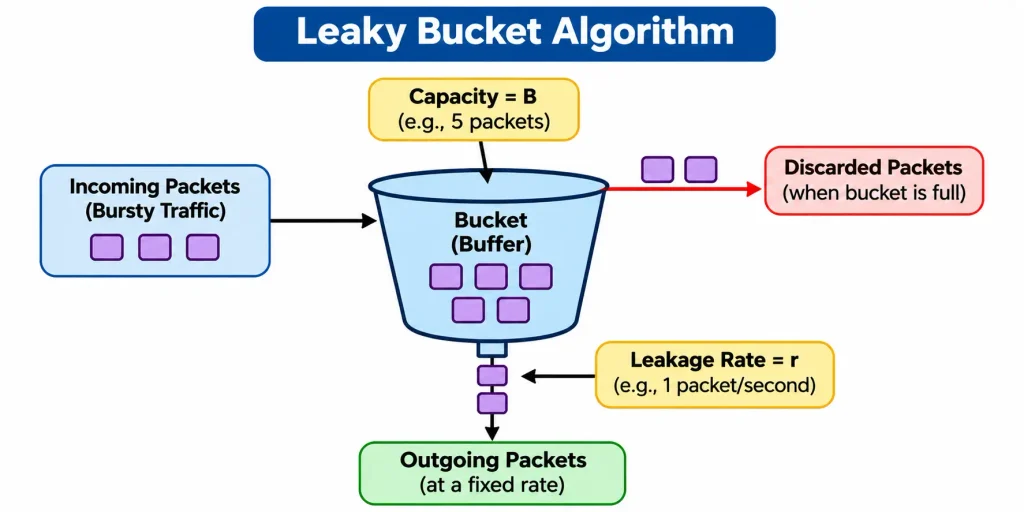
Figure: Leaky Bucket Algorithm
Characteristics of the Leaky Bucket Algorithm
The important characteristics of the Leaky Bucket Algorithm are explained below.
1. Fixed Transmission Rate
The algorithm transmits packets at a predefined rate. This helps maintain a steady flow of outgoing traffic.
2. Limited Buffer Capacity
The bucket has a fixed storage capacity. It can hold only a limited number of packets at a time.
3. Traffic Smoothing
It converts irregular and bursty incoming traffic into a smoother and more predictable output flow.
4. Packet Queuing
Incoming packets are stored in a queue when they cannot be transmitted immediately.
5. Packet Discarding
When the bucket becomes full, additional incoming packets are discarded.
6. Congestion Prevention
By controlling the output rate, the algorithm helps reduce sudden increases in network traffic and prevents excessive load on network devices.
7. Independent Output Rate
The packet transmission rate is generally independent of the rate at which incoming packets arrive.
8. Sequential Transmission
Packets are generally transmitted in the order in which they enter the queue, following a first-in, first-out (FIFO) approach.
Advantages of the Leaky Bucket Algorithm
The Leaky Bucket Algorithm provides several advantages in computer networks.
1. Controls Network Traffic
It controls the rate at which data packets are transmitted through a network. This prevents sudden increases in outgoing traffic.
2. Reduces Network Congestion
By regulating the output rate, it helps prevent network devices from becoming overloaded.
3. Provides Smooth Data Transmission
It converts irregular incoming traffic into a steady and predictable output flow.
4. Simple to Understand and Implement
The algorithm follows a simple working principle based on storing packets and transmitting them at a fixed rate.
5. Manages Buffer Resources
The fixed bucket capacity helps control the amount of data temporarily stored in network devices.
6. Improves Network Stability
By preventing sudden traffic bursts, the algorithm helps maintain more stable network performance.
7. Supports Traffic Shaping
It is useful for regulating network traffic and maintaining predefined transmission rates.
Disadvantages of the Leaky Bucket Algorithm
Although the Leaky Bucket Algorithm provides several benefits, it also has some limitations.
1. Does Not Support Burst Transmission
One major limitation is that the algorithm does not preserve accumulated transmission credits for later use. Even if the network remains idle for some time, its output rate remains fixed.
2. Packet Loss
When the bucket becomes full, additional incoming packets are discarded. This may result in packet loss.
3. Fixed Output Rate
The algorithm generally transmits packets at a fixed rate, even when the network has additional available bandwidth.
4. Increased Waiting Time
When many packets arrive together, they must wait in the buffer until they can be transmitted. This can increase packet delay.
5. Limited Flexibility
It does not easily adjust its output rate according to changing network conditions.
6. Buffer Management Required
The algorithm requires proper buffer capacity and packet queue management to handle incoming traffic efficiently.
Applications of the Leaky Bucket Algorithm
The Leaky Bucket Algorithm is useful in different networking environments where traffic needs to be regulated.
1. Network Traffic Shaping
It is used to smooth irregular data traffic and maintain a controlled packet transmission rate.
2. Router Traffic Management
Routers can use leaky-bucket-based mechanisms to regulate outgoing traffic and control the rate at which packets are forwarded.
3. Bandwidth Management
It helps maintain a predefined transmission rate and manage the amount of data sent through communication links.
4. Quality of Service (QoS)
Traffic shaping mechanisms can use the Leaky Bucket Algorithm to regulate traffic and support network quality requirements.
5. Congestion Prevention
It helps reduce sudden increases in network traffic, which can otherwise overload routers and communication channels.
Difference Between Leaky Bucket and Token Bucket Algorithms
Both Leaky Bucket and Token Bucket Algorithms are traffic shaping techniques used in computer networks. They help regulate network traffic and control data transmission.
However, they use different methods to manage packets.
| Basis | Leaky Bucket Algorithm | Token Bucket Algorithm |
|---|---|---|
| Working Principle | Stores packets in a bucket and transmits them at a controlled rate. | Stores tokens in a bucket and uses them to permit packet transmission. |
| Output Rate | Generally maintains a fixed output rate. | Controls the average rate but allows temporary bursts. |
| Bucket Contents | Stores data packets. | Stores tokens. |
| Burst Traffic | Smooths bursty traffic into a more uniform flow. | Allows burst transmission when sufficient tokens are available. |
| Idle Period | Does not accumulate transmission credits. | Tokens accumulate during idle periods until the bucket is full. |
| Overflow | Incoming packets may be discarded when the buffer is full. | Additional tokens are discarded when the token bucket is full. |
| Flexibility | Less flexible for handling burst traffic. | More flexible because it supports temporary bursts. |
| Main Purpose | Maintains a controlled and steady packet output rate. | Controls average transmission rate while permitting bursts. |
In simple words:
The Leaky Bucket Algorithm transmits packets at a relatively fixed rate, whereas the Token Bucket Algorithm allows packets to be transmitted in bursts when sufficient tokens are available.