Circuit switching is a fundamental technique used in communication networks to establish a dedicated communication path between two endpoints for the duration of a conversation or data transfer. It played a central role in traditional telephone networks and still influences how we think about quality, reliability, and resource allocation in modern communications.
Understanding circuit switching helps students appreciate why certain networks behave predictably with steady performance, while others are more efficient but variable. In this answer, we define circuit switching, explain how it works, describe its types, compare it with packet switching, and present its key advantages and disadvantages with practical examples.
What is Circuit Switching?
Circuit switching is a method of communication in which a dedicated, exclusive communication path (called a circuit) is established between two endpoints before any data is transmitted. This path reserves network resources—such as bandwidth and switching capacity—along the entire route. Once the connection is established, all data travels along the same path in sequence, with fixed bandwidth and predictable timing, until the connection is released.
- “Dedicated” means the resources are exclusively allocated to the connection, even if they are temporarily idle (for example, during silence in a voice call).
- “Connection-oriented” means there is a setup phase to build the circuit, a data phase to transmit information, and a teardown phase to release the resources.
In simple terms, imagine a private lane on a highway opened only for you and your friend to drive between two cities. Others cannot use that lane while your conversation (journey) is ongoing.
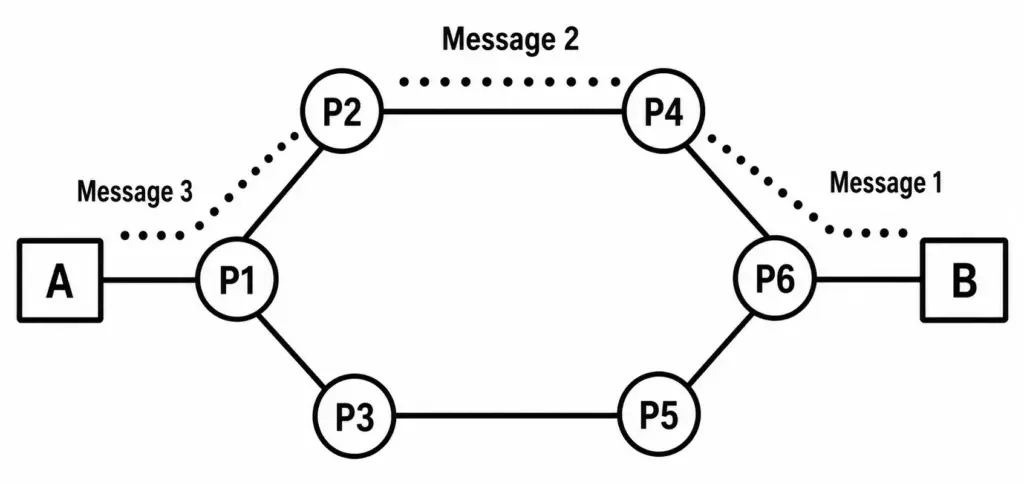
Figure: Circuit Switching
Why Circuit Switching Matters?
The main value of circuit switching is predictability. Because the route and capacity are reserved up front, it offers stable bandwidth, constant delay, and typically low jitter (variation in delay). These properties are ideal for real-time, continuous streams like voice calls or certain industrial control signals.
However, this predictability comes at the cost of efficiency: unused time in the circuit cannot be shared by others.
Historical Context and Real-World Presence
Traditional Public Switched Telephone Networks (PSTN) used circuit switching for decades. When a user dialed a phone number, the telephone exchanges progressively allocated a dedicated circuit across multiple switches and trunks.
Early systems were analog (connecting copper wires physically), while later systems became digital, using Time-Division Multiplexing (TDM) to allocate fixed timeslots across digital trunks (for example, E1/T1 lines).
Even though the modern Internet is mostly packet-switched, circuit-like services still exist in optical transport networks (e.g., SDH/SONET, WDM lightpaths) and dedicated leased lines where guaranteed bandwidth and low jitter are required.
How Circuit Switching Works: Step-by-Step
The operation of a circuit-switched connection can be split into three main phases:
- 1. Call Setup (Connection Establishment)
- The caller initiates the request (e.g., by dialing a phone number).
- Signaling messages travel through the network to find a route to the callee. In the PSTN, signaling is typically handled by systems like SS7 (Signaling System No. 7).
- Each intermediate switch along the chosen path checks for available resources (circuits or timeslots). If available, it reserves them; if not, it may try an alternate route or fail the call (busy tone).
- Once a path is successfully reserved end-to-end, the callee’s phone rings. When the callee answers, the network confirms the circuit is active and the voice path opens.
- 2. Data Transfer (Conversation)
- Voice or data flows continuously along the reserved circuit.
- Because the route and bandwidth are fixed, the delay is stable and small jitter is ensured. In digital telephony, each call often gets a 64 kbps timeslot (from PCM: 8000 samples per second × 8 bits per sample).
- There is no per-packet routing or reordering; all information follows the same path in order.
- 3. Teardown (Release)
- When either party hangs up, signaling messages instruct each switch to release the reserved resources (the timeslot/line).
- The circuit becomes available for new calls.
Types of Circuit Switching
- Analog vs. Digital
- Analog Circuit Switching: Early telephony used physical circuits carrying analog voice signals. Switches physically connected copper wires.
- Digital Circuit Switching: Modern systems sample and encode voice (e.g., PCM), then assign fixed TDM timeslots for each call over digital trunks. This improves quality, monitoring, and capacity.
- Space-Division vs. Time-Division Switching
- Space-Division Switching: Uses separate physical paths or crossbar matrices; each connection occupies a unique physical route.
- Time-Division Switching: Uses time slots on a shared physical medium; connections are separated by when they transmit rather than where.
- In practice, networks often use a combination (e.g., T-S-T architectures: time switching, space switching, time switching).
- Physical vs. Virtual Circuits
- Physical circuits: A continuous, exclusive physical or timeslot-based path is reserved.
- Virtual circuits: Some technologies (like ATM or MPLS-TE) emulate circuits over a packet-switched core, offering similar guarantees but still handling data as packets. These are not pure circuit switching but are inspired by its concepts.
Performance Characteristics
- Predictable Delay: Once set up, the path and bandwidth are fixed, producing steady delay and low jitter—excellent for real-time voice/video.
- Call Setup Delay: Users may experience a noticeable delay before the circuit is established, especially during busy periods.
- Bandwidth Guarantee: Each call gets a fixed rate (e.g., 64 kbps), ensuring no congestion during the call.
- Resource Inefficiency: If a user pauses or is silent, the reserved bandwidth cannot be used by others, leading to low utilization for bursty data.
- Blocking: If no end-to-end path is available, the call is blocked (busy tone). Switches and trunks must be dimensioned to keep blocking probabilities low (telephony engineering uses traffic models like Erlang B to plan capacity).
- Scalability: Large, strictly non-blocking crossbar fabrics are expensive; multi-stage switches reduce cost but may increase blocking.
Advantages of Circuit Switching
- 1. Guaranteed Bandwidth
- Each active call has a fixed, reserved capacity, ensuring consistent quality (for example, 64 kbps voice).
- There is no competition for bandwidth once the circuit is established.
- 2. Constant, Predictable Delay and Low Jitter
- Data follows the same path with fixed timing, making it ideal for real-time services like traditional telephony and some industrial controls.
- 3. In-Order Delivery
- Because all data travels on the same route, the order of transmission and arrival is preserved.
- 4. Simplicity at Transit Nodes
- Once the circuit is set up, intermediate switches simply forward on the reserved timeslot or path—no per-packet routing or complex buffering.
- 5. Quality-of-Service (QoS) Assurance
- Reserved resources inherently provide a strong QoS guarantee without dynamic congestion management.
- 6. Isolation
- Dedicated circuits reduce the impact of other users’ traffic; congestion elsewhere does not degrade your ongoing call.
Disadvantages of Circuit Switching
- 1. Inefficient Use of Resources
- Bandwidth is reserved whether or not it is continuously used. Silent periods, pauses, or bursty traffic waste capacity.
- Statistical multiplexing (sharing capacity among many bursty flows) is not possible in pure circuit switching.
- 2. Setup Delay and Possible Blocking
- Establishing a circuit takes time, which can be noticeable under heavy load.
- Calls can be blocked if no continuous path with free capacity is available.
- 3. Limited Flexibility and Scalability
- Networks must be engineered for peak loads to keep blocking low, leading to over-provisioning and higher costs.
- Non-blocking switch fabrics scale poorly in cost and complexity as the network grows.
- 4. Vulnerability to Single-Path Failures
- If any link or switch in the end-to-end circuit fails, the entire call is affected. Rerouting requires re-establishing a new circuit.
- 5. High Cost for Long-Duration or Long-Distance Connections
- Keeping resources reserved end-to-end, especially across long-haul trunks, can be expensive compared to packet-based sharing.
- 6. Not Suited to Data Traffic Patterns
- Most computer data is bursty (short bursts separated by idle times). Circuit switching’s fixed allocation leads to poor utilization for such workloads.
Comparison with Packet Switching and Message Switching
It is useful to contrast circuit switching with other switching paradigms:
- Circuit Switching vs. Packet Switching
- Resource Allocation: Circuit switching reserves capacity beforehand; packet switching shares capacity dynamically among many flows.
- Delay Characteristics: Circuit has stable, low jitter after setup; packet networks may have variable delay and jitter due to queueing.
- Efficiency: Packet switching is more efficient for bursty traffic because idle capacity can be used by others (statistical multiplexing).
- Reliability and In-Order Delivery: Circuit paths keep order naturally; packet networks may need sequence numbers and buffers to reorder and recover from loss.
- Scalability: Packet switching scales better for large, diverse traffic patterns.
- Use Cases: Circuit switching suits steady bit-rate, real-time streams; packet switching suits data networks (web, email, file transfer, streaming with buffering).
- Circuit Switching vs. Message Switching
- Message Switching: Entire messages are stored and forwarded hop by hop, with no dedicated path and potentially large delays (an older approach not used for real-time services).
- Circuit Switching: Requires setup but then offers immediate, continuous flow with minimal store-and-forward delay.
Examples and Applications
- Public Switched Telephone Network (PSTN)
- Classic example: dialing creates a dedicated circuit across local exchanges and long-distance trunks.
- Digital trunks (E1 with 32 timeslots; T1 with 24 timeslots) allocate a fixed slot per call (typically 64 kbps for PCM voice).
- ISDN (Integrated Services Digital Network)
- Offers circuit-switched bearer services (e.g., B-channels at 64 kbps) for voice and data with predictable performance.
- Leased Lines and Private Circuits
- Enterprises rent dedicated lines (e.g., E1/T1, optical circuits) for guaranteed bandwidth and high reliability between offices or data centers.
- Optical Transport Networks (SONET/SDH, WDM)
- Provisioned “lightpaths” behave like circuits at very high data rates (e.g., 10 Gbps, 100 Gbps), used for backbone transport.
- Emergency and Mission-Critical Communications
- Dedicated circuits support predictable performance for emergency services, military links, or industrial automation where timing is critical.
Key Terms to Remember
- Local Loop: The physical connection from a subscriber’s telephone to the local exchange.
- Trunk: A high-capacity link between switches that carries multiple circuits via TDM.
- Timeslot: A fixed time interval in a TDM frame reserved for one circuit.
- Switch/Exchange: Network node that connects and controls circuits between endpoints.
- Blocking Probability (Grade of Service): The chance that a call attempt fails due to lack of available circuits.
- Crossbar/Space Switch: Hardware that connects inputs to outputs via crosspoints.
When to Choose Circuit Switching
- Use circuit switching when:
- Traffic is continuous and requires guaranteed bandwidth (e.g., traditional voice circuits, synchronous data streams).
- Jitter must be minimized and predictable latency is critical (e.g., certain teleprotection or industrial control systems).
- Regulatory or operational requirements prefer dedicated capacity (e.g., emergency services backhaul, financial trading links—though these increasingly use engineered packet networks).
- Avoid circuit switching when:
- Traffic is bursty (web browsing, file transfers) where statistical multiplexing yields higher efficiency.
- Scalability and cost efficiency are top priorities, and slight delay variability is acceptable.
Illustrative Example: End-to-End Voice Call
Consider a user at Home A calling Home B in another city:
- The caller picks up the phone (off-hook). The local exchange provides a dial tone.
- The caller dials the number. The local exchange interprets the digits and selects an outbound trunk towards the destination’s region.
- Intermediate exchanges, using signaling, find a path and each reserves one timeslot on a trunk (e.g., timeslot 7 on the first trunk, timeslot 14 on the second, etc.), mapping them so that the stream from Home A flows seamlessly to Home B in every frame.
- Home B’s line rings. When answered, the circuit becomes active, and voice samples travel at a constant 64 kbps each way.
- During silences in the conversation, the circuit remains reserved. No other call can use the timeslot even though no one is speaking.
- When either party hangs up, signaling tears down the circuit and frees the timeslots.
Practical Considerations in Engineering Circuit-Switched Networks
- Capacity Planning: Engineers dimension trunks and switches so that the probability of a blocked call remains below a target (e.g., 1%). This often leads to over-provisioning.
- Redundancy: To mitigate failures, multiple routes and spare capacity are designed, but switching to a new route typically requires circuit re-establishment.
- Quality Monitoring: Digital systems monitor bit-error rates and alarms on trunks; faulty paths trigger maintenance.
- Interworking with Packet Networks: Gateways convert between circuit-switched and packet-switched domains (e.g., VoIP gateways bridging SIP/RTP to TDM circuits).
Conclusion
Circuit switching is a connection-oriented communication method that establishes a dedicated path between endpoints for the duration of a session. It reserves resources end-to-end, ensuring guaranteed bandwidth, stable delay, low jitter, and in-order delivery—properties that historically made it the backbone of telephony and still make it valuable in specialized, real-time, or mission-critical applications. However, these benefits come at the cost of efficiency, flexibility, and scalability: circuits can sit idle during silence or inactivity, there is setup delay and potential call blocking, and large-scale non-blocking architectures are expensive.
Compare this with packet switching.