Packet switching divides a message into small packets. Each packet can take its own path through the network, and the receiver assembles them again. The Internet uses packet switching.
Modern digital communication relies on breaking information into manageable pieces and delivering those pieces across complex networks in an efficient and reliable way. Packet switching is the core method that allows this to happen. It is the foundation of the Internet and nearly all contemporary data networks.
Understanding packet switching is essential for students of computer networks, telecommunications, and information technology because it explains how emails, web pages, video streams, voice calls over the Internet, and cloud applications all move from one place to another.
This answer explains what packet switching is, how it works step by step, the types and components involved, its advantages and disadvantages, and how it compares with other switching techniques like circuit switching.
What is Packet Switching?
Packet switching is a method of data transmission in which messages are divided into small units called packets. Each packet contains a portion of the user data (payload) and control information (header) such as source and destination addresses. These packets are sent independently through the network and may travel along different paths. At the destination, the packets are reassembled to reconstruct the original message.
In packet-switched networks, network resources (links and routers) are shared among many users using statistical multiplexing. Instead of reserving a dedicated path for one communication session, packets from multiple users are interleaved on the same links as they arrive, making the network more efficient and flexible.
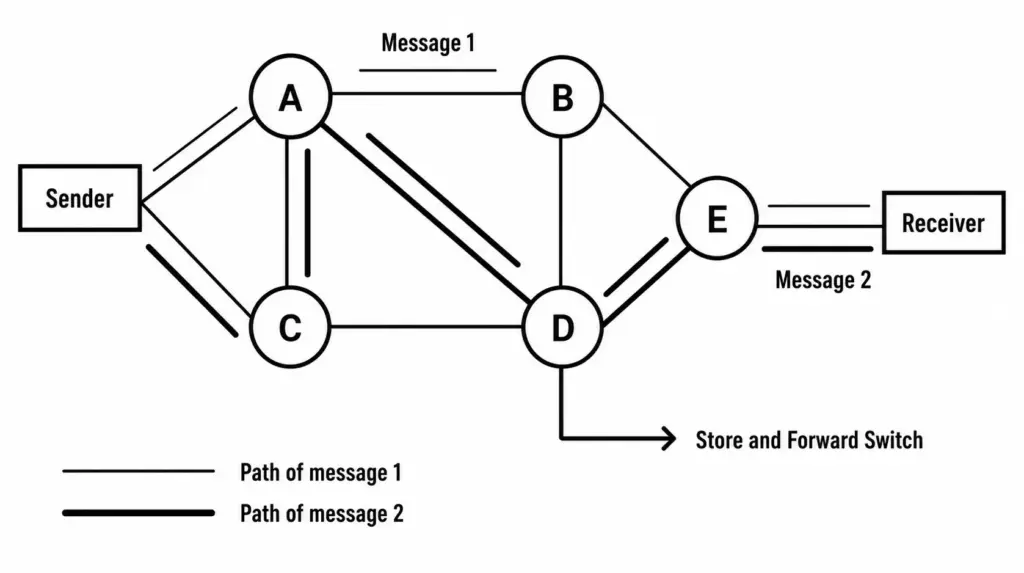
Figure: Packet Switching
Historical Context and Importance
Packet switching emerged in the 1960s as a response to the limitations of circuit switching, which was dominant in telephony. Pioneers such as Paul Baran, Donald Davies, and the ARPANET team demonstrated that dividing data into packets and dynamically routing them could make networks more resilient to failures and better utilize shared infrastructure.
Today, from the Internet Protocol (IP) layer to mobile data networks (4G/5G), packet switching is the standard mode of operation.
Core Concepts and Components
Packet switching involves several key components and concepts:
- Packet: A small unit of data comprising a header and a payload. The header includes control information like source and destination addresses, sequence numbers, and error detection codes. The payload carries the actual user data.
- Routers/Switches: Intermediate devices that examine packet headers and forward packets towards their destinations using forwarding tables. In the Internet, routers operate at the network layer (Layer 3).
- Links and Interfaces: Physical or logical connections (e.g., Ethernet, fiber, wireless) over which packets travel. Each link has a specific bandwidth and transmission characteristics.
- Queues and Buffers: Memory inside routers used to temporarily store packets waiting to be transmitted on an outgoing link. Queuing introduces delay and may cause packet loss if buffers overflow.
- Protocols: Rules that govern packet format and behavior. The most important is the Internet Protocol (IP) at the network layer, together with transport protocols such as TCP (reliable, connection-oriented) and UDP (connectionless).
- Addressing and Naming: IP addresses identify endpoints for routing packets. Domain names are mapped to IP addresses for human convenience.
- Maximum Transmission Unit (MTU) and Fragmentation: Each link has an MTU limiting packet size. If a packet is too large, it may be fragmented into smaller packets to pass through the network and reassembled at the destination.
How Packet Switching Works: Step-by-Step
The process by which data moves across a packet-switched network can be described in steps:
- Application Data Generation: A user application such as a web browser or video call produces a data stream.
- Segmentation: TCP divides its byte stream into segments sized with the path MTU in mind. UDP preserves application datagram boundaries; applications should keep datagrams within the path MTU because oversized IP packets may be fragmented or dropped.
- Encapsulation: Each segment is encapsulated into a packet. The network layer (IP) adds headers containing source and destination IP addresses, and other fields (e.g., TTL, protocol). The link layer further encapsulates into frames to traverse a specific link.
- Routing Decision at the Source: The host consults its routing table and sends the packet to the next hop (often a default gateway router).
- Store-and-Forward at Routers: Each router receives the packet, checks the header, looks up the best next hop in its forwarding table, and forwards the packet to the next link. The router temporarily stores the packet in a buffer before sending it out.
- Dynamic Path Selection: Different packets from the same message may take different paths depending on current network conditions and routing tables.
- Error Detection and Handling: Link-layer checks (like CRC) detect bit errors. Corrupted frames are discarded and higher layers (e.g., TCP) handle retransmissions if needed.
- Congestion Control: When many packets compete for the same links, queues build up. TCP regulates its sending rate using algorithms (slow start, congestion avoidance) based on detected loss or delay.
- Reassembly at the Destination: The receiver collects packets and reorders them using sequence numbers. Missing packets are requested again (TCP) or tolerated (UDP) depending on the application requirements.
Types of Packet Switching
Two main models of packet switching are used:
- Datagram Packet Switching:
- Each packet (datagram) is routed independently based on the destination address in its header.
- No setup phase is required. There is no prearranged path; packets may take different routes.
- Examples: The Internet Protocol (IP) network is a datagram network.
- Pros: Simple, robust, adaptable to failures; no setup overhead.
- Cons: Packets can arrive out of order, or not at all; delay and jitter vary.
- Virtual-Circuit Packet Switching:
- A logical path called a virtual circuit is established before data transfer. All packets follow this path and carry an identifier (VCI) instead of full addresses.
- Examples: X.25, Frame Relay, and ATM (cells) historically; MPLS uses label switching with similar ideas for traffic engineering.
- Pros: More predictable performance, easier to provide Quality of Service (QoS), less per-packet overhead.
- Cons: Setup time and state must be maintained by the network; less flexible if failures occur.
Routing and Forwarding in Packet-Switched Networks
Routing is the process of determining the path that packets take from source to destination. Forwarding is the actual process of moving a packet from an incoming interface to the appropriate outgoing interface according to a forwarding table. These concepts are implemented as follows:
- Forwarding Tables: Routers maintain tables mapping destination prefixes to next hops. They use the longest prefix match to choose the best entry for a given IP address.
- Routing Protocols: Protocols such as OSPF and IS-IS (link state) or RIP (distance vector) compute shortest paths within a domain. BGP connects autonomous systems across the Internet, making policy-aware interdomain routing decisions.
- Adaptation to Failures: If a link or router fails, routing protocols update tables and packets are redirected along alternate paths. This contributes to robustness and high availability.
- Store-and-Forward Behavior: Routers typically store a complete packet before forwarding it. This ensures error checking but introduces a small forwarding delay per hop. On local area networks, some devices may use cut-through switching to reduce latency, but across the Internet, store-and-forward is dominant.
Quality of Service, Reliability, and Congestion Control
Packet switching provides flexibility but introduces variable delay and potential loss. Networks and protocols compensate using several mechanisms:
- Reliability at Transport Layer:
- TCP provides reliable delivery using acknowledgments, retransmissions, sequence numbers, and checksums. It also performs flow control to prevent overwhelming a receiver.
- UDP provides no reliability by itself. Real-time applications using UDP may implement their own loss recovery or accept occasional loss for lower latency.
- Congestion Control:
- TCP algorithms (slow start, congestion avoidance, fast retransmit, fast recovery) adjust sending rates based on detected congestion signals (loss, delay).
- Active Queue Management in routers (e.g., RED, CoDel) drops or marks packets early to signal congestion before buffers overflow.
- Quality of Service (QoS):
- QoS mechanisms classify traffic into different priority classes. For instance, voice packets can be given higher priority than bulk file transfers.
- Techniques include DiffServ (differentiated services), traffic shaping and policing, priority queuing, and MPLS-based traffic engineering for predictable performance.
Real-World Applications and Examples
Packet switching underpins almost every modern communication service:
- Web and Email: HTTP traffic fetching web pages, images, and emails uses TCP over IP.
- Streaming Media: Video services adapt to available bandwidth using packet-level feedback; streaming often uses UDP with application-level error handling.
- Voice over IP (VoIP): Internet telephony sends voice samples as packets with strict delay targets; QoS is used to minimize jitter.
- Online Gaming: Real-time updates about player positions are sent as small packets with low latency requirements.
- Cloud Services: Requests and responses between clients and cloud servers traverse packet-switched networks; datacenter fabrics are built on packet switching.
- Mobile Networks: 4G and 5G cores are fully packet-based, transporting voice and data over IP through tunnels (e.g., GTP).
- Internet of Things (IoT): Sensors send small bursts of data as packets, benefiting from statistical multiplexing and low overhead for bursty traffic.
Advantages of Packet Switching
Packet switching offers many benefits that explain its widespread adoption:
- Efficient Utilization of Resources:
- Links are shared among many users via statistical multiplexing. When a user is silent, others can use the bandwidth.
- This results in higher overall utilization compared to dedicated circuits that sit idle during pauses.
- Scalability:
- Packet networks can grow by adding more links and routers without a need to pre-allocate end-to-end circuits for every pair of users.
- Routing protocols dynamically adapt to new topology and load.
- Robustness and Fault Tolerance:
- Multiple paths exist between source and destination. If one path fails, packets can be rerouted automatically.
- This property makes packet networks resilient to link or node failures.
- Flexibility and Heterogeneous Traffic Support:
- Supports bursty data, real-time media, and control messages on the same infrastructure.
- Different applications can coexist using different transport protocols (TCP, UDP) and QoS classes.
- No Call Setup Delay (Datagram Model):
- Datagram packet switching does not require establishing a dedicated connection; packets can be sent immediately.
- Cost Effectiveness:
- Shared infrastructure reduces cost, and capacity can be statistically multiplexed to match aggregate demand patterns.
- Resource Sharing and Multiplexing:
- Time and bandwidth are allocated dynamically according to traffic bursts, leading to better service for bursty workloads.
- Ease of Integration of New Services:
- New applications can be introduced without changes to the physical infrastructure, as long as they can use packets and standard protocols.
- Support for Mobility:
- In mobile and wireless networks, packet switching supports handovers and roaming by routing packets to the user’s current point of attachment.
- Lower Idle Overhead:
- No reserved channels mean less wasted capacity during periods of silence (e.g., during pauses in a conversation or typing).
Disadvantages of Packet Switching
Despite its strengths, packet switching presents challenges and trade-offs:
- Variable Delay (Latency) and Jitter:
- Because packets share links and contend for buffers, delay varies depending on congestion, leading to jitter.
- Real-time applications (voice, video, control systems) may suffer if jitter buffers and QoS are not configured properly.
- Packet Loss:
- Buffers can overflow during congestion, resulting in dropped packets.
- Loss triggers retransmissions (TCP) and can reduce throughput or degrade media quality.
- Out-of-Order Delivery:
- Packets may arrive in a different order than sent, requiring reordering at the receiver and larger buffers.
- Protocol Overhead:
- Each packet carries header fields (IP, TCP/UDP, link-layer headers). For small payloads, the overhead percentage can be significant, reducing effective throughput.
- Complexity:
- End hosts and network devices must implement sophisticated functions: routing, congestion control, sequence handling, reassembly, and QoS mechanisms.
- Unpredictable Performance:
- Without QoS, the best-effort nature of packet switching means performance can fluctuate, which is problematic for mission-critical or latency-sensitive tasks.
- Security Considerations:
- Open, shared networks create opportunities for attacks (spoofing, denial of service). Additional security layers (firewalls, encryption) are needed.
- Fragmentation Overheads:
- If packets exceed the MTU and are fragmented, loss of a single fragment requires retransmission of the whole original packet, increasing inefficiency.
- Fairness Issues:
- Competing flows may not receive equal share of bandwidth, especially when some do not implement congestion control properly.
Comparison with Circuit Switching (and Message Switching)
A comparison helps clarify where packet switching excels and where it may fall short:
- Resource Allocation:
- Circuit Switching: Reserves a dedicated end-to-end path with fixed bandwidth for the duration of a session (e.g., traditional telephone networks). Efficient for constant-rate streams but wastes capacity during silence.
- Packet Switching: Shares links among many users with on-demand use. Efficient for bursty traffic, but performance varies.
- Setup and Tear-Down:
- Circuit Switching: Requires time to establish and release a circuit.
- Packet Switching: Datagram mode has no setup; virtual circuits require setup but still share resources statistically.
- Delay Characteristics:
- Circuit Switching: Predictable delay; minimal jitter once circuit is established.
- Packet Switching: Variable delay and jitter due to queueing and dynamic routing.
- Reliability and Robustness:
- Circuit Switching: If the dedicated path fails, call is dropped unless expensive protection is provided.
- Packet Switching: Packets can be rerouted around failures; network remains available.
- Scalability:
- Circuit Switching: Number of simultaneous circuits limited by link capacity and switch crosspoints.
- Packet Switching: Scales well with routing and hierarchical addressing.
- Example Use Cases:
- Circuit Switching: Legacy PSTN telephony, leased lines for deterministic performance.
- Packet Switching: Internet data, VoIP, streaming, cloud computing, IoT.
- Message Switching (for context):
- Entire messages are stored and forwarded as single units at each hop. It suffers from high delay and buffer requirements for large messages.
- Packet switching improved on message switching by breaking messages into smaller packets, reducing per-hop storage time and improving throughput.
Performance Considerations and Trade-offs
Several factors influence performance in packet-switched networks:
- Throughput: Total data successfully transferred per unit time. Throughput depends on link capacity, protocol overhead, and congestion control behavior.
- Latency: End-to-end delay comprises propagation, transmission, processing, and queueing delays. Queueing is the most variable component.
- Jitter: Variation in delay. Real-time applications use jitter buffers to smooth delivery; excessive jitter can cause glitches in voice/video.
- Header Overhead: For example, an Ethernet+IP+TCP header can be around 54 bytes (not counting options). With a common MTU of 1500 bytes, the overhead is roughly 54/1500 ≈ 3.6%. With small packets (e.g., 200 bytes), overhead rises to 27%, reducing efficiency.
- Packet Size Trade-off: Larger packets reduce header overhead but increase retransmission cost if lost. Smaller packets reduce per-packet delay and buffer pressure but increase overhead.
- Queue Management: Tail drop can induce bursty loss and TCP synchronization. Active queue management (e.g., CoDel) reduces latency under load.
- Traffic Engineering: MPLS and segment routing can steer flows to balance load and meet QoS targets, offsetting some disadvantages of best-effort routing.
Conclusion
Packet switching revolutionized communication by enabling flexible, efficient, and scalable data transfer across shared networks. Its ability to dynamically route packets and share bandwidth makes it ideal for today’s diverse and data-intensive applications. Although it introduces challenges such as delay variation, loss, and reordering, these are effectively managed through QoS mechanisms, congestion control, and higher-layer protocols. In essence, packet switching is the backbone of modern networking, balancing efficiency and adaptability while powering the Internet and virtually all contemporary digital communication systems.
The other store-and-forward method is message switching.