In modern communication networks, physical cables play an important role in transferring data between devices, buildings, and different locations. Although wireless communication technologies are widely used today, wired transmission media are still essential for providing reliable, stable, and high-speed data communication.
Twisted Pair Cable, Coaxial Cable, and Fiber Optic Cable are the three major types of guided transmission media used in computer networks. Each cable has a different structure, working principle, data transmission method, speed, transmission distance, and cost.
Twisted pair cable consists of two insulated copper wires twisted around each other to reduce electromagnetic interference. It is commonly used in telephone connections and Local Area Networks (LANs). Coaxial cable contains a central copper conductor surrounded by insulating material and a metallic shield. It is widely used in cable television and broadband connections. Fiber optic cable uses thin strands of glass or plastic to transmit information in the form of light signals. It supports high-speed data transmission over long distances with very low signal loss.
Each type of cable has its own advantages and limitations. For example, twisted pair cable is generally affordable and suitable for short-distance network connections, coaxial cable provides better shielding against external interference, and fiber optic cable offers high bandwidth and supports long-distance communication.
1. Twisted Pair Cable
Structure and Types
A Twisted Pair Cable is a type of guided transmission medium consisting of two insulated copper conductors twisted around each other in a spiral pattern. It is commonly used to transmit voice and data signals in communication networks.
The main purpose of twisting the copper wires is to reduce electromagnetic interference (EMI) and crosstalk. When external electrical noise affects the cable, the twisting arrangement helps both wires experience similar interference. The receiver can reject this common noise and recover the original signal, improving the reliability of data transmission.
Diagram description: Imagine a cable cross-section showing two insulated copper wires twisted together in a spiral. For shielded variants, a thin metallic foil or braided shield surrounds the twisted pair, covered by a protective outer jacket.
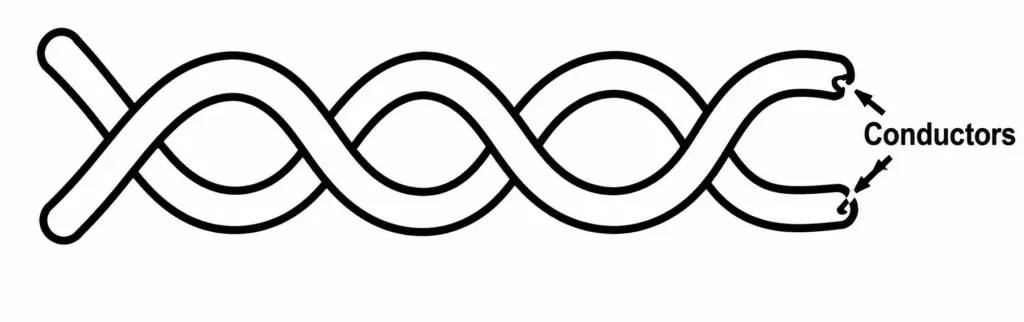
Figure: Twisted Pair Cable
Working of Twisted Cable
Twisted pair cable works by transmitting electrical signals through two insulated copper wires twisted around each other. It is commonly used in telephone systems, Ethernet networks, and data communication. The twisting arrangement helps reduce electromagnetic interference (EMI) and crosstalk, allowing signals to travel with better quality and reliability.
Working Process:
1. Signal Generation: The transmitting device converts digital data into electrical signals that can travel through the copper wires.
2. Signal Transmission: The electrical signals travel from the transmitting device to the receiving device through the two copper conductors.
3. Noise Reduction: When external electromagnetic interference affects the cable, the twisting arrangement helps both wires experience similar noise. This reduces the effect of unwanted signals on data transmission.
4. Signal Reception: At the receiving end, the network device detects the electrical signals carried through the wires. In balanced transmission, it uses the difference between the signals on the two wires to reject common noise.
5. Data Recovery: The receiving device interprets the signals and converts them back into digital data. The recovered data is then delivered to the appropriate application or network component.
Advantages of Twisted Pair Cable
- Low Cost: Twisted pair cables are economical compared to many other transmission media. Their manufacturing and installation costs are relatively low.
- Easy Installation: These cables are lightweight and flexible, making them easy to install through walls, ceilings, and network conduits.
- Noise Reduction: The twisting arrangement helps reduce electromagnetic interference (EMI) and crosstalk, improving signal quality.
- Easy Maintenance: Their simple construction makes testing, troubleshooting, repairing, and replacing cables easier.
- Voice and Data Transmission: They support both voice and digital data communication and are widely used in telephone systems and Ethernet networks.
Disadvantages of Twisted Pair Cable
- Limited Transmission Distance: They support shorter transmission distances compared to fiber optic cables, as signal quality decreases over longer distances.
- Limited Bandwidth: They generally provide lower bandwidth than fiber optic cables, depending on the cable category.
- Signal Attenuation: Electrical signal strength gradually decreases as it travels through the cable, which can affect communication.
- Electromagnetic Interference: They can be affected by external electromagnetic fields, particularly UTP cables without additional shielding.
- Security Limitations: Signals may be intercepted if someone gains physical access to the cable, so encryption and physical security are important.
Applications of Twisted Pair Cable
- Telephone Systems: Used to transmit voice signals in telephone communication networks.
- Local Area Networks (LANs): Used to connect computers, printers, and other devices within homes, schools, and offices.
- Ethernet Networks: Used for wired connections between computers, routers, switches, and other networking devices.
- Internet Connections: Used in wired broadband and local network connections to provide internet access.
- CCTV Systems: Used in certain security camera installations to transmit video and control signals.
- Industrial Communication: Used to connect sensors, controllers, and monitoring devices in industrial environments.
2.Coaxial Cable
Coaxial Cable is a type of guided transmission medium used to transmit data, voice, and video signals from one device to another. It consists of a central copper conductor surrounded by an insulating material, a metallic shielding layer, and an outer protective jacket. These layers are arranged along the same central axis, which gives the cable its name.
The central conductor carries electrical signals, while the metallic shielding protects the signals from external electromagnetic interference (EMI) and unwanted noise. The insulating layer separates the conductor from the shield and prevents electrical contact between them. Coaxial cables provide reliable signal transmission and are commonly used in cable television, broadband internet, CCTV systems, and communication networks.
Structure of Coaxial Cable
A coaxial cable consists of the following main components:
1. Central Conductor: It is usually made of copper and carries electrical signals from the transmitting device to the receiving device.
2. Insulating Layer (Dielectric): It surrounds the central conductor and separates it from the metallic shielding. It prevents electrical contact and maintains proper signal transmission.
3. Metallic Shielding: It is made of braided copper, aluminium, or metallic foil. It protects the cable from external electromagnetic interference and reduces signal leakage.
4. Outer Protective Jacket: It is the outermost covering of the cable, usually made of plastic. It protects the internal components from physical damage, moisture, and environmental conditions.
Diagram description: Visualize a straight cable with layers from center to outside: a solid or stranded copper conductor, a white foam or plastic dielectric, a metallic foil, a braided copper shield, and a protective jacket.
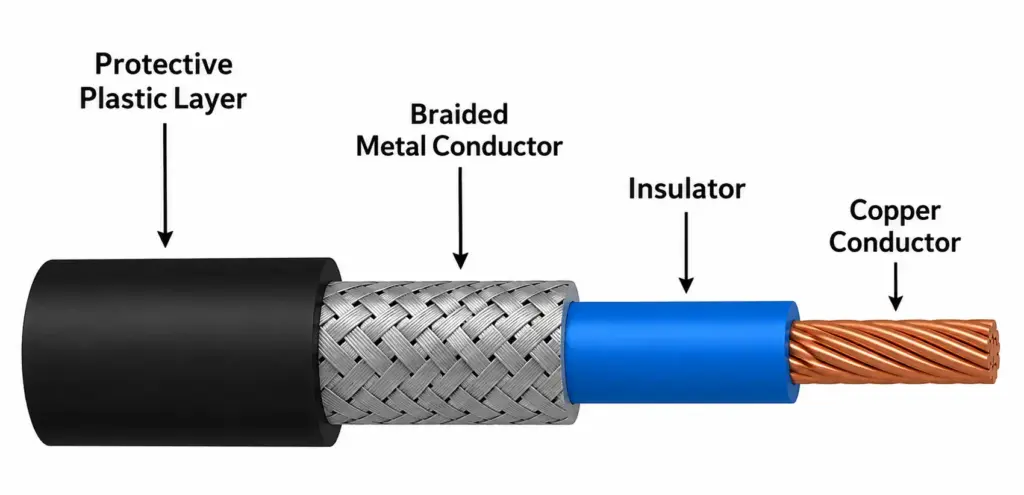
Figure: Coaxial cable
Working of Coaxial Cable
Coaxial cable works by transmitting electrical signals through its central copper conductor. It is designed with multiple protective layers that help maintain signal quality and reduce electromagnetic interference (EMI). The central conductor carries the signals, while the surrounding metallic shield protects them from external noise and reduces signal leakage.
Working Process
1. Signal Generation: The transmitting device converts data, voice, or video information into electrical signals suitable for transmission through the cable.
2. Signal Transmission: The electrical signals travel through the central copper conductor from the transmitting device to the receiving device.
3. Signal Insulation: The dielectric insulating layer separates the central conductor from the metallic shielding. It prevents electrical contact and maintains proper signal transmission.
4. Interference Protection: The metallic shielding protects the electrical signals from external electromagnetic interference and reduces unwanted signal disturbances.
5. Signal Reception: At the receiving end, the connected device detects the electrical signals transmitted through the coaxial cable.
6. Data Recovery: The receiving device processes the signals and converts them into useful information, such as voice, video, or digital data.
Advantages of Coaxial Cable
- Better Noise Protection: The metallic shielding protects electrical signals from external electromagnetic interference (EMI) and unwanted noise, improving transmission quality.
- Reliable Data Transmission: Its layered construction helps maintain signal quality and supports reliable transmission of voice, video, and data signals.
- High Bandwidth: Coaxial cables support a wide range of frequencies, allowing them to carry large amounts of information.
- Longer Transmission Distance: They can transmit signals over longer distances than many traditional twisted pair installations, depending on the cable type and application.
- Durable Construction: The outer protective jacket and metallic shielding protect the internal components from physical damage and external disturbances.
Disadvantages of Coaxial Cable
- Higher Cost: Coaxial cables are generally more expensive than basic twisted pair cables because of their complex construction.
- Difficult Installation: They are thicker and less flexible, making installation and handling comparatively difficult.
- Signal Attenuation: Signal strength gradually decreases as it travels through the cable, especially over longer distances.
- Limited Flexibility: Their thick and rigid construction makes bending and routing through narrow spaces difficult.
- Maintenance Difficulties: Damaged connectors, insulation, or shielding can affect signal quality and may require careful repair or replacement.
Applications of Coaxial Cable
- Cable Television: Used to transmit television signals from service providers to television receivers.
- Broadband Internet: Used in cable internet connections to provide internet access to homes and offices.
- CCTV Systems: Used to transmit video signals from security cameras to recording devices and monitors.
- Radio Communication: Used to connect radio transmitters, receivers, and antennas for signal transmission.
- Video Transmission: Used in professional video systems to transmit video signals between different devices.
- Communication Networks: Used in communication and signal distribution systems where reliable electrical signal transmission is required.
3.Fiber Optic Cable
Fiber Optic Cable is a type of guided transmission medium that uses thin strands of glass or plastic fibers to transmit data in the form of light signals. Unlike twisted pair and coaxial cables, which use electrical signals, fiber optic cables use light to carry information from one device to another.
A fiber optic cable consists of a central part called the core, surrounded by a layer called cladding and protective outer coverings. The core carries light signals, while the cladding helps keep the light within the core through a process called total internal reflection. This allows data to travel over long distances with very little signal loss.
Fiber optic cables provide very high transmission speeds, high bandwidth, low signal attenuation, and immunity to electromagnetic interference (EMI). They are widely used in high-speed internet connections, telecommunications, cable television, medical equipment, and long-distance communication networks.
Structure of Fiber Optic Cable
A fiber optic cable consists of the following main components:
1. Core: The core is the central part of the fiber optic cable, usually made of glass or plastic. It carries light signals from the transmitting device to the receiving device.
2. Cladding: The cladding is the layer surrounding the core. It has a lower refractive index than the core and helps keep light inside the core through total internal reflection.
3. Protective Coating: It is a protective layer surrounding the cladding. It protects the optical fiber from moisture, scratches, and physical damage.
4. Strength Members: These components provide additional mechanical strength and protect the optical fibers from stretching or breaking during installation.
5. Outer Jacket: It is the outermost protective covering of the cable. It protects the internal components from environmental conditions and physical damage.
Diagram description: Picture a thin glass core at the center, a slightly different glass cladding around it, then protective coatings and strength members, all inside a durable outer jacket. For multi-fiber cables, several such fibers lie side by side within the same jacket.
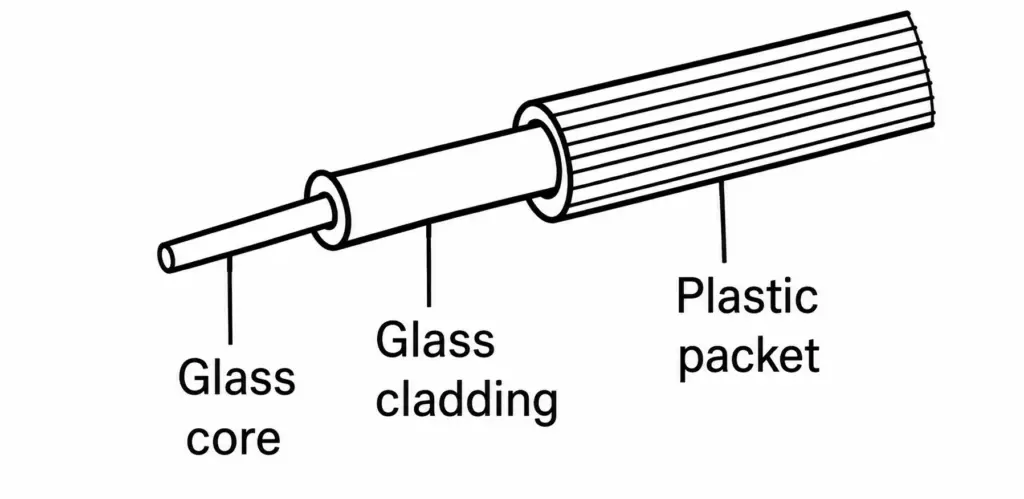
Figure: Optical Fiber Cable
Working of Fiber Optic Cable
Fiber optic cable works by transmitting information in the form of light signals through thin glass or plastic fibers. It uses the principle of Total Internal Reflection (TIR) to guide light through the core of the cable with very little loss.
Working Process
1. Signal Generation: The transmitting device converts electrical data into light signals using a light source such as an LED or laser diode.
2. Light Transmission: The generated light signals enter the core of the optical fiber and travel through it.
3. Total Internal Reflection: The light repeatedly reflects within the core at the core-cladding boundary because of the difference in their refractive indices. This keeps the light within the core.
4. Signal Reception: At the receiving end, a photodetector receives the transmitted light signals.
5. Data Recovery: The photodetector converts the light signals back into electrical signals, which are processed to recover the original information.
Advantages of Fiber Optic Cable
- High Transmission Speed: Fiber optic cables support very high data transmission speeds, making them suitable for high-speed internet and modern communication networks.
- High Bandwidth: They provide high bandwidth and can carry large amounts of data simultaneously.
- Low Signal Attenuation: Light signals experience very little loss over long distances compared to electrical signals in copper cables.
- Immunity to Electromagnetic Interference: Since they transmit data using light instead of electrical signals, they are not affected by electromagnetic interference.
- Better Security: Fiber optic cables are difficult to tap without disturbing the optical signal, providing better physical transmission security.
- Lightweight and Small Size: They are generally thinner and lighter than copper cables, making them easier to use in many installations.
Disadvantages of Fiber Optic Cable
- High Initial Cost: Fiber optic cables and the equipment required for installation and maintenance can be expensive.
- Difficult Installation: Installing fiber optic cables requires specialized tools, equipment, and technical knowledge.
- Fragility: Optical fibers can break if they are bent excessively or subjected to physical stress.
- Difficult Maintenance: Repairing damaged optical fibers requires specialized equipment and trained technicians.
- Specialized Equipment: Light sources, optical receivers, and other optical networking devices are required for communication.
- Cannot Carry Electrical Power: Fiber optic cables transmit light signals and cannot directly supply electrical power to connected devices.
Applications of Fiber Optic Cable
- Internet Communication: Used to provide high-speed broadband internet connections to homes, offices, and businesses.
- Telecommunication Networks: Used for long-distance telephone communication and high-speed data transmission.
- Cable Television: Used to distribute television signals over long distances with high signal quality.
- Medical Applications: Used in medical instruments such as endoscopes to transmit light and help doctors examine internal body structures.
- Military Communication: Used in secure communication systems because of its resistance to electromagnetic interference.
- Data Centers: Used to connect servers, switches, and storage systems that require high-speed data transmission.
- Undersea Communication: Used in submarine cables to transmit large amounts of data between different countries and continents.
Difference Between Twisted Pair, Coaxial and Fiber Optic Cable
| S.No. | Twisted Pair Cable | Coaxial Cable | Fiber Optic Cable |
|---|---|---|---|
| 1. Transmission Medium | Uses two insulated copper wires twisted together. | Uses a central copper conductor. | Uses thin glass or plastic optical fibers. |
| 2. Signal Type | Transmits electrical signals. | Transmits electrical signals. | Transmits light signals. |
| 3. Construction | Consists of twisted insulated copper wire pairs. | Consists of a central conductor, dielectric insulation, metallic shield, and outer jacket. | Consists of a core, cladding, protective coating, and outer jacket. |
| 4. Transmission Speed | Supports moderate to high speeds depending on cable category. | Supports high speeds depending on cable type and technology. | Supports very high transmission speeds. |
| 5. Bandwidth | Comparatively lower bandwidth. | Provides higher bandwidth than traditional twisted pair in many applications. | Provides very high bandwidth. |
| 6. Interference | More affected by electromagnetic interference, especially UTP. | Metallic shielding provides good protection against external interference. | Immune to electromagnetic interference. |
| 7. Signal Attenuation | Signal strength decreases over distance. | Generally has lower signal loss than twisted pair over comparable distances. | Has low signal loss over long distances. |
| 8. Transmission Distance | Suitable for relatively short distances. | Suitable for medium-distance transmission, depending on the application. | Suitable for long-distance communication. |
| 9. Security | Electrical signals may be intercepted through physical access. | Shielding reduces signal leakage, but interception is still possible. | Difficult to tap without disturbing the optical link. |
| 10. Cost | Generally inexpensive. | Moderately priced. | Higher initial installation and equipment costs. |
| 11. Installation | Easy to install because it is lightweight and flexible. | Comparatively thicker and less flexible. | Requires specialized tools and careful handling. |
| 12. Applications | Telephone systems, Ethernet networks, and LANs. | Cable television, broadband internet, and CCTV systems. | High-speed internet, telecommunications, and long-distance networks. |