In modern communication systems, users need fast and reliable ways to transmit voice, data, and video. Earlier, traditional telephone networks supported only analog signals, which limited speed and quality. Therefore, a better digital solution became necessary to handle multiple types of communication efficiently.
ISDN was introduced to solve this problem by providing a fully digital communication network. It allows users to send voice, data, text, and video over the same line. As a result, ISDN improves communication speed, clarity, and overall performance compared to older systems.
What is ISDN?
ISDN (Integrated Services Digital Network) is a digital telecommunication network that provides end-to-end digital connectivity for transmitting both voice and non-voice data over a single line. It was designed to integrate various services such as telephone, fax, data transfer, and video conferencing into a single, unified network structure.
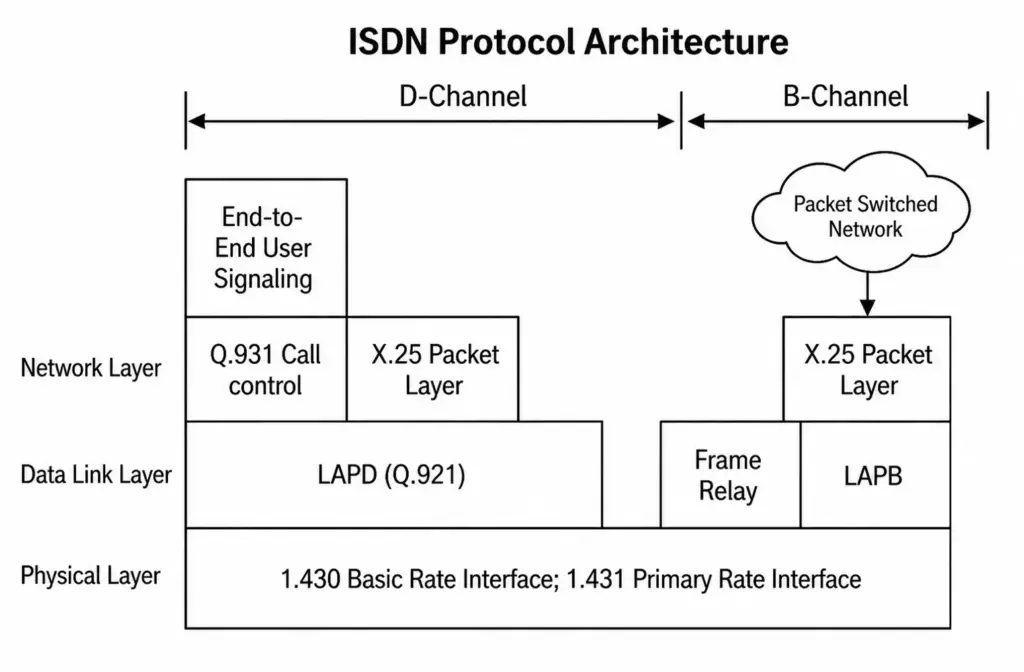
Figure: ISDN Protocol Architecture
Explanation of ISDN Protocol Architecture:
- Separation of D-Channel and B-Channel
The diagram clearly shows two parts: the D-channel and the B-channel. The D-channel is used for signaling and control, while the B-channel is used for actual data transmission like voice and video. Therefore, ISDN separates control and data for better efficiency. - User-Network Signaling
On the D channel, Q.931 over LAPD carries signaling between the terminal and the local ISDN exchange for call setup, maintenance, and release; signaling through the provider network is handled separately. - Network Layer Functions (Q.931 and X.25)
The network layer includes Q.931 for call control and X.25 packet layer for packet-switched communication. Q.931 handles call establishment, while X.25 supports data transfer. Therefore, this layer ensures proper routing and connection management. - Data Link Layer Protocols
The data link layer uses LAPD (Q.921) in the D-channel for reliable signaling. A B channel can transparently carry circuit-switched voice or data; for packet-mode bearer services it may carry protocols such as X.25/LAPB or Frame Relay, depending on the service. - Physical Layer Interfaces
The physical layer includes I.430 (Basic Rate Interface – BRI) and I.431 (Primary Rate Interface – PRI). These define how data is physically transmitted over the network. Therefore, they form the base for all ISDN communication. - Packet Switched Network Support
For an X.25 packet-mode service, a B channel may connect the user to a packet-switched network; this is one supported service, not the behavior of every B channel.
Working of ISDN
ISDN works by converting all communication into digital signals and then dividing the available bandwidth into separate logical channels. This separation helps ISDN carry multiple types of data at the same time without interference. Now let’s understand the process step by step in a simple way.
1. Digital Conversion and Setup
- First, when a user makes a call or sends data, the ISDN device (like an ISDN phone or terminal adapter) converts analog signals into digital form.
- Then, the system uses the D Channel to send a request to the network for connection setup.
- This channel handles call setup, routing, and control signals, so the communication starts quickly and efficiently.
2. Role of B Channel (Bearer Channel)
After the connection is established, the B Channels start carrying the actual data.
- Each B channel has a speed of 64 kbps
- It carries voice, video, or data
- It supports full-duplex communication (send and receive at the same time)
In BRI (Basic Rate Interface), there are 2 B channels, so users can:
- Make two calls at the same time, OR
- Combine both channels to get 128 kbps speed for faster data transfer
3. Role of the D Channel (Signaling Channel)
The D Channel plays a very important supporting role.
- It carries signaling and control information
- It manages call setup, maintenance, and termination
- It ensures proper coordination between sender and receiver
In BRI, the D channel is 16 kbps, while in PRI, it is 64 kbps
4. Parallel Transmission
One of the key features of ISDN is that it allows simultaneous transmission.
This means:
- Voice can travel on one B channel
- Data or video can travel on another B channel
- Control signals are handled by the D channel
As a result, ISDN provides faster and more efficient communication compared to traditional systems.
5. Data Reassembly at Receiver
Finally, at the receiver’s end:
- The incoming digital signals are recombined and processed
- If needed, they are converted back into analog form (for voice)
- The user receives clear audio, video, or data
Evolution and Development of ISDN
1. Early Telephone Networks (Before 1960s)
Initially, communication systems were based on analog technology. These networks were mainly used for voice calls and had limited capability for data transmission. Moreover, noise and signal loss were common problems.
2. Introduction of Digital Technology (1960s–1970s)
With the growth of computers, the demand for digital data communication increased. Therefore, researchers started developing digital switching systems. This period laid the foundation for ISDN by introducing the idea of integrating voice and data.
3. Standardization Phase (1980s)
During the 1980s, the International Telecommunication Union (ITU) worked on standardizing ISDN. It defined protocols, channel structures, and services. As a result, ISDN became a globally accepted communication standard.
4. Commercial Deployment (Late 1980s–1990s)
ISDN was introduced for commercial use in many countries. It provided faster and more reliable communication than traditional telephone systems. Businesses widely adopted ISDN for video conferencing, data transfer, and internet access.
5. Decline with Modern Technologies (2000s–Present)
With the rise of DSL, broadband, and fiber optics, ISDN usage started decreasing. These new technologies offered higher speeds and lower costs. Therefore, ISDN gradually became outdated, although it is still used in some specialized applications.
Advantages of ISDN
1. High-Quality Digital Communication
ISDN uses digital signals instead of analog signals. Therefore, it provides clear voice and accurate data transmission. Moreover, it reduces noise and distortion, which improves overall communication quality.
2. Supports Multiple Services
ISDN can carry voice, data, text, and video over a single line. As a result, users do not need separate connections for different services. This integration makes communication more efficient and convenient.
3. Simultaneous Communication
ISDN allows multiple channels to work at the same time. For example, a user can make a phone call and transfer data simultaneously. Hence, it improves productivity and multitasking.
4. Faster Connection Setup
ISDN establishes connections quickly using signaling channels. Therefore, users experience less delay compared to traditional dial-up systems. This makes communication smoother and more responsive.
5. Better Bandwidth Utilization
ISDN divides communication into channels such as B and D channels. As a result, it uses available bandwidth efficiently. Additionally, users can combine channels to increase data speed when needed.
6. Reliable and Secure Communication
Since ISDN is digital, it ensures more reliable data transfer. Moreover, it is less affected by interference, which improves stability and consistency.
7. Flexible Usage
ISDN supports both home users and large organizations through different service types like BRI and PRI. Therefore, it can be used in different environments based on requirements.
Disadvantages of ISDN
1. High Cost
ISDN is more expensive than traditional analog telephone systems. Users need to pay for installation, service charges, and special equipment. Therefore, it may not be affordable for small users or home networks.
2. Requires Special Equipment
ISDN needs specific devices such as ISDN phones and terminal adapters. As a result, existing analog devices cannot be used directly. This increases the overall setup complexity and cost.
3. Limited Speed
Although ISDN is faster than dial-up connections, its speed is still low compared to modern technologies like broadband and fiber optics. Hence, it is not suitable for high-speed internet needs today.
4. Complex Setup and Configuration
ISDN systems require proper configuration and technical knowledge. Therefore, installation and maintenance can be difficult for non-technical users.
5. Becoming Outdated
With the advancement of newer technologies such as DSL, cable internet, and fiber optics, ISDN is gradually becoming obsolete. As a result, its usage is decreasing in modern networks.
6. Limited Availability
ISDN services are not widely available in all areas, especially in rural regions. Hence, users may face difficulty accessing ISDN connections.
7. Not Suitable for Heavy Data Applications
ISDN cannot handle large-scale data transfer efficiently. Therefore, it is not ideal for applications like video streaming, cloud computing, or large file transfers.
Applications of ISDN
1. Video Conferencing
ISDN supports real-time video communication with stable and clear connections. Therefore, organizations use it for meetings between offices in different locations. Moreover, it reduces delay and improves coordination during discussions. As a result, teams can communicate effectively without physical travel.
2. Internet Access
ISDN was widely used for internet access before broadband became common. It provides faster and more reliable connectivity than traditional dial-up systems. In addition, users can browse, send emails, and download files with better speed. Hence, it played an important role in early internet usage.
3. Telecommunication Services
ISDN improves voice communication by using digital transmission. Therefore, it offers clear calls with less noise and interference. Moreover, it allows multiple calls at the same time using different channels. As a result, it is useful for offices, call centers, and business communication.
4. Data Transfer
ISDN enables fast and secure transfer of data between systems. It is useful for banking, file sharing, and business transactions. Furthermore, it ensures accuracy and reliability in data communication. Hence, organizations can manage information efficiently.
5. Remote Access
ISDN allows users to connect to office networks from remote locations. Therefore, employees can access files and systems while working from home or other places. In addition, it provides a stable and secure connection. As a result, it supports remote working and business continuity.
6. Broadcasting and Media
ISDN is used in radio and television broadcasting for live reporting. It helps in transmitting audio and video signals with good quality. Moreover, journalists can send live updates from remote areas. Hence, it supports smooth media communication.
7. Backup Communication System
ISDN can act as a backup network when the main internet connection fails. Therefore, businesses can continue their operations without interruption. In addition, it ensures reliability during network downtime. As a result, it is useful for critical communication systems.
Conclusion
ISDN (Integrated Services Digital Network) played a significant role in the transition from analog to digital communication systems. It introduced the concept of transmitting voice, data, and video over a single digital network, which improved communication speed, clarity, and efficiency. Moreover, its use of separate channels for data and signaling made communication more organized and reliable.
Furthermore, ISDN helped businesses and individuals perform multiple tasks at the same time, such as making calls while transferring data. This capability increased productivity and made communication more flexible. In addition, it provided better connection quality and faster setup compared to traditional telephone systems, which made it widely adopted in earlier networking environments.
However, with the rapid advancement of technologies like broadband, DSL, and fiber optics, ISDN has gradually lost its importance. These modern technologies offer much higher speed, lower cost, and better scalability. Therefore, ISDN is now considered outdated in many regions, although it still exists in some specialized applications.
The reference points and the 2B+D line are in the ISDN user interface.